Day trip guide
Jerez de la Frontera day trip from Cádiz: sherry, horses and the Alcázar

Written by
Marta Jiménez Cossío Outdoors and travel writer covering Cádiz beaches, coastal walks and day trips.
Updated Published
Cádiz is a city you finish in two days. Jerez is the reason to stay a third. It sits inland on the same Cercanías line, it is the historical and cultural heart of the sherry region, and it packs a baroque cathedral, an Almohad fortress and a working equestrian school into an old town you can cover on foot.
This guide is for the single day: how to get there, what is worth the ticket, and how to stop the day turning into a queue of bodega doors. If you are still choosing between Jerez and the other bay towns, our excursions from Cádiz by train, catamaran, and bus compares all five. If you have settled on Jerez, read on.
On this page
Jump to a section
Getting there by train
The train is the whole answer. Renfe's Cercanías line runs the full distance between Cádiz and Jerez, and since the timetable change of 21 September 2026 the weekday offer is 21 trains in each direction that stop at every intermediate station. The first service of the day leaves Cádiz at 5.45 and reaches Jerez at 6.36, which gives you a sense of the journey: a little under an hour, with stops.
Three trains in each direction also serve Jerez airport on the way. That matters if you are flying into Jerez rather than Seville or Málaga and want to leave your bags in Cádiz first.
Check before you go
Renfe's figures above are weekday ones. Weekend and holiday timetables differ, and the last train back and the fare were not confirmed at the time of writing, so look both up on the day. Do not plan an evening in Jerez without knowing the last departure.
One alternative is worth knowing about if you want a boat in the day: the catamaran from Cádiz to El Puerto de Santa María takes about 25 minutes, depending on the sea. El Puerto is the second point of the sherry triangle, so a boat out and a train back from the bay side is a pleasant variation. It does not replace the train to Jerez itself.
Cathedral and Alcázar
The cathedral
Jerez's cathedral is a building of the 18th century, not the Middle Ages. The cathedral chapter began work on a new church on 9 May 1695, and the whole building was blessed on 6 December 1778. Only the bell tower survives from the earlier church: its lower stage is 15th-century Gothic-Mudéjar, the upper one 18th-century work. Inside, the octagonal dome rises 40 metres above the floor.
The cathedral lists Monday to Saturday opening from 10:00 to 19:00 and Sunday from 13:00 to 19:00. A general ticket is €8 with an audioguide, and a combined ticket with the Church of San Miguel is €13. There is a free visit on Tuesdays from 10:00 to 11:00, with limited places and online booking. At the time of writing the cathedral's own page says tower visits are temporarily suspended, so do not build your plan around the climb.
The Alcázar
The Alcázar is the older story. It is a fortress and palace complex declared a Bien de Interés Cultural in 1931, and it is described as one of the few structures that best exemplify Almohad architecture in the Iberian Peninsula. The Octagonal Tower is Almohad, while the Villavicencio Palace inside the walls is a Baroque building of 1664.
Its mosque is the only one left of the 18 that once stood in the city, and its minaret became a bell tower after the Christian conquest. If you have time for one monument, make it this one. Current opening hours and the ticket price were not available from an official page at the time of writing, so check the Ayuntamiento de Jerez website before you set off rather than trusting any figure you find in a listing.
Sherry and the bodegas
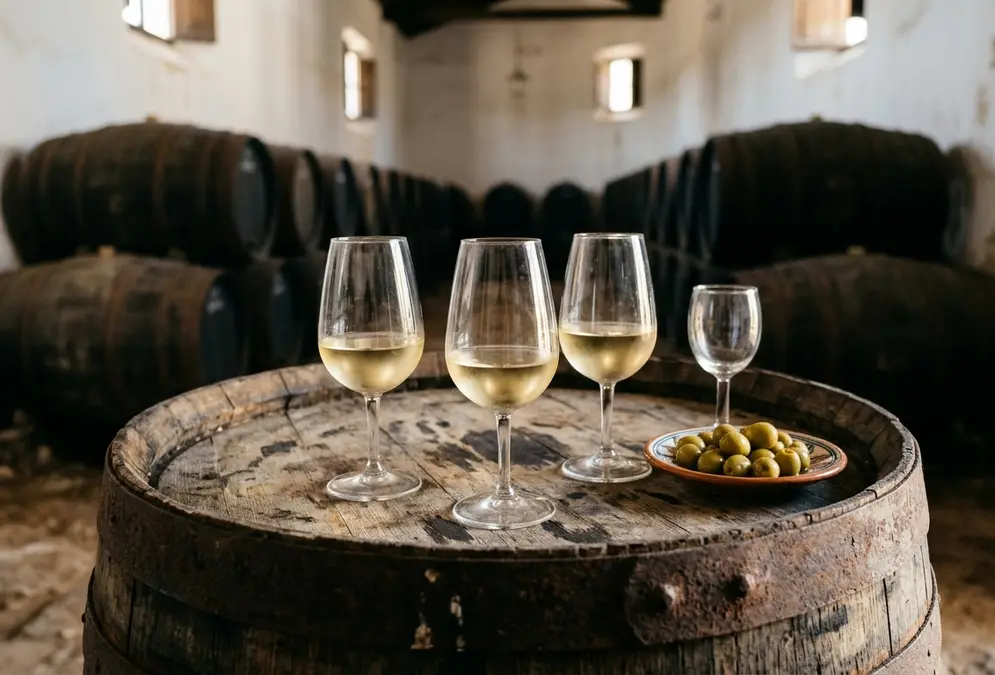
You came for the wine, so understand the map first. Sherry is made in the Sherry Triangle of Jerez, El Puerto de Santa María and Sanlúcar de Barrameda, and the Jerez-Xérès-Sherry denomination, established in 1933, was Spain's first protected designation of origin. Wines age in 500-litre American oak casks, either under a layer of yeast called flor or oxidatively. The result runs from crisp, bone-dry fino through nutty amontillado and aromatic oloroso to dark, sweet Pedro Ximénez.
In the Jerez region, "bodega" means both the warehouse where the wine ages and the company that owns it. The Consejo Regulador keeps official registers of the bodega firms in the denomination, and its website is the safest place to start if you want to pick a producer. Bodegas across the region welcome visitors for guided tours and tastings, but no single bodega's hours or prices were confirmed at the time of writing, so book directly with the one you choose.
A practical rule for the day: one bodega visit, not three. A guided tour and tasting takes a good part of a morning or afternoon, and a second glass of oloroso at noon makes the Alcázar less interesting than it deserves to be. If you want to taste back in Cádiz afterwards, the Cádiz food guide covers where to eat and drink in the city.
The Royal Andalusian School of Equestrian Art
The Royal Andalusian School is devoted to preserving the Spanish equestrian tradition and is well known for its "dancing stallions" shows, staged in a purpose-built arena. It is one of the four most prestigious classical riding academies in the world.
The school also offers visits beyond the show. Show days, start times, visit types and ticket-office hours were not confirmed at the time of writing, so check the school's own site for the date you travel, and book the show first, because it fixes the shape of your day.
Flamenco and tabancos
A tabanco is a traditional sherry bar where the wine comes straight from the cask, and some are accompanied by flamenco. It is the easiest way to taste without committing to a bodega tour, and a sensible place for lunch on your feet. Individual tabancos and their music nights were not confirmed at the time of writing, so ask at the tourist office in Jerez or check each bar's own page before relying on live flamenco at a given hour.
If you want a guaranteed flamenco evening, save it for the way back: the flamenco show in Cádiz page covers the city's options.
Building the day
Work backwards from the fixed points. First, the last train back. Second, the school's show if you want it, at whatever time the school lists for your date. Third, the cathedral hours, which run to 19:00 on most days. Everything else bends around those.
- Take a morning train from Cádiz and go straight to the Real Escuela if the show or a tour is your priority.
- Walk into the old town for the cathedral, then the Alcázar.
- Lunch at a tabanco or tapas bar, with a glass of fino rather than a flight.
- One bodega visit, booked in advance, in the afternoon.
- Catch a train back before you check the time, not after.
Early September is the festival month: the Vendimia, the grape harvest festival, is held in early September. Check crowds and timetables first before driving or taking the train to Jerez on a festival day.
Questions about Jerez as a day trip
How far is Jerez de la Frontera from Cádiz?
Close enough for a day trip by train. Renfe lists the earliest weekday Cercanías as leaving Cádiz at 5.45 and arriving in Jerez at 6.36, so allow a little under an hour each way and check the timetable for the train you actually plan to take. Weekday services run the full line 21 times in each direction.
Is Jerez worth visiting?
Yes, if you care about sherry, horses or a quieter old town. Jerez is the historical and cultural heart of the sherry region, it has a baroque cathedral and an Almohad Alcázar, and it is home to the Royal Andalusian School of Equestrian Art. It is a poor choice if you only want a beach, which Cádiz already gives you.
What is Jerez famous for?
Sherry above all. The Jerez-Xérès-Sherry denomination dates from 1933 and was Spain's first protected designation of origin. The town is also known for its horses, for flamenco and, in 2026, as Spain's Gastronomic Capital.
Can I visit Jerez from Cádiz without a car?
Yes. The Cercanías train links the two cities, with 21 services in each direction on weekdays that stop at every station on the way, and three in each direction that also serve Jerez airport. Everything in this guide is reachable on foot or by a short taxi from the station area, so a car adds nothing.
Do I need to book the Real Escuela show?
Check the school's official site before you travel. Show days, start times and ticket-office hours change, so confirm them for your date and book ahead rather than relying on a walk-up. Then fit the rest of the day around the show.
How much is the cathedral?
The cathedral lists a general ticket at €8, audioguide included, and a combined ticket with the Church of San Miguel at €13. It also lists a free visit on Tuesdays from 10:00 to 11:00 with limited places and online booking. Prices change, so check the cathedral site on the day you plan to go.
Further reading
Sources
18 references Show Hide
- Renfe: new Cercanías timetable for Cádiz from 21 September (opens in a new tab)
“el primer tren con salida de Cádiz a las 5.45 h llegará a Jerez a las 6.36 h”
- grupo.renfe.com (opens in a new tab)
“21 por sentido circularán entre Cádiz y Jerez, con paradas en todas las estaciones intermedias del recorrido”
- grupo.renfe.com (opens in a new tab)
“tres por sentido conectarán Aeropuerto de Jerez con Cádiz”
- Consorcio de Transportes de la Bahía de Cádiz: catamaran (opens in a new tab)
“cubre el trayecto entre las dos localidades con una duración del viaje de aproximadamente 25 minutos, dependiendo de las condiciones del mar”
- Catedral de Jerez: hours and tickets (opens in a new tab)
“GENERAL Incluye audioguía. | 8,00€”
- Catedral de Jerez: hours and tickets (opens in a new tab)
“Visita Gratuita a la Catedral los martes de 10:00h a 11:00h. Aforo limitado, previa reserva online.”
- Catedral de Jerez: hours and tickets (opens in a new tab)
“Las visitas a la torre estarán suspendidas temporalmente.”
- Catedral de Jerez: architecture (opens in a new tab)
“El Cabildo Colegial acometió el 9 de mayo de 1695”
- Catedral de Jerez: architecture (opens in a new tab)
“La cúpula tiene una altura de 40 m. desde el suelo de la iglesia.”
- Alcázar of Jerez de la Frontera (Wikipedia) (opens in a new tab)
“The alcázar is one of a few structures that best exemplify Almohad architecture in the Iberian Peninsula.”
- Wikipedia — Alcázar of Jerez de la Frontera (opens in a new tab)
“the only remaining of the 18 once present in the city”
- Sherry Wines: the Sherry Triangle (opens in a new tab)
“tabancos are traditional Sherry bars where the wines are served straight from the cask - sometimes accompanied by flamenco.”
- sherry.wine (opens in a new tab)
“was established in 1933, as Spain’s first such protected designation”
- sherry.wine (opens in a new tab)
“from crisp, bone-dry Fino, to nutty Amontillado, aromatic, golden Oloroso and dark, sweet Pedro Ximénez (PX)”
- sherry.wine (opens in a new tab)
“bodegas welcome visitors to discover the art of Sherry-making with guided tours and tastings”
- Royal Andalusian School of Equestrian Art (Wikipedia) (opens in a new tab)
“is well known for its "dancing stallions" shows for the tourists, staged in its purpose-built arena”
- Wikipedia — Royal Andalusian School of Equestrian Art (opens in a new tab)
“It is one of the "Big Four", the most prestigious classical riding academies in the world.”
- Sherry Wines: registered bodegas (opens in a new tab)
“Those bodega firms belonging to the Denomination of Origin are recorded in the different official registers kept by Consejo Regulador”