
10:00 am on All Saints' Day: five minutes that shook Cádiz
The morning started in calm autumn weather.[1] At 10:00 am on 1 November 1755, an earthquake shook Cádiz for five full minutes.[1] Modern seismologists estimate that the offshore Lisbon earthquake reached a moment magnitude of 7.7 or greater, rupturing the Atlantic floor roughly 200 kilometres west-southwest of Cape St. Vincent.[7] One week after the catastrophe, King Ferdinand VI ordered the governor of the Supreme Council of Castile to compile an official inquiry across Spain, preserving eyewitness dispatches from Cádiz.[8]
Among those observers in Cádiz was the naval officer and Enlightenment scientist Jorge Juan y Santacilia, who measured the oscillations using a technique he had practised in Peru during the great 1746 earthquake that ruined Lima and Callao.[9] His instrument was simple. He held an iron bar sealed at one or both ends into a wall to gauge the movement.[9]
For an hour after the ground steadied, the sea gave little warning of what was travelling toward the Gulf of Cádiz. Then the ocean rose rapidly from every side at once.[2]
- 10:00 am, 1 Nov 1755
- 11:10 am
- 11:10 am – 1:15 pm
- 1:15 pm
Fifth major wave
Jorge Juan records the fifth major tsunami surge of nearly equal force before the waters subside.[3]
- 8 Nov 1755
Royal inquiry ordered
King Ferdinand VI instructs the Supreme Council of Castile to compile nationwide reports on the disaster.[8]
11:10 am at La Caleta: stone blocks hurled eighty varas inland
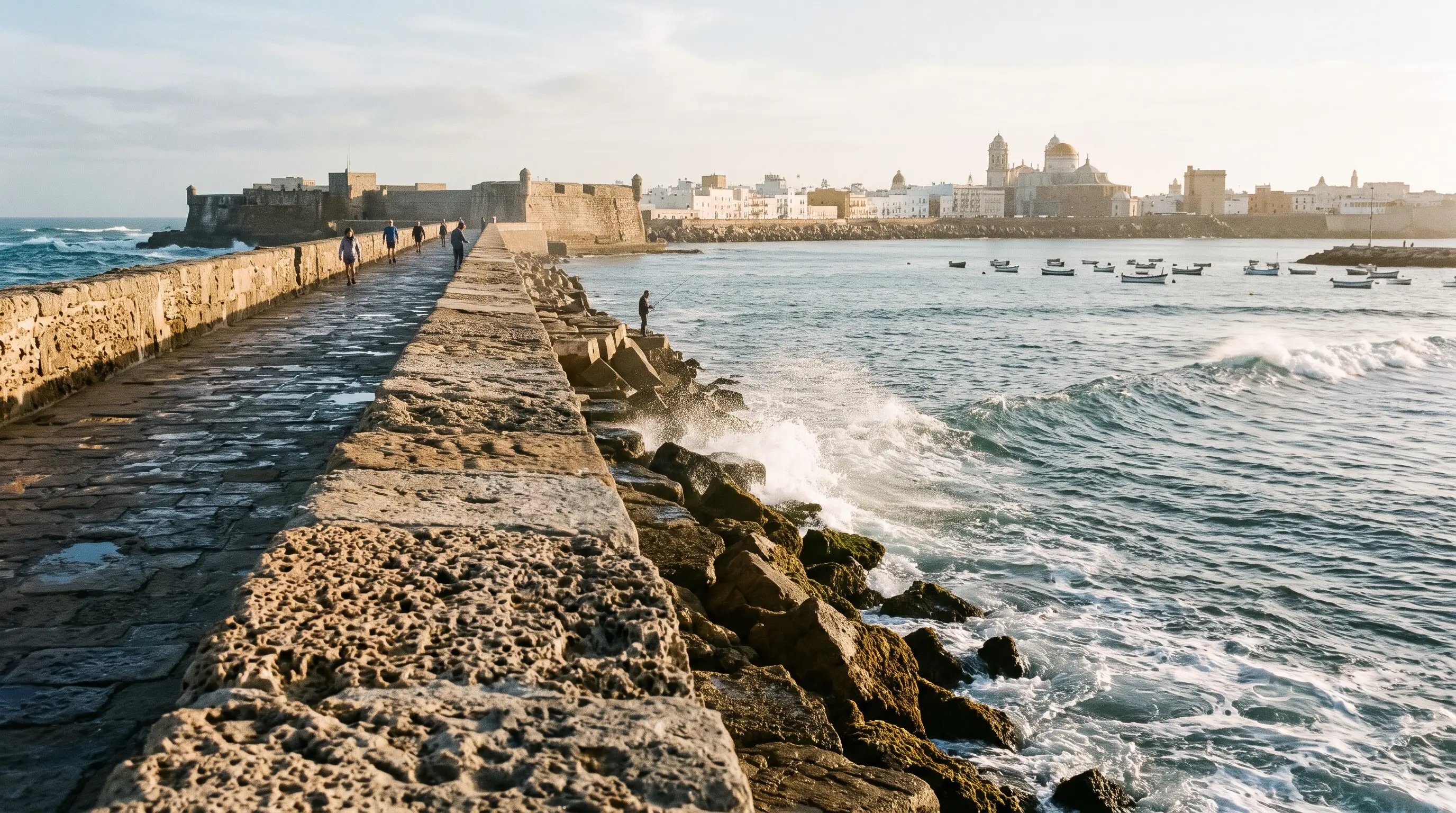
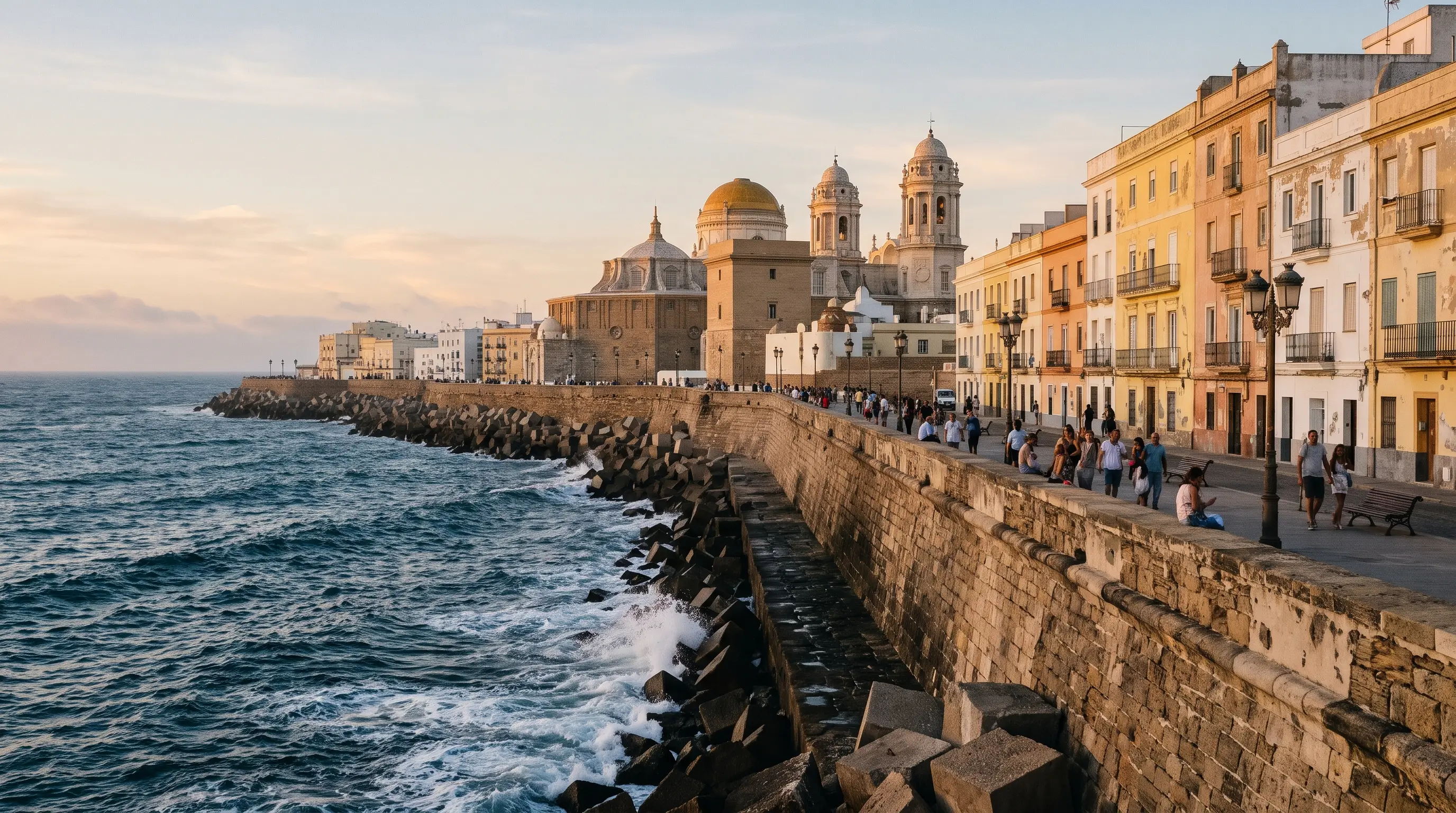
According to Jorge Juan's timing, the first major wave struck at 11:10 am, and the sea repeated its assault five times with nearly identical force until the fifth wave at 1:15 pm.[3] La Caleta took the heaviest blow. Three distinct impacts of water ripped away 300 varas of the stone wall's parapet and flung solid masonry sections measuring 6 to 7 varas long and weighing 100 quintals each up to 80 varas inland.[4]
North and west along the ramparts, the damage ran from fortress to fortress. Along the curtain wall leading toward Castillo de Santa Catalina, the waves ruined 530 varas of parapet and another 4 varas on its flank.[11] Out on the reef at Castillo de San Sebastián, the surge swept away the entrance bridge facing the city and left the bridge toward the chapel and watchtower badly broken.[12]
Water also poured through the harbour gates. Floodwaters entered through the Puerta de la Mar as far as Plaza de San Juan de Dios, and through the Puerta de Sevilla up to the corner of Calle San Agustín and the post office.[13] Outside the walls along the narrow isthmus, the ocean waters from Santa María beach and the bay waters from Puntales met across the sandspit, wrecking small houses and drowning people caught in the open.[14]
Death on the Arrecife and Governor Azlor's order at Puerta de Tierra
The deadliest trap on 1 November 1755 was the Arrecife, the narrow causeway road linking Cádiz to the Isla de León (modern San Fernando), which the tsunami completely destroyed and left impassable.[10] Panicked travellers fled onto that low road right after the tremor. Outside the walls where the two seas of Santa María beach and Puntales joined across the isthmus, small houses were ruined and people caught in the open drowned, including two French merchants, Don Juan Mason and Don Juan Racine (grandson of the French playwright Jean Racine), who perished on the Arrecife after leaving immediately for the Isla de León.[5][14]
Inside Cádiz, Military Governor Don Antonio de Azlor made a decision that historians credit with ensuring the number of fatalities remained lower and preventing robbery and looting.[5][15] Foreseeing that panicked residents would rush out in disorder to save their lives and meet their deaths on the flooded causeway just as Mason and Racine did, Azlor ordered the gates closed, above all Puerta de Tierra, and forbade anyone from leaving.[5]
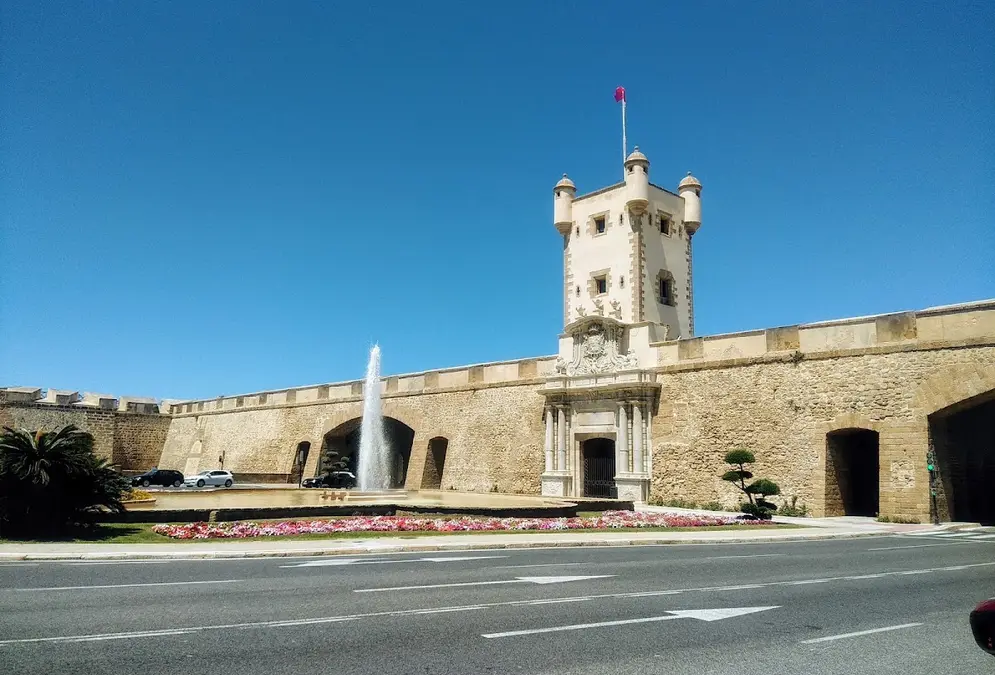
Don't miss · Monument
Puerta de Tierra
Cádiz's surviving 18th-century land gate, with Cayón's 1756 marble portal, a walkable upper level and the Puppet and Lithography museums. C…
Why La Viña flooded and where the Virgin of La Palma stopped the water
Inside the walls, the fishing quarter of La Viña suffered the greatest danger.[2][6] Geography made it vulnerable. Jorge Juan pinpointed the two physical reasons why: La Viña stood directly behind the breached sea wall at La Caleta, and its street level lay two varas lower than high tide.[6] When the parapet gave way and masonry fragments were flung 40 to 80 varas inland, seawater poured straight down into the low neighbourhood.[2][4]
As the surge advanced toward the Iglesia de Nuestra Señora de la Palma, a church whose origins go back to the Capuchin order and the late-17th-century public rosaries promoted by Fray Pablo de Cádiz, residents turned to the parish sanctuary.[17] Period accounts record that the parish priest walked out into the street carrying the banner of the Virgin and cried out: «¡Hasta aquí, madre mía, y no más!» ("Up to here, Mother of mine, and no further!").[18]
Recommended tours
Tours are selected for quality, not commission. We earn a small fee if you book, at no extra cost to you.
The waters halted there.[19] Popular tradition in Cádiz attributes the halting of the flood before the church to the intercession of Nuestra Señora de la Palma, and the annual 1 November commemoration in La Viña is officially recognised as a Bien de Interés Cultural (BIC) in the category of ethnological activity.[19][20]
Where to trace the 1755 tsunami in Cádiz today
Because Cádiz's 18th-century fortifications and churches were repaired after the storm, you can walk the exact ground described in Governor Azlor's and Jorge Juan's November 1755 dispatches in under two hours. Four stops connect the tsunami's path across the old city:
- Iglesia de Nuestra Señora de la Palma (La Viña): Visit the Capuchin-founded baroque church and inspect the public street retablo on Calle Virgen de la Palma that commemorates where the waters stopped on 1 November 1755; if you visit on All Saints' Day, you can witness the BIC-listed annual commemoration.[17][19][20]
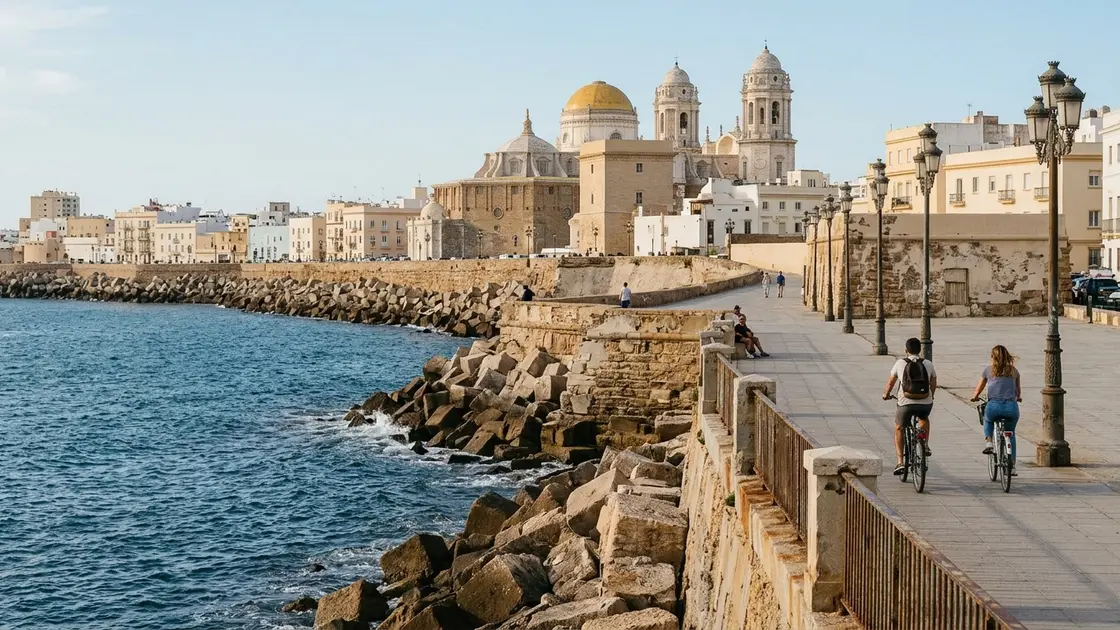
- La Caleta sea wall and Castillo de Santa Catalina: Walk the western ramparts between La Caleta beach and Castillo de Santa Catalina, where the 1755 waves tore out 300 varas of parapet along the beach and 530 varas along the curtain wall.[4][11]
- Castillo de San Sebastián causeway: Look out from the southern end of La Caleta toward the islet fortress where the tsunami carried away the entrance bridge facing the city.[12]
- Puerta de Tierra and Plaza de San Juan de Dios: Stand at the landward gate that Governor Azlor ordered locked to keep residents off the San Fernando causeway, then step inside the harbour gate to Plaza de San Juan de Dios, the high-water mark of the bay surge through Puerta de la Mar.[5][13]
Deep dive · Article
12 Interesting Facts About Cádiz: History, Towers & Secrets
Discover 12 interesting facts about Cádiz, from Phoenician houses buried under a puppet theatre and two marble sarcophagi to 134 watchtower…