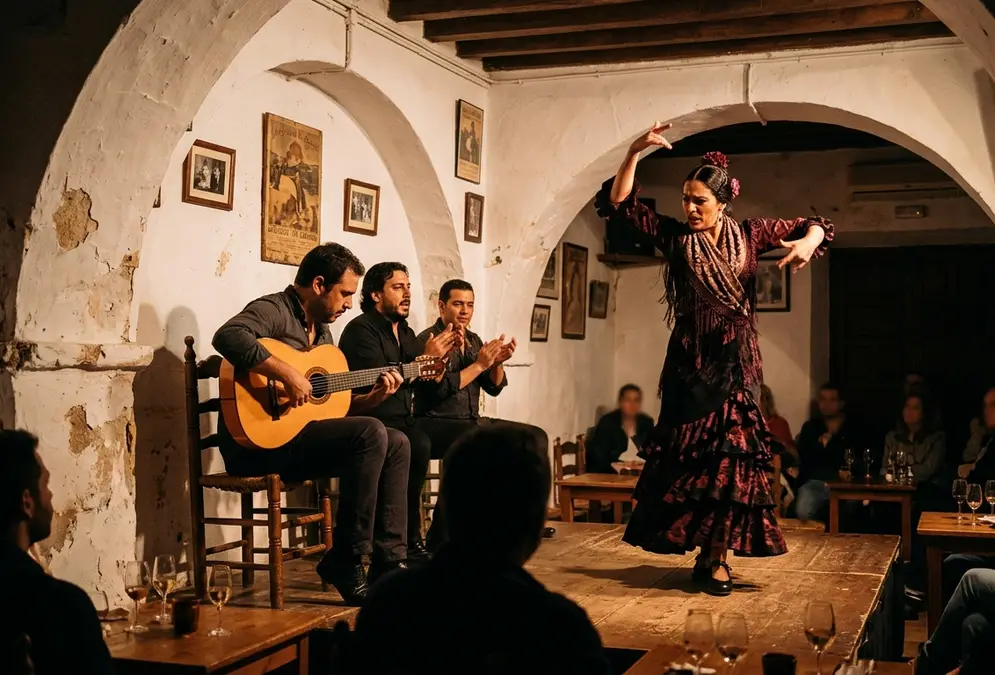

Cádiz is the home of the alegría, the bright, quick-stepping song that anchors the cantiñas family. The best-known option for visitors is a tavern show at La Cava, but the city also runs a quieter circuit of peñas and a municipal flamenco centre where the audience is mostly local.
The La Cava tavern show
La Cava opened in 1999 as a flamenco bar and now stages a ticketed show. The format is simple: 60 minutes, starting at 21:30, finishing around 22:30, with four artists on the floor. The group is one singer, one guitarist and two dancers, usually one man and one woman.
On the venue's booking page the adult ticket is €32 and includes one drink, and children aged 3 to 12 pay €16; confirm the current prices when you book. If you plan to eat there first, the venue suggests arriving around 20:30; for drinks only, 21:00 is enough. Shows are not nightly according to one third-party listing, which gives Tuesday, Thursday and Saturday, so check the venue's own calendar before you walk over.
Be warned that the room is loud. Intense clapping and heel tapping are the point of the evening, and people sensitive to loud noise can find it uncomfortable. Cancellations and changes to the booking only qualify for a refund if made at least 24 hours before the show.
Peñas and the municipal centre
For flamenco without the ticket-office feel, look to the peñas flamencas, the members' clubs that program recitals and competitions. The Junta de Andalucía's flamenco guide names Peña Enrique el Mellizo, which has hosted Los Jueves Flamencos every Thursday for more than thirty years, and Peña Perla de Cádiz, which organises a national alegrías dance competition. Schedules change, so confirm dates with the club before you go.
The Centro Flamenco La Merced, the municipal flamenco arts centre on Plaza de la Merced, runs a programme that changes monthly. Opening hours are posted in its agenda; check the current month on its website rather than relying on a printed guide.
Why alegrías and why Santa María
The alegría is part of the cantiñas, the songs of Cádiz par excellence, and is played at a lively 120 to 170 beats per minute. It seems to derive from the Aragonese jota, which took root in the city during the French occupation and the Cortes of Cádiz. Flamenco as a whole was inscribed on UNESCO's Representative List of the Intangible Cultural Heritage of Humanity in 2010, as an art that fuses cante (song), baile (dance) and toque (guitar).
The Santa María district is described in the official Andalusian guide as perhaps the city's most quintessential flamenco barrio, where Enrique el Mellizo forged his career. It is a good place to anchor an evening: the Cádiz Cathedral rises nearby, and a daytime climb up the cathedral tower fits neatly before a 21:30 show.
Planning the evening
A 60-minute show leaves room for dinner. Many visitors pair it with fried fish, pescaito frito, in the nearby tavern streets of La Viña, then walk back after the show. Keep the evening unhurried: arrive in time for the seats you want, and book in advance through the official channel rather than turning up on the night.