Die Another Day at La Caleta: Halle Berry, 007, and the 1926 bathhouse
Politics brought 007 to Andalusia. Because the US blockade of Cuba ruled out filming in the real Havana for the twentieth Eon Productions James Bond film, Die Another Day (2002), the Atlantic port of Cádiz stood in for the Cuban capital (while the interior of the Havana cigar factory where Bond drops the code name "Universal Exports" was actually filmed at Simpson House, 92 Stoke Newington Road in north London).[1][2] Directed by Lee Tamahori and starring Pierce Brosnan alongside Halle Berry as NSA agent Giacinta "Jinx" Johnson, the film went on to gross $432 million worldwide.[2]
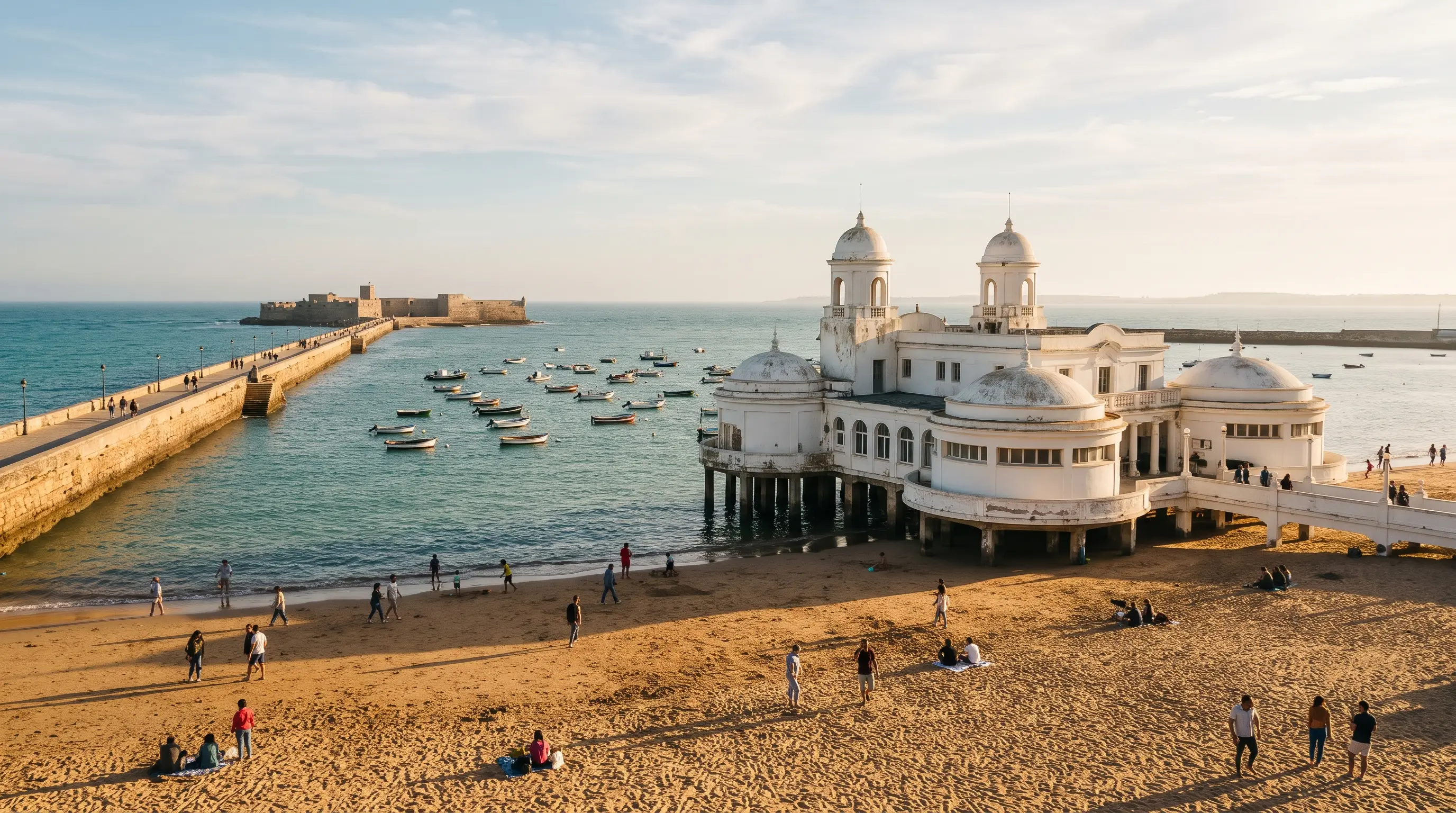
Every outdoor Cuban sequence in Die Another Day, including both the streets and waterfront of Havana and the fictional island of Isla de Los Organos (site of Dr. Álvarez's DNA gene-therapy clinic), was filmed around La Caleta in Cádiz.[3] Stretching 495 metres in length with an average low-tide width of 50 metres, Playa de La Caleta is the only beach situated inside the historic old town, framed between the Castillo de Santa Catalina and the stone causeway (Malecón) that links the island of Castillo de San Sebastián to the city.[6]
Conditions on the sand were far from tropical. It rained constantly during the shoot, and Halle Berry's famous coral bikini emergence from the surf (designed as a direct homage to Ursula Andress's swimsuit in Dr. No) was filmed in cold, windy Atlantic weather that forced Berry to wrap up in thick towels between takes to avoid catching a chill.[1][4] Worse still, during the Cádiz action filming, debris from a smoke grenade flew into Berry's eye and had to be removed in a 30-minute surgical operation.[5]
Don't miss · Monument
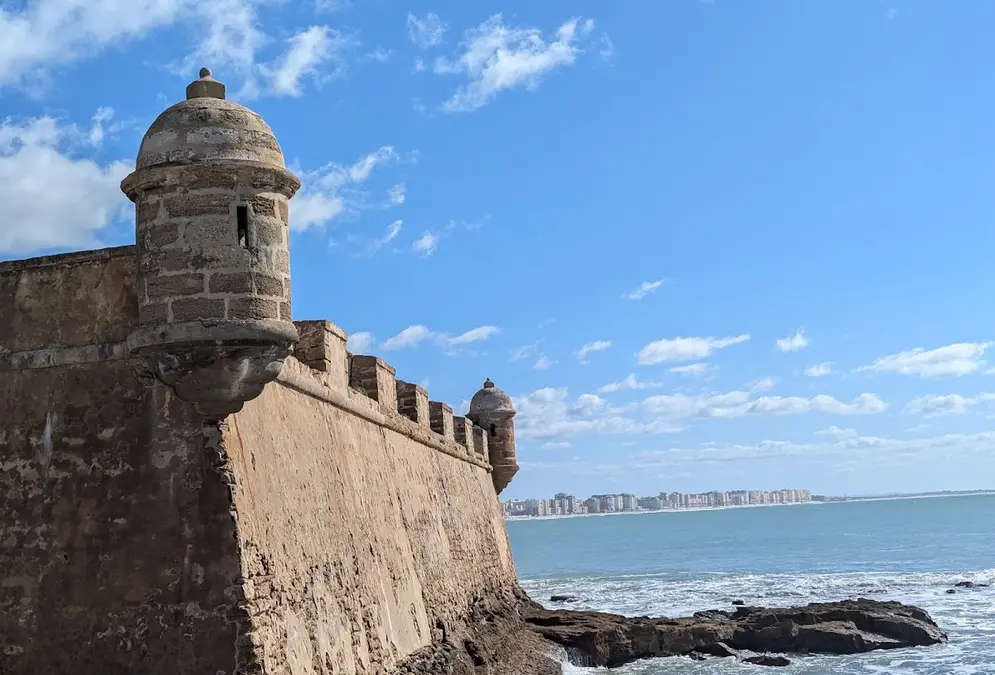
Castillo de San Sebastián
Castillo de San Sebastián is Cádiz's nine-sided sea fortress at the end of La Caleta. Its history, the 2024 reopening and what to check bef…
Curving directly onto the sands behind Berry's camera mark is the whitewashed Antiguo Balneario de Nuestra Señora de la Palma y del Real, inaugurated in 1926 to replace the older wooden Baños del Real bathhouse.[7] Viewed from the beach promenade, its white arcades overlooking the surf completed the illusion of a Caribbean shoreline. Today the 1926 Balneario de la Palma houses the Andalusian Center for Underwater Archaeology (Centro de Arqueología Subacuática), which conducts research, activities, and exhibitions on submerged archaeological heritage.[8]
The twin castles of La Caleta: Santa Catalina and San Sebastián on screen
Two coastal fortresses anchor the horizon at either end of the beach. At the southern tip of La Caleta, a long stone causeway (Malecón) runs out across the reef to the island of Castillo de San Sebastián, providing the dramatic sea-surrounded exterior vista seen in the Isla de Los Organos sequences of Die Another Day.[3][6] At the northern end of the sand stands its older counterpart, the star-shaped Castillo de Santa Catalina.[6][9]
King Philip II ordered the construction of Santa Catalina on 25 October 1597, directly after the 1596 Anglo-Dutch sack of Cádiz, entrusting the design to military engineer Cristóbal de Rojas.[9] A commemorative plaque at the main gate records the start of construction in 1598, and the fortress was completed on 5 September 1621.[9] Built of dark, porous local oyster stone (piedra ostionera), the castle projects a three-pointed star battery directly into the Atlantic surf while a moated ravelin guards its landward gate.[10]
After the Spanish Ministry of Defence ended military use of the site in 1991, an agreement with the Cádiz City Council turned the fortress into a multipurpose cultural venue.[10] Fittingly for a bastion that has framed so many feature shoots on La Caleta, the castle now hosts permanent exhibition halls, cultural events, craft workshops, and the Alcances Documentary Film Festival (Festival de Cine Alcances).[10] Admission to Castillo de Santa Catalina (Calle Antonio Burgos, s/n) is free, with daily opening hours from 11:00 to 19:30 in summer (1 April to 30 September) and 11:00 to 19:00 in winter (1 October to 31 March).[11]
Why Cádiz looks like Havana: shared 18th-century military engineering
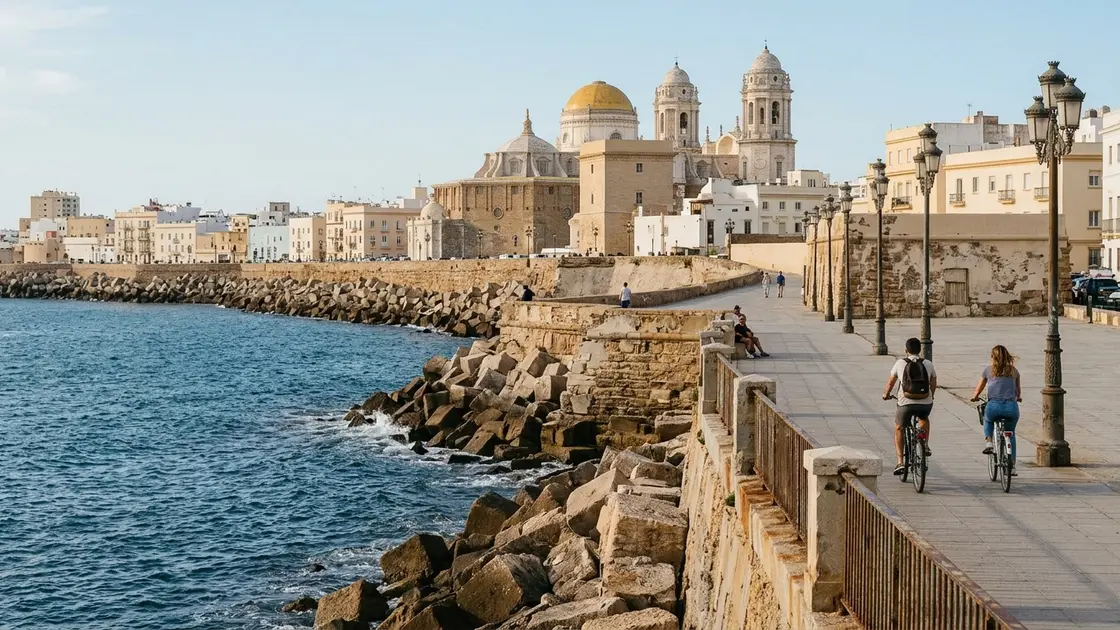
Visitors walking south from La Caleta past the twin castles toward the sweeping curve of the Campo del Sur invariably notice how closely the sea wall resembles Havana's seafront.[12] Beneath the historic skyline of Cádiz Cathedral, the Atlantic promenade links the coastal bastions of Los Mártires, Capuchinos, and San Roque in a continuous stone rampart beaten by ocean spray.[12]
That visual kinship is not an accident of set dressing. Following the eighteenth-century expansion of colonial commerce and the rise of the local mercantile bourgeoisie, Cádiz enclosed its urban peninsula inside a sophisticated bastion and sea-wall network.[13] As historians of the fortifications note, the defensive system built around Cádiz served directly as the model for Spanish colonial military architecture across the Americas.[13]
Deep dive · Article
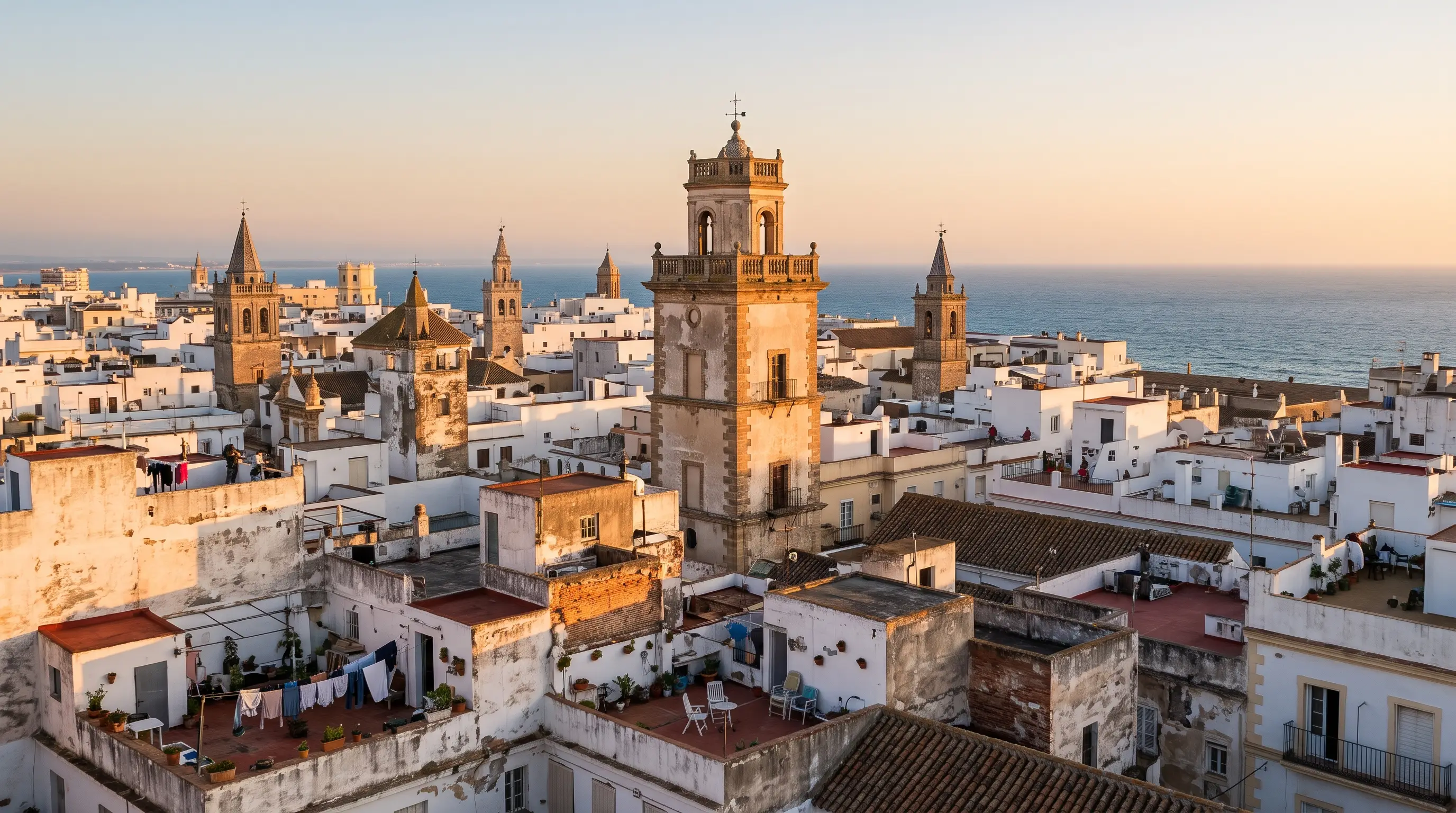
Cádiz Watchtowers and Torre Tavira: Inside the Lookout Network
Why do more than 100 Baroque watchtowers crown the rooftops of Cádiz? Explore Torre Tavira, the 1717 Indies trade monopoly, and where to se…
The royal military engineers who drafted the sea walls, bastions, and sentry boxes of Cádiz belonged to the same tradition that fortified ports across the Spanish Americas.[13] When cinema cameras frame the weathered ramparts of La Caleta or the curved seawall of the Campo del Sur, they are filming the European prototype that inspired Spanish American coastal defences.[12][13]
Beyond 007: Sean Connery's Cuba, Alatriste, and Tom Cruise in Knight and Day
Pierce Brosnan was not even the first James Bond actor to use Spain as pre-revolutionary Havana. More than two decades before Die Another Day, original 007 star Sean Connery arrived in Spain in December 1978 to shoot director Richard Lester's Panavision adventure film Cuba (1979).[14] Portraying the build-up to the 1958 Cuban Revolution, Connery's production established the template that Eon Productions later followed at La Caleta.[3][14]
Spanish historical epics have leaned just as heavily on the city's historic streets and fortifications. Between 7 March and 17 June 2005, director Agustín Díaz Yanes filmed Alatriste (2006) on location in Cádiz alongside Seville, Córdoba, Baeza, Úbeda, Jaén, Uclés, and León.[15] Starring Viggo Mortensen as seventeenth-century veteran soldier Diego Alatriste from Arturo Pérez-Reverte's novels, the 24-million-euro production became the most expensive Spanish-language film in Spanish cinema history up to that date and won three Goya Awards in 2006 (Best Production Supervision for Cristina Zumárraga, Best Art Direction for Benjamín Fernández, and Best Costume Design for Francesca Sartori).[15][16]
Recommended tours
Tours are selected for quality, not commission. We earn a small fee if you book, at no extra cost to you.
Four years later, Hollywood returned for high-speed street action across the old town. Director James Mangold's 2010 action-comedy Knight and Day (released in Spain as Noche y día), starring Tom Cruise, Cameron Diaz, and Jordi Mollà, shot major action sequences through the streets of Cádiz and Seville.[17] In a famous piece of geographical licence, the film staged a fictional running of the bulls of San Fermín hurtling through the Andalusian streets.[17]
| Film & Year | Director & Lead Cast | On-Screen Setting | Key Cádiz Filming Details |
|---|---|---|---|
| Cuba (1979) | Richard Lester; Sean Connery | 1958 Havana (Cuban Revolution) | Shot in Panavision on location in Spain in December 1978[14] |
| Die Another Day (2002) | Lee Tamahori; Pierce Brosnan, Halle Berry | Havana & Isla de Los Organos, Cuba | Filmed at Playa de La Caleta in cold, windy, rainy weather; grossed $432M[1][2][3][4] |
| Alatriste (2006) | Agustín Díaz Yanes; Viggo Mortensen | 17th-century Golden Age Spain | Shot March–June 2005 on a €24M budget; won 3 Goya Awards[15][16] |
| Knight and Day (2010) | James Mangold; Tom Cruise, Cameron Diaz | Spanish street bull-run chase | Staged San Fermín bull-running action sequences in Cádiz and Seville[17] |
How to walk the James Bond and movie locations in Cádiz today
Because all of 007's coastal camera marks sit within a fifteen-minute walk of one another on the western edge of the old town, you can trace the entire Havana seafront route on foot without tickets or transport.[3][6][11] Time your walk for late afternoon along La Viña and the western ramparts, when the Atlantic light hits the oyster-stone walls of Castillo de Santa Catalina and the seafood terraces open along the pedestrian lanes facing the beach.[10][18]
Five stops on a self-guided Cádiz film walk
- Castillo de Santa Catalina (Calle Antonio Burgos, s/n): Start inside the only fortress on the route open daily to the public for free (11:00–19:30 in summer, 11:00–19:00 in winter), built between 1597 and 1621 at the northern point of La Caleta and home to the Alcances film festival.[9][10][11]
- Playa de La Caleta sand: Walk down onto the 495-metre old-town beach where Halle Berry filmed Jinx's coral bikini scene in Die Another Day between takes wrapped in thick towels against the cold wind.[3][4][6]
- Balneario de Nuestra Señora de la Palma y del Real (exterior view from the sand): Pause on the beach below the curved white 1926 bathhouse (now the headquarters of the Centro de Arqueología Subacuática) to admire its exterior arcades from the shoreline and promenade.[7][8]
- Malecón and Castillo de San Sebastián (exterior view from the promenade): Look out from the southern end of La Caleta along the stone causeway (Malecón) toward the island fortress of Castillo de San Sebastián, taking in the dramatic exterior silhouette that framed Isla de Los Organos in Die Another Day.[3][6]
- Campo del Sur and Calle Virgen de la Palma: Continue south along the Havana-style Campo del Sur seawall past the bastions of Los Mártires, Capuchinos, and San Roque, then turn inland up Calle Virgen de la Palma, the lively maritime spine of the La Viña quarter directly facing La Caleta.[12][18]