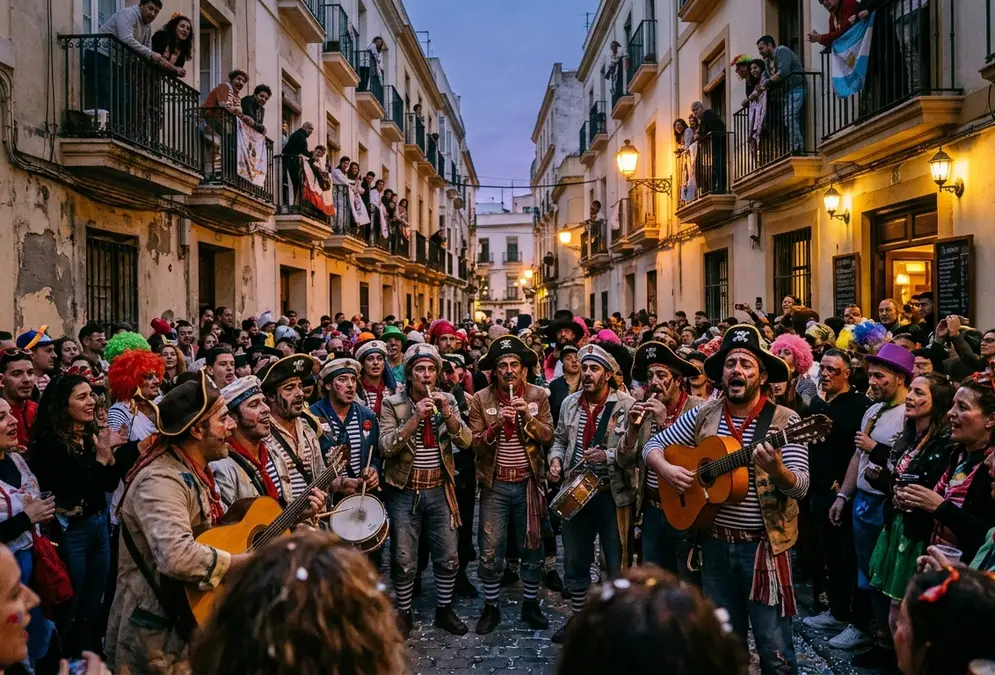

The Ayuntamiento de Cádiz schedules Carnaval de Cádiz 2027 from Thursday 4 to Sunday 14 February 2027[7]. Declared a Fiesta of International Tourist Interest, the celebration traces its roots to the late 15th century, when Ligurian merchants settled in the port, and developed its ironic lyrical tradition around Plaza del Tío de la Tiza in La Viña[1][16]. For day-by-day route strategy, bar stops, and first-timer advice, see our Cádiz Carnival guide.
Confirmed 2027 dates and municipal schedule
The city council publishes the 2027 calendar as a provisional programme (programación prevista) pending the final municipal decree[13]. Before the official eleven-day window opens, three free open-air gastronomic warm-ups (the Pestiñada, Ostionada, and Erizada) serve tastings alongside the year's first satirical songs[17].
| Date | Event | Main Location |
|---|---|---|
| Friday 5 February 2027 | Gran Final of the COAC competition[8] | Gran Teatro Falla |
| Saturday 6 February 2027 | Official Pregón del Carnaval & costume night[9] | Plaza de San Antonio |
| Sunday 7 February 2027 | Domingo de Coros & Gran Cabalgata Magna[10] | Mercado Central & main avenue |
| Monday 8 February 2027 | Lunes de Coros (local public holiday)[11] | Historic centre squares |
| Sunday 14 February 2027 | Domingo de Piñata & Quema de la Bruja Piti[12] | Historic centre |
One week after the official Sunday closing ceremony and the burning of the Bruja Piti, locals and street ensembles return for Carnaval Chiquito (also called the Carnaval de los Jartibles) on the following Sunday[12].
COAC theatre contest vs free street performances
Two distinct circuits share the festival. Indoors at the Gran Teatro Falla on Plaza Fragela, the Concurso Oficial de Agrupaciones Carnavalescas (COAC) brings together four categories (coros, comparsas, chirigotas, and cuartetos) to sing satirical coplas reviewing the year's events[3][18]. Once the Friday night final concludes, the focus shifts outdoors, where all street performances are free across the historic centre's plazas and corners[14].
On Sunday and Monday, choirs ride open-top floats (bateas) in the Carruseles de Coros, circling the Mercado Central de Abastos, the 1838 neoclassical market designed by Torcuato Benjumeda on Plaza de la Libertad[6][19]. Meanwhile, informal groups known as agrupaciones ilegales (or callejeras) and solo romanceros, who point to illustrated easel boards (cartelones) while reciting verse, perform without fixed stages or timetables[15][19].
Key neighbourhoods and cultural venues
Both official ensembles and callejeras concentrate in six primary areas: La Viña (the traditional fishing and satirical quarter), medieval El Pópulo, Plaza de San Antonio, Plaza de Candelaria, the Mercado Central, and Plaza de San Agustín[2][15]. Along the seafront wall, the palm-lined courtyard of the Baluarte de la Candelaria also hosts Carnival performances and concerts[4].
- Costume custom: Wearing a costume (tipo) is strongly expected on the first Saturday and Sunday if you want to blend into the street crowd[20].
- Holiday closures: Monday 8 February 2027 is an official local bank holiday (Fiesta Local) in Cádiz[11].
- Reduced monument hours: Municipal exhibition spaces such as the Casa de Iberoamérica cut their opening hours to mornings only (10:00 to 14:00) throughout Carnival week[5].