History of Cádiz Carnival: Chirigotas, Comparsas & Censorship
Explore the history of Cádiz Carnival, from 15th-century Genoese merchants and the 1937 ban to Paco Alba's comparsas and COAC versus street chirigotas.
Historian specialising in Cádiz's ancient, colonial and constitutional heritage.
Published
Rooted in the arrival of Ligurian merchants around the Bay of Cádiz in the second half of the 15th century, the Carnaval de Cádiz evolved from an unruly harbour mask festival into Spain's sharpest tradition of sung political satire[1]. Neither the Napoleonic siege of 1810 to 1812 nor the 5 February 1937 wartime prohibition managed to silence its street verses[4][10]. After the catastrophic 1947 naval mine explosion forced authorities to tolerate the festival under a disguised name, lyricist Paco Alba transformed its sound in 1960 by creating the modern comparsa alongside the comic chirigota[13].
Synod Carnival records
1591
Synod Constitutions of 1591 and Agustín de Horozco document early Cádiz Carnestolendas[2]
Wartime Carnival ban
5 Feb 1937
Official decree banned Carnival before its postwar return as Fiestas Típicas[10]
Comparsa category created
1960
Contest rules added comparsas for Paco Alba's poetic style, led by Los Pajeros[13]
In this article
Jump to a section
⌄
From Genoese Merchant Masks to 19th-Century Censorship
Documentary evidence traces the earliest precedents of the Carnaval de Cádiz to the second half of the 15th century, when Ligurian traders from Genoa moved west after the fall of Constantinople to the Ottoman Turks and established a powerful commercial colony around the Bay of Cádiz[1]. Alongside banking and shipping, those Italian settlers brought their pre-Lenten mask traditions, confetti (papelillos), and paper streamers (serpentinas). The port absorbed the custom quickly.
The first surviving written accounts appear at the close of the 16th century in two works by the Cádiz historian Agustín de Horozco, who noted that during Carnival days local women plucked flowers from their window pots to toss at passers-by in jest[2]. Church and academic records from the same decade confirm how unruly the custom had already become: both the 1591 Synod Constitutions and the 1596 Statutes of the Seminary of Cádiz attempted to regulate the festivities[2]. By the first half of the 17th century, the celebration was so deeply entrenched that ecclesiastical authorities had to grant special dispensations to parishioners during Carnival week, while naval officials were forced to suspend ship repair work at the royal shipyards (Atarazanas) of Cádiz[3].
Timeline
Late 15th century
Ligurian merchants settle in Cádiz
Genoese traders bring Italian mask traditions to the bay after the fall of Constantinople.
1591 & 1596
Earliest institutional records
Synod Constitutions, Seminary Statutes and chronicler Agustín de Horozco record the festivities.
1861
First municipal Carnival budget
Mayor Juan Valverde assigns 30,000 reales de vellón to regulate the street festival.
1884
Prior censorship edict
Mayor Eduardo Genovés Puig requires singing groups to submit lyrics for a street licence.
1905
Los duros antiguos premiered
El Tío de la Tiza's choir Los anticuarios sings the tango that becomes Carnival's unofficial anthem.
1927
Carnival enters Gran Teatro Falla
Manuel López Cañamaque's choir Los Pelotaris performs the first Carnival coplas inside the theatre.
Early local newspapers such as the Gaceta de Cádiz were already reporting on Carnival preparations in February 1763, and not even the French artillery blockade of 1810 to 1812 halted the street celebrations[4]. As the 19th century progressed, however, the city's merchant bourgeoisie sought to tame the chaotic street Carnestolendas. In 1861, Mayor Juan Valverde allocated a municipal budget of 30,000 reales de vellón to reform and organise the festival[5]. Twenty-three years later, in 1884, Mayor Eduardo Genovés Puig issued an edict compelling every singing group to submit its coplas in advance for municipal approval before receiving a street licence, establishing the first documented system of prior lyric censorship in the history of the Cádiz Carnival[6].
El Tío de la Tiza, La Viña and the Move Into Gran Teatro Falla
Once municipal regulation pushed groups to rehearse structured repertoires, the large Carnival choirs (coros) entered their first golden age at the turn of the 20th century. The defining figure of that era was Antonio Rodríguez Martínez (1861–1912), universally known as El Tío de la Tiza, whose participation brought the coro to its first artistic maturity[7]. His most remembered choirs, Los claveles (1896) and Los anticuarios (1905), set the musical benchmark for the turn of the century; from the 1905 repertoire of Los anticuarios came the famous tango Los duros antiguos, which is sung to this day as the unofficial anthem of the Carnaval de Cádiz[7].
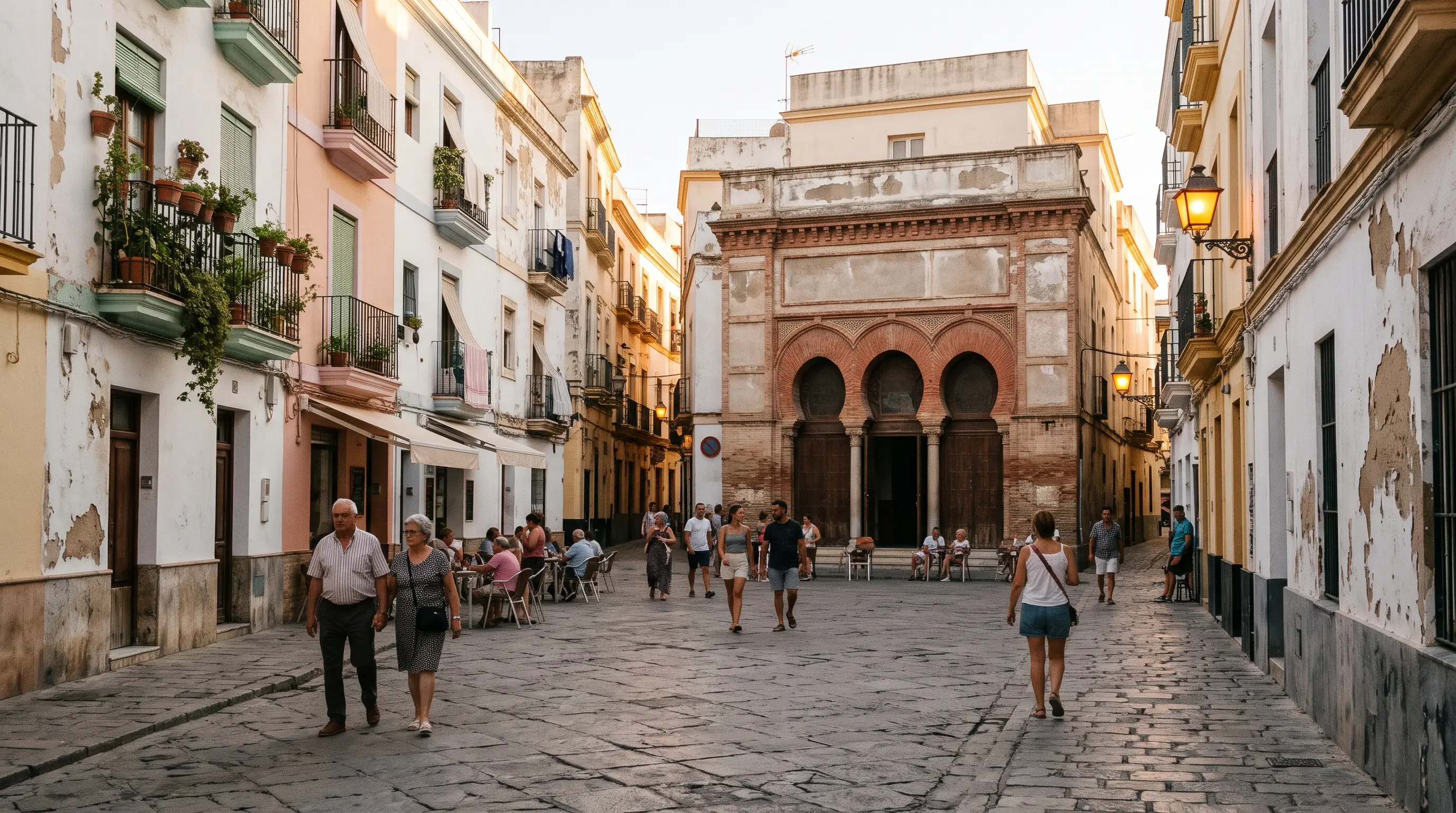
Today, the square bearing his name — the Plaza del Tío de la Tiza — anchors the traditional fishing quarter of La Viña, where the ironic, fast-witted chirigota took shape and where a festival now declared of International Tourist Interest still keeps its popular roots[8].
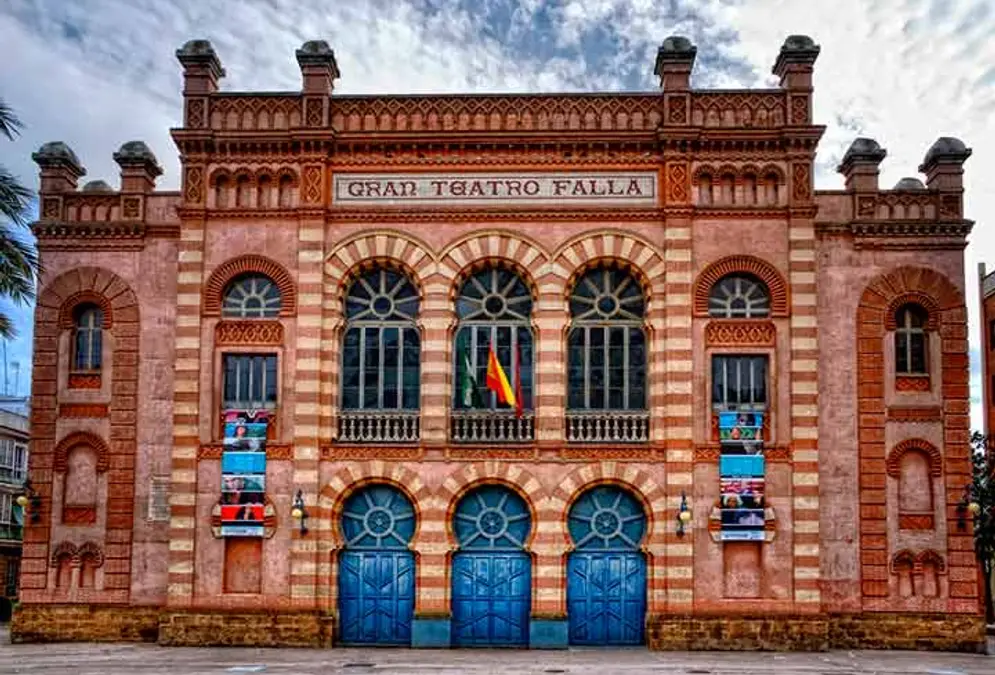
At the same time, the singing groups gained a permanent indoor stage. Raised in red Neo-Mudéjar brick between 1884 and 1910 to designs by architect Adolfo Morales de los Ríos, the city's main theatre was renamed the Gran Teatro Falla in 1926 in honour of Cádiz-born composer Manuel de Falla. Carnival coplas rang out inside its horseshoe auditorium for the first time in 1927, when Manuel López Cañamaque's choir Los Pelotaris took the stage[9].
The 1937 Prohibition, the 1947 Explosion and Fiestas Típicas Gaditanas
Six months into the Spanish Civil War, Nationalist authorities moved to shut down the street satire. On 5 February 1937, the Official State Bulletin published an order signed two days earlier by Governor-General Luis Valdés banning Carnival celebrations across Nationalist territory, and a follow-up order on 12 January maintained the prohibition indefinitely[10]. In Cádiz, the ban failed. Nostalgic neighbours kept gathering behind closed doors in courtyard tenements and backstreet taverns to sing in secret[10].
Recommended tours
Tours are selected for quality, not commission. We earn a small fee if you book, at no extra cost to you.
Paradoxically, it was the darkest night in 20th-century Cádiz that brought the festival back into public view. On 18 August 1947, the explosion of the San Severiano submarine mine depot plunged the city into mourning. Determined to lift the shattered population's morale, Civil Governor Carlos María Rodríguez de Valcárcel authorised the return of the choirs and street groups under a regime-approved euphemism: the Fiestas Típicas Gaditanas[11]. For nearly three decades, lyricists mastered the art of double meaning to slip social commentary past the provincial censor.
After Franco's death, 15 February 1977 marked the first democratic Carnival celebrated in full freedom, spearheaded by the choir Los dedócratas, which proved fundamental in both the recovery of the traditional coro and the restoration of the traditional February Carnival in 1977[12].
During those same postwar decades, Conil-born lyricist Francisco Alba Medina (Paco Alba, 1918–1976) revolutionised the festival's musical language. Beginning in 1953, Alba brought groups whose poetic depth, vocal harmony, and stylized costuming outgrew the slapstick mould of conventional comic chirigotas[13]. Because contest juries could no longer score both styles under one rubric, organisers rewrote the rules in 1960 to create the comparsa category, making Alba's Los Pajeros the first official comparsa in history[13]. Fifteen years later, in 1975, when Alba entered his group Los belloteros as a chirigota to protest how blurred the two genres had become, the official jury reclassified them and awarded them First Prize in comparsas[14].
Chirigotas vs Comparsas, Coros and Cuartetos: How COAC and the Street Differ
Every January and February, the Official Contest of Carnival Groups (COAC) at the Gran Teatro Falla unfolds across four elimination rounds: Preliminaries (clasificatoria), Quarter-Finals, Semi-Finals, and the Grand Final[15]. Each group gets at most 30 minutes on stage, timed from the opening note of the presentation to the closing chord of the popurrí[15]. Four official modalities compete under distinct musical and satirical rules[16][17]:
Coros (~45 members): The largest ensembles in the contest. Outside the theatre during the street festival they ride open floats in the famous Carrusel de Coros, while inside the COAC their most genuine composition and tie-breaker is the tango[16][17].
Comparsas (~15 members): Heirs to the modality created for Paco Alba in 1960, defined by a more serious presentation and sharply critical lyrics addressing social and political themes, with COAC ties decided by their pasodobles[16][17].
Chirigotas (~12 members): Comic satirical ensembles where humour, wit, and double meaning prevail throughout the repertoire, and where COAC tie-breakers are settled by the points scored in their cuplés and estribillos (short refrains)[16][17].
Cuartetos (3, 4, or 5 performers): Small ensembles defined by theatrical parody (composed of three or five members as well as four), with contest ties resolved by the score obtained in their parodia[16][17].
Unlicensed street groups ('ilegales'), romanceros and the La Viña calendar
Once the Falla curtain falls, the Cádiz Carnival guide moves outdoors, where unlicensed popular traditions take over the pavements without stages, microphones, or judges[18]. The agrupaciones ilegales (also called familiares or callejeras) are informal groups of friends, coworkers, peñas, and families who rival the official contest groups with their street repertoires, turning the steps outside the Post Office (Edificio de Correos) on Plaza de las Flores into their open-air 'Teatro Falla', while solo romanceros compete in their own Thursday contest before taking their rhymed boards to the streets[18].
The calendar starts warming up in January with three open-air gastronomic curtain-raisers (the Pestiñada, the Ostionada, and the Erizada) which serve as the starting gun for the COAC[20]. During the main week, Calle Virgen de la Palma and its neighbouring alleys facing La Caleta become the epicentre of the street singing[19]. Even after official Piñata Sunday ends, die-hard fans return on the Second Sunday of Lent for the Carnaval de los Jartibles (or Carnaval Chiquito)[22]. In December 2019, the Junta de Andalucía inscribed the entire festival in the General Catalogue of Andalusian Historical Heritage as a Bien de Interés Cultural (BIC) under Decree 609/2019[21].
Frequently asked questions
How did the history of Cádiz Carnival begin?
The history of Cádiz Carnival traces back to the second half of the 15th century, when Ligurian merchants from Genoa settled around the Bay of Cádiz after the fall of Constantinople and introduced their Italian mask traditions. The earliest written records appear in late-16th-century works by Agustín de Horozco and in the 1591 Synod Constitutions.
What is the difference between a chirigota and a comparsa in Cádiz?
A chirigota is a comic ensemble of around 12 singers where humour, satire, and double meaning prevail, judged in tie-breakers by its short cuplés and estribillos. A comparsa, created as an official category in 1960 for lyricist Paco Alba, is a 15-member group with a more serious, poetic presentation and socially critical lyrics, judged in tie-breakers by its pasodobles.
Why was the Cádiz Carnival banned in 1937 and how did it survive under Franco?
An official bulletin published on 5 February 1937 banned Carnival during the Spanish Civil War, though locals continued singing in secret. After the catastrophic 18 August 1947 naval mine explosion in San Severiano plunged Cádiz into mourning, Civil Governor Carlos María Rodríguez de Valcárcel allowed the festival to return disguised as the 'Fiestas Típicas Gaditanas' until democratic Carnival resumed on 15 February 1977.
Who was El Tío de la Tiza and why is 'Los duros antiguos' famous?
Antonio Rodríguez Martínez ('El Tío de la Tiza', 1861–1912) was the leading composer of the first golden age of Cádiz Carnival choirs (coros). With his 1905 choir 'Los anticuarios', he composed the tango 'Los duros antiguos', which remains the unofficial anthem of the Carnaval de Cádiz.
Who was Paco Alba and why did he create the comparsa?
Francisco Alba Medina ('Paco Alba', 1918–1976) was a Conil-born lyricist whose groups from 1953 onward blended poetic social commentary with refined vocal harmony. Because contest juries could no longer score his groups alongside conventional comic chirigotas, COAC organisers created the comparsa category in 1960, making his group 'Los Pajeros' the first official comparsa.
What is the difference between COAC groups at the Gran Teatro Falla and street 'ilegales'?
Official COAC groups compete across four elimination phases inside the Gran Teatro Falla under strict 30-minute time limits in four categories (coros, comparsas, chirigotas, and cuartetos). Street 'ilegales' (or callejeras) and solo 'romanceros' do not enter the theatre contest; instead, they perform unlicensed on street corners and squares across La Viña and the Old Town.
“las referencias documentales que conocemos nos conducen a creer que los precedentes del Carnaval gaditano se remontan a la segunda mitad del siglo XV, época de la llegada de los comerciantes ligures que se desplazaron hacia Occidente tras la caída de Constantinopla en manos de los turcos. Consecuencia de ello, en la Bahía de Cádiz se fue formando una importante colonia de genoveses, principalmente, que junto a la actividad económica, trajeron sus tradiciones y costumbres.”
“Las primeras referencias documentadas a la celebración del carnaval que conocemos hasta ahora, se encuentran en la obra del historiador gaditano Agustín de Horozco. En dos obras que datan de finales del siglo XVI, Horozco expone que en tiempos de carnaval, las gaditanas arrancaban las flores de las macetas para lanzárselas unos a otros a modo de broma. Otros documentos donde queda constancia de la celebración de los carnavales son las Constituciones Sinodales de 1591 y los Estatutos del Seminario de Cádiz en 1596.”
“en la primera mitad del siglo XVII, podemos leer documentos que muestran un fuerte arraigo del Carnaval gaditano, tanto, que obligaba a la iglesia a "dispensar" a sus feligreses en los días de Carnaval, o a suspender los trabajos de reparación de los barcos en las atarazanas de Cádiz.”
“También en los primeros periódicos gaditanos encontramos referencias al Carnaval, como ocurre con "Gaceta de Cádiz", que en febrero de 1763 daba noticia de los preparativos de las fiestas. Pese a reiterados intentos de supresión, el Carnaval terminó triunfando -ni tan siquiera durante el asedio del ejército de Napoleón se llegaron a suspender las fiestas de Carnaval en Cádiz- y en la segunda mitad del siglo XIX el Ayuntamiento acabó asumiendo la fiesta como propia de la ciudad, incluyéndola en su programa festivo y en sus presupuestos.”
“En 1884, el alcalde Eduardo Genovés Puig, publicó un edicto en el que volvería a repetir las restricciones ya conocidas, y añadió la obligación de las agrupaciones participantes en los carnavales a presentar previamente las coplas que cantarían durante las fiestas. Las agrupaciones conseguían así una licencia para poder salir por las calles y solo interpretarían aquellas que fueran autorizadas, es el primer antecedente de censura en el carnaval de Cádiz.”
“Los coros alcanzan su primera madurez a finales del siglo XIX y principios del siglo XX, con la participación de Antonio Rodríguez Martínez, el tío de la tiza. Sus coros más recordados son Los claveles (1896) y Los anticuarios (1905). De este último es recordado el tango de los duros antiguos que es hoy día el himno oficioso del carnaval de Cádiz.”
“Otra plaza, la del Tío de la Tiza, es el eje central del barrio de La Viña, donde los Carnavales, Fiesta de Interés Turístico Internacional, tienen su origen chirigotero (letrillas irónicas).”
“Hasta 1926 se llamó Gran Teatro, año en el que pasó a llamarse Gran Teatro Falla en honor al hijo predilecto de la ciudad Manuel de Falla. Un año después el Carnaval sonó por primera vez en el teatro con el coro Los Pelotaris de Manuel López Cañamaque.”
“Durante la guerra, el 5 de febrero de 1937 se publica el boletín oficial del estado que dos días antes había firmado el gobernador general Luis Valdés, en el que se prohibía la celebración del carnaval. El 12 de enero, se publica una nueva orden manteniendo definitivamente la prohibición. En Cádiz, sin embargo, la prohibición no llegó a cumplirse ya que los nostálgicos de la fiesta la seguían celebrando a escondidas.”
“Paradójicamente, el Carnaval de Cádiz resucitó gracias al sufrimiento provocado por la explosión del depósito de minas de San Severiano, ocurrida en 1947. Vistió a Cádiz de luto y llevó la tristeza a la ciudad de la alegría. Tanto, que el gobernador civil, Carlos María Rodríguez de Valcárcel, pensó que había que levantar los ánimos.”
“El 15 de febrero de 1977 es la primera fecha del carnaval democrático o en libertad. De este año destaca el coro Los dedócratas, fundamental en la transición de las fiestas típicas gaditanas a carnaval y en la recuperación del coro.”
“Los organizadores del Concurso de Agrupaciones del Carnaval de Cádiz eran incapaces de calificar por igual las chirigotas convencionales a las agrupaciones que Paco Alba estaba trayendo desde 1953. Así que en 1960 deciden cambiar las reglas creando la modalidad de comparsa. De esta forma se trató de encajar este nuevo estilo. El autor de Conil pasó a la historia como el creador de la comparsa, siendo "Los Pajeros" su primera comparsa oficial.”
“En total, el concurso consta de cuatro fases: clasificatoria (preliminares), cuartos de final, semifinales y final. En cada una de ellas, cada Agrupación tendrá un máximo de 30 minutos de actuación en cada sesión, que comienza a contar desde el inicio de la presentación hasta el final del popurrí.”
“En caso de empate, se valorará la composición más genuina de su modalidad. Se sumarán los puntos obtenidos en cuplés y estribillos en el caso de las chirigotas, los obtenidos en pasodobles en el caso de comparsas, contarán los tangos para los coros y se valorará las puntuación obtenida en la parodia en el caso de cuartetos.”
“Las llamadas agrupaciones “ilegales” o, también denominadas, “familiares”, nacieron hace varios años como una forma más de participación popular en el Carnaval. Multitud de charangas compuestas por grupos de amigos, compañeros de trabajo, peñas, familias, etc. rivalizan con las agrupaciones “oficiales en sus repertorios.”
“Es un barrio con un profundo sabor marinero, que vive completamente frente a la playa de La Caleta, y tanto esta calle como las vecinas forman el epicentro del Carnaval más castellano de Cádiz.”
“tienen lugar las primeras congregaciones populares: la pestiñada, la ostionada y la erizada, que van subiendo las temperaturas de los meses de enero y febrero y es ese gusanillo de las nuevas coplas el que empieza a picar y el que sirve de pistoletazo de salida del concurso oficial de agrupaciones carnavalescas (COAC) que tiene lugar en el Gran Teatro Falla.”
“En 2019 fue registrado en el Catálogo General de Patrimonio Histórico Andaluz (CGPHA) como bien de interés cultural (BIC), por una orden publicada en el Decreto 609/2019 en boletín número 240 de 16/12/2019 del BOJA.”