Roman Gades: a consul and a farming writer
Lucio Cornelio Balbo, known as Balbus the Elder, was born in Gades around 100 BCE.[4] Pompey gave citizenship to him and his family for services against Sertorius in Spain,[5] and he went on to become one of the chief financiers in Rome and Julius Caesar's chief engineer in Gaul.[6][7] When he was prosecuted over his citizenship, Cicero, Pompey and Crassus spoke for him and he was acquitted.[8] In 40 BCE he became the first naturalized Roman to hold a consulship.[1] He also kept a diary of the main events of his own life and Caesar's, which has not come down to us,[9] and back home the people of Gades chose him as their patron.[10]
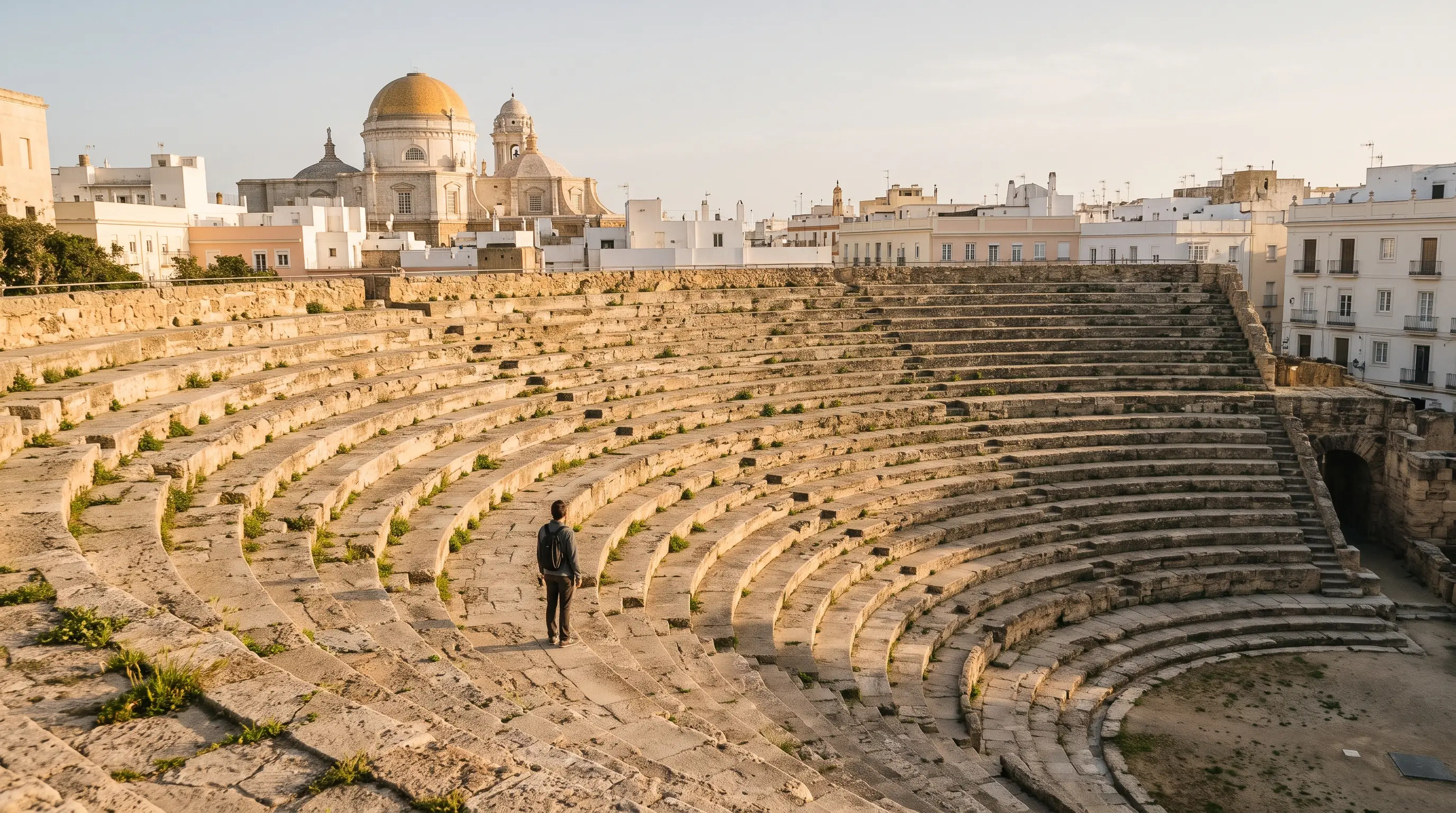
The stone that survives in Cádiz belongs to his nephew and namesake. Balbus the Younger had the Roman Theatre built in the 1st century BCE, the Theatrum Balbi,[11] and its diameter of almost 120 metres makes it the oldest Roman theatre on the Iberian Peninsula and the second largest.[12] The cathedral's Casa de la Contaduría stands on part of its cavea.[13]
Columela grew up in the same Gades. He was born there and spent his early years with his paternal uncle Marco Columela,[14][15] then served as a tribune in Syria and farmed estates in Latium[16] before writing De re rustica, twelve volumes that survive complete.[17] Book 10, on gardens, is composed in hexameter verse as a homage to Virgil,[18] and the full text resurfaced among the books that Poggio Bracciolini found in monastery libraries.[19] A monument to him stands in the city,[20] and the theatre above is the nearest stone to the Gades he knew.
The eighteenth century: a botanist and a soldier-writer
José Celestino Mutis was born in Cádiz in 1732 and trained at the Colegio de Cirugía of his home city.[21] That was the Real Colegio de Cirugía de la Armada, founded in 1748 by the naval surgeons Juan Lacomba and Pedro Virgili,[22] and its student registers carry several entries under his name.[23] He sailed for America in September 1760 as physician to the viceroy and reached Santafé de Bogotá in February 1761.[24] In 1783 he was named director of the Royal Botanical Expedition of New Granada,[25] which gathered 5,393 plates of the region's plants.[26] Alexander von Humboldt stayed with him for two months in 1801 and admired his botanical collection.[27] Much of the work stayed unpublished, so Mutis is remembered less as a discoverer than as a promoter of science.
The building where he studied did not survive. The college Virgili opened in 1750 was demolished in the second half of the twentieth century, and the faculty that grew from it has used its present premises since October 1972.[28] What the city kept is a street with his name.[29]
5,393
José Cadalso took a different road. Born in Cádiz in 1741, the son of a rich merchant,[30][31] he became a career soldier and a writer who belonged to the circle that met at the Fonda de San Sebastián in Madrid.[32] His satire Los eruditos a la violeta mocked superficial learning,[33] and his Cartas marruecas stages a fictitious exchange of letters between two Moroccans and a Spaniard and appeared in instalments in 1789 before its book edition in 1793,[34][35] while Noches lúgubres is the work he is best known for.[36] He was promoted to colonel shortly before his death at the siege of Gibraltar.[37]
His tomb is in the church of Santa María la Coronada in San Roque, where the town honours it every year.[38] No monument or plaque to him in Cádiz is documented, so the old town is the only setting left to visit for the port he came from.
Liberal Cádiz: a prime minister and an anarchist mayor
Juan Álvarez Mendizábal was born in 1790 into a household of Cádiz merchants.[39][40] He made his name in finance rather than ideology: in 1820 his main part in Riego's pronunciamiento was to pay for it, and in 1823 he and the Bertrán de Lis house financed the move of the court and the Cortes from Madrid to Cádiz.[41][42] When Cádiz finally surrendered, he went into exile.[43] As finance minister and prime minister in 1835 and 1836 he is tied to the disentailment, the sale of Church property that led to the disappearance of numerous convents and monasteries.[44][45] He came back to Spain in 1847 and sat in the Cortes until his death in 1853.[46]
The city kept one visible result. The Museo de Cádiz began with fine-arts holdings from the Mendizábal disentailment of 1835, joined by deposits from the city's Academy of Fine Arts.[2] It has stood on Plaza de Mina since 1935.[47]
Fermín Salvochea was born in the Plaza de las Viudas in 1842.[48] Sent abroad as a boy to learn trade, he spent five years between London and Liverpool.[49] Appointed mayor in March 1873, he expropriated Church property and banned religious teaching.[50] When the Cantón de Cádiz capitulated to General Pavía's troops he was tried in Seville and sentenced to life,[51] and in 1890 he organised the city's first 1 May celebration.[52] Despite the offices he held, he lived close to destitution.[53] About 50,000 people are said to have attended his funeral in a downpour.[54]
His is the easiest trail of the nine to walk. The city marked eight points, among them the Plaza de las Viudas,[55] and a plaque at the former Cárcel Real on the Paseo del Vendaval, now the Casa de Iberoamérica, recalls where he was held.[56] In December 1868 he had been shut in the fortress of Santa Catalina,[57] and his grave is in the Cementerio de San José.[58]
Falla and Pemán: two friends in one crypt
Manuel de Falla was born on the Plaza de Mina in 1876, and a plaque there recalls the house.[59][60] As a teenager he founded two magazines in the city, El Cascabel and El Burlón.[61] After a concert at the Museo de Cádiz at 17, where he heard orchestral works by Beethoven and Grieg, music became his vocation.[62] He grew into Spain's most important composer of the 20th century,[63] gave his last twenty years almost entirely to the unfinished oratorio Atlántida.[64] He moved to Argentina in 1939 and died there in 1946.[65] His remains came home and were buried in the cathedral crypt with the authorisation of Pius XII.[66] The city's main theatre, the Gran Teatro Falla, has carried his name since 1926.[67]
Recommended tours
Tours are selected for quality, not commission. We earn a small fee if you book, at no extra cost to you.
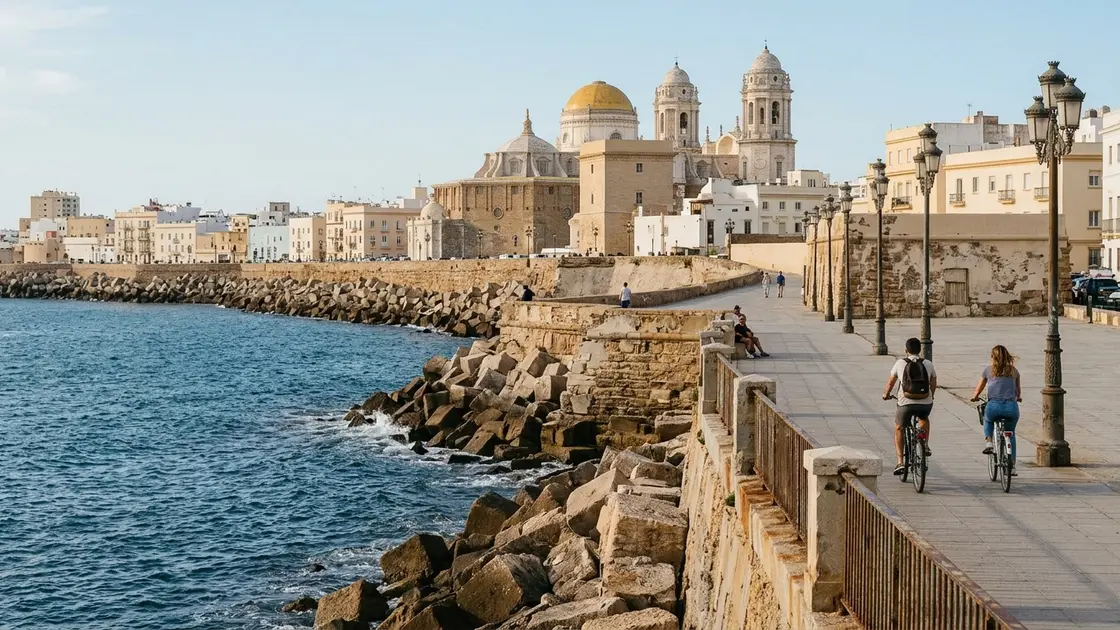
He lies beside his friend and fellow townsman José María Pemán.[68] Pemán was born in Cádiz in 1897,[69] a poet, a successful playwright[70] and a prolific columnist whose column "Nieva en Cádiz" won the 1935 Premio Mariano de Cavia.[71] His marble tomb in the crypt has bronze balusters holding a Golden Fleece.[72] A visit to Cádiz Cathedral takes in both graves.
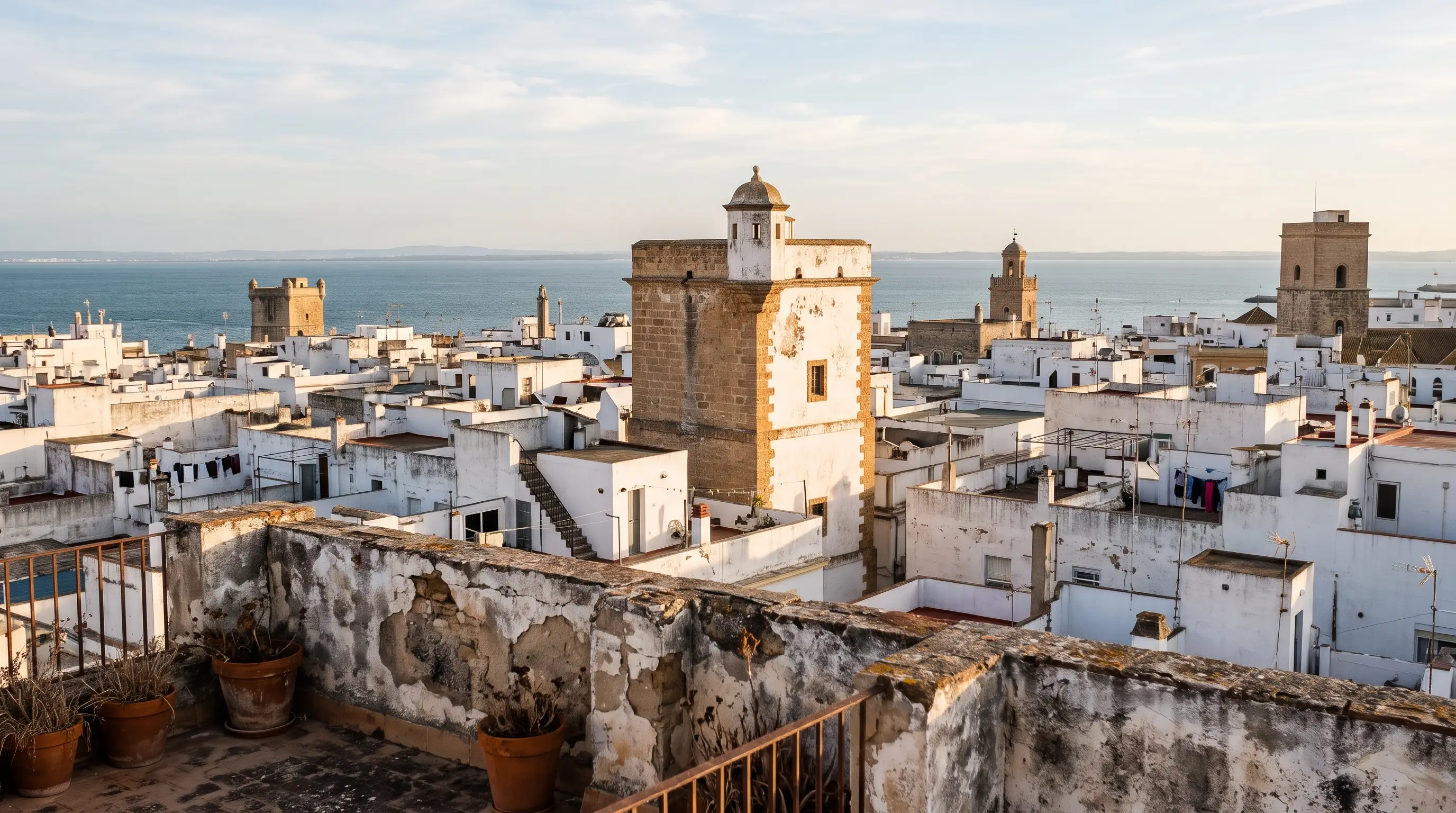
Deep dive · Article
Cádiz and the Atlantic Trade: When One Port Held the Indies
How Cádiz won Spain's monopoly on trade with America in 1717, grew rich on it and shaped two Gaditanos: the writer José Cadalso and the phy…
Pemán's public record is contested. The Real Academia Española, which he directed twice, records that he was politically active under Alfonso XIII, the Republic, the Civil War and Francoism,[73] and the city council removed the bust at his birth house in 2020 under the Historical Memory Law.[74] Visitors can still see the house-museum on the Plaza de San Antonio that carries his name.[75]
Enrique el Mellizo: the voice that never left
Enrique el Mellizo was born Enrique Jiménez Fernández in Cádiz in 1848.[76] He worked at the municipal slaughterhouse, a trade inherited from his father,[77] yet singers from the rest of Andalusia and Spain came to Cádiz to seek him out.[78] He sang in cafés cantantes such as La Jardinera, El Perejil and La Filipina,[79] and he never went into a recording studio, so his cantes survived through the singers who learned them.[80] He is credited with three styles of soleá, and his cantes include siguiriyas, malagueñas, alegrías, tientos and saetas;[81][82] the attribution of the tientos is contested.[83]
He was baptised in the parish of Santa Cruz, the Old Cathedral,[84] which was closed on 6 January 2026 because of the building's poor condition.[85] A bronze bust of him stands on calle Santa María, in the Santa María quarter,[86] and the Gran Teatro Falla held a gala for the centenary of his death on 24 May 2006.[87] He was buried the day after he died, in the Cádiz cemetery, before a vast crowd.[88] The city gave him a funeral with the highest honours.[89]
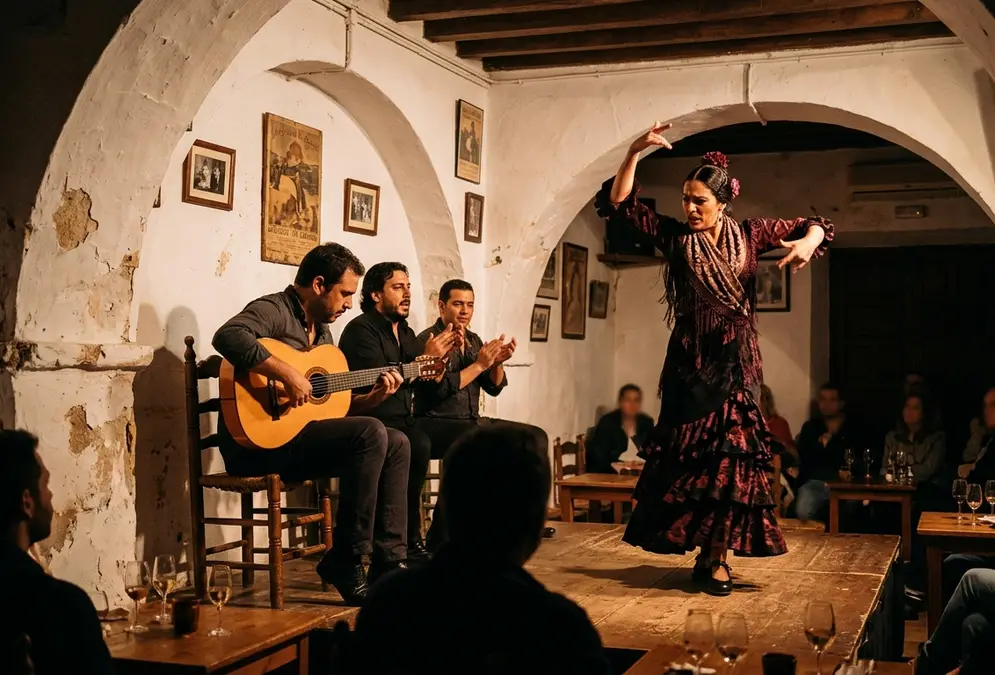
Don't miss · Activity
Flamenco Show in Cádiz
Where to see live flamenco in Cádiz: the 60-minute La Cava tavern show, plus the peñas and the municipal flamenco centre in Santa María. Ch…
Where each name lives in the city today
The nine fit on one short route, and each has a single place to start from:
- Balbus: the Roman Theatre that his nephew built.[11]
- Columela: the same theatre, as the nearest stone to his Gades, and the statue.[20]
- Mutis: the street named for him, since the college where he studied was demolished.[28]
- Cadalso: his tomb in Santa María la Coronada, in San Roque.[38]
- Mendizábal: the Museo de Cádiz on Plaza de Mina.[2]
- Salvochea: the Plaza de las Viudas and the eight-point route.[55]
- Falla: the plaque on Plaza de Mina and the cathedral crypt.[60]
- Pemán: the house-museum on the Plaza de San Antonio and the crypt tomb.[75]
- El Mellizo: the bronze bust in Santa María.[86]
Taken in that order, the walk runs from the Roman theatre and the cathedral through Plaza de San Antonio to Plaza de Mina, where the plaque and the museum share a square.[47] Allow a full day if you want to add the Cementerio de San José for Salvochea, and a second one if San Roque for Cadalso is on the list. Of the nine, only Cadalso needs a leap of imagination; the other eight each leave a place or marker you can find.