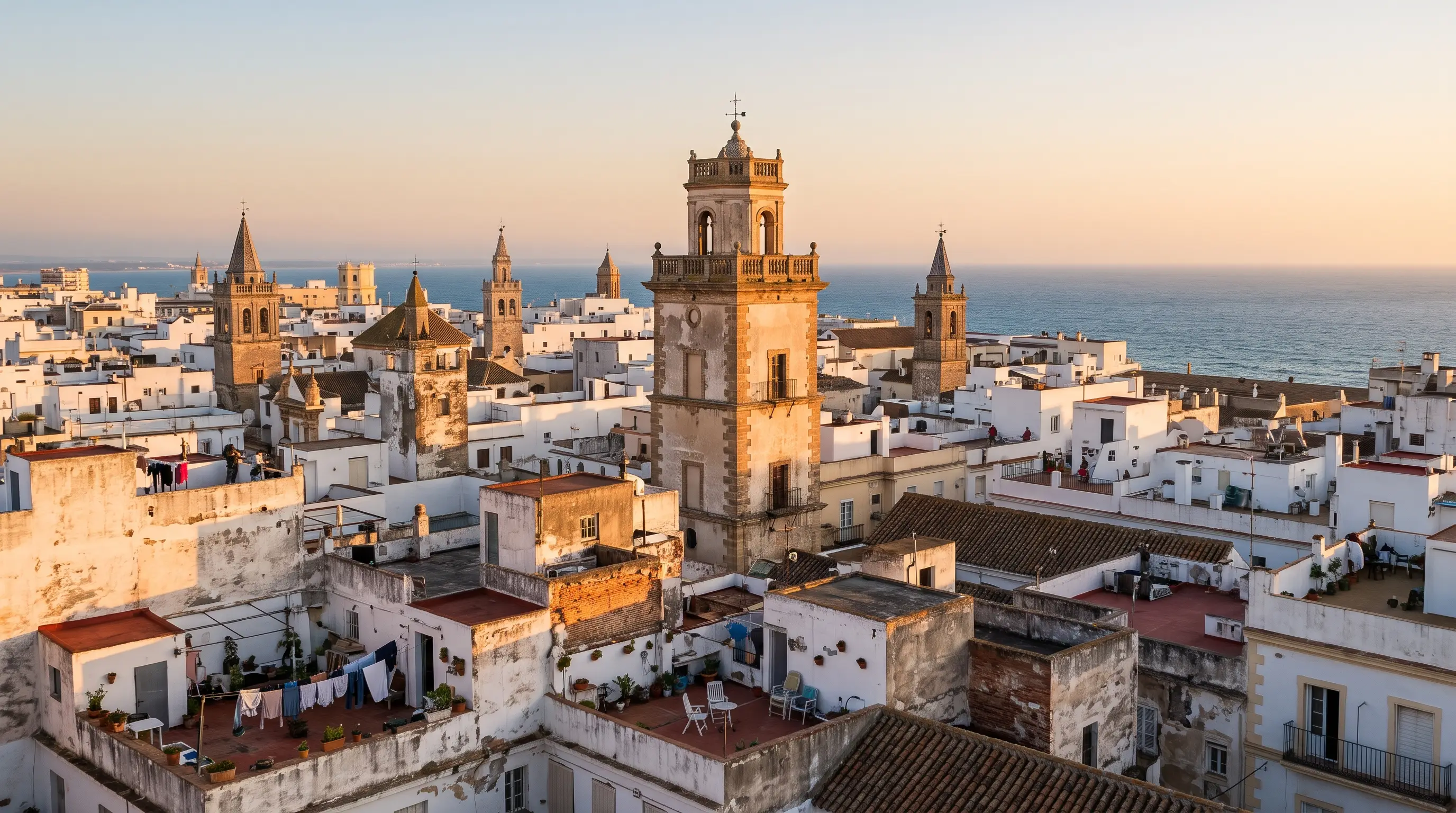

Why 18th-century Cádiz built a skyline of merchant watchtowers
Trade built this skyline. In 1717, King Philip V decided to transfer the Casa de la Contratación from Seville down to the deep-water bay of Cádiz, launching the city's eighteenth-century economic golden age.[1] As commercial relations expanded, a prosperous local mercantile bourgeoisie rose inside the narrow peninsula, attracting international traders such as the Syrian merchant Juan Clat Fragela to establish their counting houses in the city.[2][4][9]
Wealth on that scale brought immediate danger. Because the port's surging commercial prosperity attracted frequent pirate raids, the city fortified its perimeter by constructing defensive bastions, coastal castles, and rooftop torres de vigía on its flat roof terraces (azoteas).[3] At the same time, the expanding urban fabric remained protected at every moment by a defensive wall system that later served as an architectural example for military fortifications across the Americas.[4]
Information meant money. For a trading house in Cádiz and the Atlantic trade, sighting an incoming sail first carried an immediate commercial advantage. A merchant climbing into his rooftop turret with a spyglass could scan the ocean horizon from the top of the staircase before ships entered the inner bay.[2][11] From that eighteenth-century era of wealthy merchants and luxurious residences, more than one hundred rooftop lookout towers (torres mirador) still survive across the historic centre today.[2]
Deep dive · Article
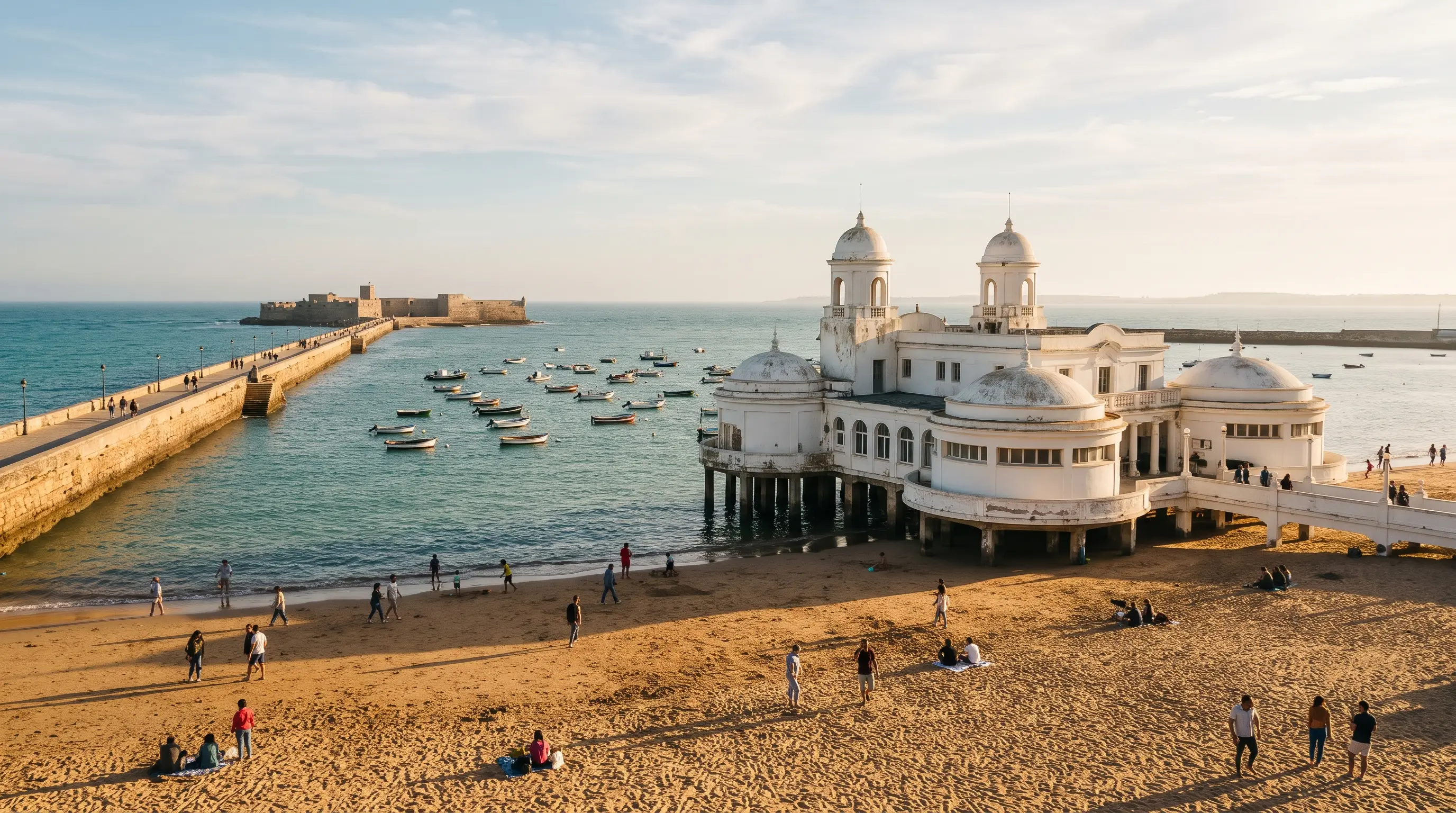
Movies Filmed in Cádiz: How La Caleta Became James Bond's Havana
See where James Bond's Die Another Day, Sean Connery's Cuba, Viggo Mortensen's Alatriste, and Tom Cruise's Knight and Day were filmed acros…
How the towers worked: garitas, telescope seats, and belvederes
Every Cádiz merchant palace was engineered from the ground up as a vertical residence and observation post. Historic houses across the old city preserve architectural features such as monumental or imperial staircases, central courtyard patios with cistern wells (pozos), glazed galleries, and a rooftop torre mirador overlooking the tiled and whitewashed roofs of the city.[19][20] Rising above the upper cornice, the rooftop turret gave the house owner an unobstructed sweep toward the sea.
Different centuries favoured distinct tower silhouettes. Among the oldest surviving examples in the area are the two torri-belvedere (belvedere towers) crowning the three-bodied Casa del Almirante in El Pópulo, where a monumental portal crafted from reddish marbles of varying tones imported from Genoa announces the family's prestige at street level.[16][17] During the eighteenth century, builders frequently adopted the compact torre de garita (sentry-box tower), built on a square or polygonal plan rising from the corner of the house.[10][15]
Step inside one and the geometry is ingenious. In the corner towers of the Casa de las Cuatro Torres, the horizon is visible directly from the staircase itself, which continues up through the interior of the sentry turret (garita) and ends at a built-in seat (sillín), where the owner inserted a telescope through small circular spyholes (óculos) to scan the sea.[11] On the neighbouring Casa de las Cinco Torres, erected around 1771 in a Baroque style transitioning to Neoclassicism, all of the rooftop watchtowers follow the square garita plan except for house number 5-D, which has a polygonal plan.[14][15]
Key structural features of Cádiz merchant towers
- Torri-belvedere (belvedere towers): Early rooftop belvedere turrets crowning the three structural bodies of the historic Casa del Almirante, considered among the oldest conserved watchtowers in the area.[16]
- Torres de garita (sentry-box turrets): Square-plan lookout towers of the garita type—alongside the polygonal exception at house number 5-D on Casa de las Cinco Torres—rising above eighteenth-century merchant blocks.[10][11][15]
- Sillín and óculos: The interior staircase extending inside a garita turret terminates at a small seat (sillín) where the house owner aimed a telescope through small circular portholes (óculos) toward the horizon.[11]
- Mirador terraces: Multi-storey watchtowers, led by the five-floor Torre Tavira, that combine interior exhibition halls with an open-air rooftop viewing deck (mirador) at the summit.[7]
Torre Tavira: the official 1778 signal tower of the port of Cádiz
Height decided the port's official lookout. Standing in the heart of the old city, Torre Tavira is the tallest watchtower in historic Cádiz, rising approximately 33 metres above the ground and 45 metres above sea level.[5] Across the entire old town, it is the second-highest point of elevation, surpassed only by the bell towers of Cádiz Cathedral at roughly 58 metres above sea level.[5]
Because it held the highest watchtower elevation in the city, maritime authorities designated it the official watchtower of the port of Cádiz in 1778.[6] The tower takes its enduring name from its first official lookout, frigate lieutenant (teniente de fragata) Antonio Tavira, who scanned the bay and Atlantic approaches from its summit.[6] Since March 2005, under Decree 95/2005, Torre Tavira has held official protection as a Bien de Interés Cultural (BIC) in the monument category, and it welcomes more than 100,000 visitors every year.[8]
Don't miss · Monument
Torre Tavira
Torre Tavira is Cádiz's 1778 watchtower, 45 m above sea level, with Spain's first camera obscura. Tickets are €8; allow 45 minutes and arri…
Inside, the climb is brisk and vertical. Structurally, Torre Tavira is divided into five floors housing two exhibition halls and an open-air rooftop viewpoint (mirador) at the top.[7] Stepping out onto that upper deck places you 45 metres above the water, revealing how closely packed the more than one hundred surviving merchant lookout turrets stand across the whitewashed roofs below.[2][5][7]
Casa de las Cuatro Torres and Cinco Torres on the harbour front
Nowhere is the concentration of merchant lookouts more striking than in the San Carlos area facing the harbour. Between 1736 and 1745, the Syrian merchant Juan Clat Fragela, who had established himself in Cádiz, promoted the construction of the monumental Casa de las Cuatro Torres.[9] Its architectural design is famous for the singularity of raising a watchtower at each of the building's four corners, where internal staircases climb into the garitas to the telescope seats (sillines) and circular óculos at the top.[10][11]
Recommended tours
Tours are selected for quality, not commission. We earn a small fee if you book, at no extra cost to you.
Look up at the upper walls and cornices. There you can still trace the building's original eighteenth-century polychromy.[12] Decorative architectural motifs tie the four corner towers to the cornices, and the property divisions between the estates are marked with intricate geometric strapwork drawings (lacería) painted in deep red ochre (almagra roja) that repeat across other elements of the structure.[12] In recognition of its historic and artistic value, the Casa de las Cuatro Torres was declared a monument under Decree 1004/1976 of 2 April 1976.[13]
Right next door stands its late-Baroque neighbour on Plaza de España. Constructed around 1771, the Casa de las Cinco Torres consists of five separate houses raised across a single large city block in a Baroque style transitioning toward Neoclassicism.[14] All of its watchtowers are built on a square plan of the garita type except for house number 5-D, which rises on a polygonal plan, completing an ensemble of nine closely spaced eighteenth-century turrets across the two adjacent blocks.[10][14][15]
| Landmark | Date / Period | Key Architectural Feature | Watchtower Type |
|---|---|---|---|
| Casa del Almirante | Historic Cargadores era | Three-bodied palace with monumental portal of Genoese reddish marbles[16][17] | Two early torri-belvedere among the oldest conserved in the area[16] |
| Casa de las Cuatro Torres | 1736–1745 | Promoted by Syrian merchant Juan Clat Fragela; red almagra lacería polychromy[9][12] | Four corner garita towers with internal sillín seats and óculos[10][11] |
| Casa de las Cinco Torres | c. 1771 | Five separate houses on a large block in Baroque-to-Neoclassical style[14] | Four square garita towers plus one polygonal tower at house 5-D[15] |
| Torre Tavira | Official port tower 1778 | Five floors with two exhibition halls and rooftop mirador; BIC monument (2005)[7][8] | Tallest watchtower in old Cádiz (33 m above ground, 45 m above sea level)[5] |
Where to see and climb Cádiz's watchtowers today
Most of the more than one hundred surviving watchtowers crown private buildings across the old city.[2] Only a select handful can be entered directly, while others are best appreciated from street level, museum scale models, or neighbouring rooftop terraces.[2][18][21] Start at the Museo de las Cortes de Cádiz in the historic centre.[18] One of its finest pieces is the monumental 1777 scale model of Cádiz (maqueta de la ciudad de Cádiz), crafted in mahogany and ivory by military engineer Alfonso Jiménez at the request of King Charles III, which documents the eighteenth-century walled city and its rooftop towers in miniature.[18]
From the museum, you can trace the finest surviving examples on foot or stay inside restored historic buildings that preserve their original lookout towers:
Essential stops on a self-guided watchtower route
- Torre Tavira: Climb the five-floor official 1778 port watchtower (named after frigate lieutenant Antonio Tavira) to visit its two exhibition halls and look out from its 45-metre-high rooftop mirador.[5][6][7]
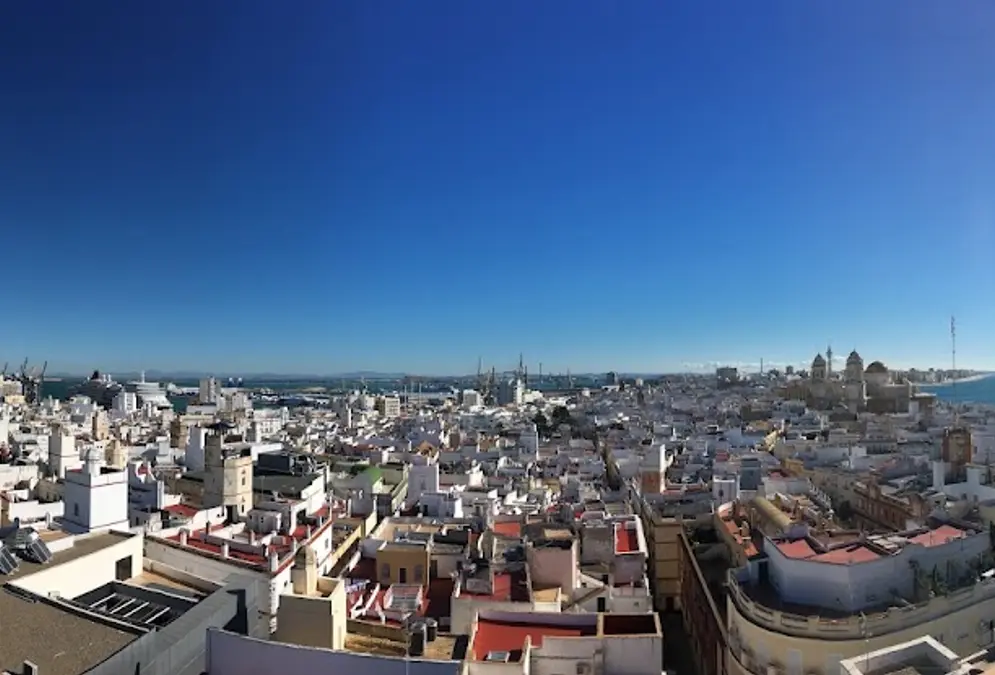
- Bella Escondida from Mirador Las Cortes: Head up to the rooftop terrace at Mirador Las Cortes (Hotel Las Cortes de Cádiz) for a 360-degree sunset panorama with direct views toward the Bella Escondida watchtower, Torre Tavira, the Port of Cádiz, and the 1812 Constitution Bridge.[21]
- Casa de las Cuatro Torres and Casa de las Cinco Torres: Admire the four corner garita towers and red-ochre lacería polychromy of Juan Clat Fragela's 1736–1745 monument (Decree 1004/1976) alongside the five circa-1771 houses next door.[9][10][12][13][14]
- Casa del Almirante: Inspect the monumental portal carved in reddish marbles of different tones imported from Genoa and look up at the two torri-belvedere crowning its three bodies, considered among the oldest conserved watchtowers in the zone.[16][17]
- Historic palace accommodations with preserved towers: Both the Baroque-Isabelline Hotel Áurea Casa Palacio Sagasta (preserving its monumental staircase, central patio, and rooftop torre mirador overlooking the city roofs) and the Apartamentos Tandem Palacio Veedor de Galeras Suites (preserving its imperial staircases, torre-mirador, cistern well, and glazed gallery with reduced-mobility accessibility) allow guests to stay inside historic towered residences.[19][20]