Three Millennia Beneath the Pavement: Gadir and Gades

1. Europe's oldest continuously inhabited western city still preserves 9th-century BCE streets under a puppet theatre. Classical tradition places the founding of Cádiz around 1104 BCE, when Phoenician merchants from Tyre established a settlement they named Gadir ((ʾ)gdr), meaning a walled enclosure or fortress[1]. Beneath the Teatro del Títere La Tía Norica on Calle San Miguel, the Yacimiento Arqueológico Gadir exposes the clay-paved streets and mud-and-clay walls of eight Phoenician houses arranged across two terraces from the 9th century BCE, centred on the story of Mattan, a Phoenician resident who perished in a great 6th-century BCE fire[2].
Timeline
  1. 9th century BCE

    Phoenician houses at Gadir

    Eight clay-paved dwellings built on two terraces beneath modern Calle San Miguel.

  2. 40 BCE

    Balbus becomes Roman consul

    Gades native Lucius Cornelius Balbus is the first naturalised foreigner to hold the consulship.

  3. 1887

    Male sarcophagus unearthed

    Found at Punta de la Vaca, founding the archaeological collection of the Museo de Cádiz.

  4. 26 Sep 1980

    Dama de Cádiz discovered

    Second anthropoid marble coffin uncovered during building works on Calle Ruiz de Alda.

  5. 2020

    Osteological twist confirmed

    University of Cádiz researchers prove the skeleton in the female sarcophagus was a man aged 45 to 50.

2. Two Phoenician sarcophagi found 93 years apart, and a 2020 skeleton twist

Only two carved marble anthropoid sarcophagi of this type have ever been discovered in Spain, and both came out of the subsoil of Cádiz. On 30 May 1887, workers at the necropolis of Punta de la Vaca accidentally uncovered the bearded male anthropoid sarcophagus, a find that prompted the creation of the archaeological section of the Museo de Cádiz on Plaza de Mina[3]. The museum's later director, Pelayo Quintero Atauri, spent decades arguing that a female companion piece lay buried nearby, yet died without finding it[3]. On 26 September 1980, mechanical diggers excavating foundations on Calle Ruiz de Alda, right beneath a palm tree at Quintero's former home, struck the 5th-century BCE marble Dama de Cádiz[4]. Four decades later, in 2020, osteological researchers from the University of Cádiz examined the bones inside that female-carved coffin and proved beyond doubt that the skeleton belonged to a robust man aged 45 to 50[5].

3. Five hundred Roman knights and a 120-metre theatre under El Pópulo

Under Augustus, the port of Gades grew so prosperous on salted fish and Atlantic shipping that the geographer Strabo noted 500 citizens of the equestrian order in a single census, a concentration of wealthy Roman knights matched outside Rome only by Patavium (Padua)[6]. Foremost among its patrician families was Lucius Cornelius Balbus the Elder, born in Gades around 100 BCE, who served as Julius Caesar's trusted confidant and in 40 BCE became the first foreign-born naturalised citizen ever elected Roman consul[7]. The family financed the Roman Theatre of Cádiz in the 1st century BCE; rediscovered in 1980, its 120-metre diameter makes it the oldest known Roman theatre in the Iberian Peninsula and the second largest[8]. Only the semicircular seating (cavea) and vaulted galleries have been uncovered, while the monumental stage and rear portico still rest directly under the inhabited apartments and medieval alleys of El Pópulo[9].

Rooftop Watchtowers, Merchant Loopholes and Curved Balconies
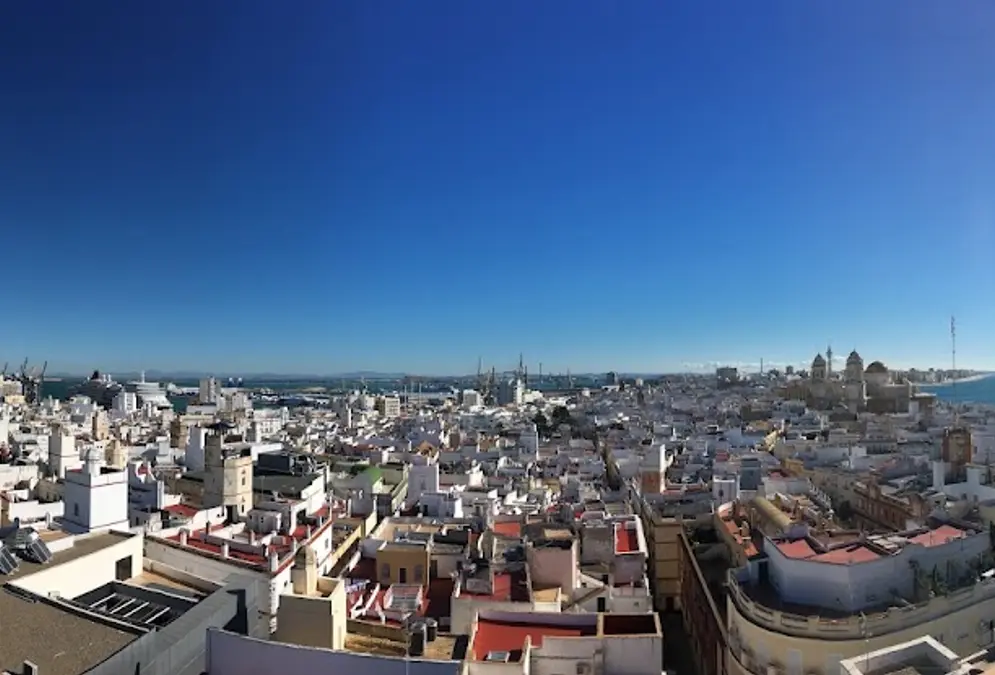
4. A 1717 trade monopoly raised 134 watchtowers across the Old Town skyline. When King Philip V transferred the Casa de la Contratación and the Consulado de Cargadores from Seville to Cádiz in 1717, the city became the official commercial and financial headquarters of the Carrera de Indias[10]. International merchant families moved their counting houses to the bay, storing silver bullion, cocoa, cochineal, and colonial cargo on the ground floors of their courtyard palaces while living on the noble main floors above. To gain an early market advantage, shippers built rooftop lookout towers (torres miradores) equipped with signal flags and spyglasses to spot their fleets on the Atlantic horizon hours before the vessels anchored. Over a hundred of these towers still crown the old town in terraced, turret, and battlemented styles. In 1778, naval authorities named Torre Tavira the port's official watchtower because its summit stands at the highest point of the historic centre, 45 metres above sea level, where Spain's first camera obscura now projects live moving views of the bay and rooftops[11].
Torre Tavira watchtower rising above the rooftops and azoteas of Cádiz's old town, with the Atlantic beyond

Don't miss · Monument

Torre Tavira

Torre Tavira is Cádiz's 1778 watchtower, 45 m above sea level, with Spain's first camera obscura. Tickets are €8; allow 45 minutes and arri…

5. A Syrian merchant built four houses in one block just to circumvent a one-tower law. Eighteenth-century municipal building ordinances strictly forbade any residential palace from erecting more than a single lookout tower. When the Syrian-born merchant Juan Fragela planned his property overlooking Plaza de España between 1736 and 1745, he bypassed the municipal cap with legal precision: he constructed four independent adjoining houses inside a single unified building block, allowing him to crown each corner with its own tall turret and create the landmark Casa de las Cuatro Torres[12].
6. Old Town corners are armoured with iron cannons and balconies are bent for crinoline skirts. A slow walk through the merchant streets around Calle Sagasta and Calle Ancha reveals how 18th-century builders adapted every facade to port traffic and fashion:
  • Piedra ostionera: Palaces and sea walls were cut from porous local marine oyster-shell stone, whose encrusted fossils still show in doorways and bastions.
  • Guardacantones: Street corners were reinforced with stone bollards or upright cast-iron cannons to stop heavy iron-rimmed carriage wheels from chipping the house angles.
  • Crinoline railings: On mansions such as the Casa Palacio Sagasta, the lower bars of the wrought-iron balconies curve outward in a rounded belly so ladies wearing wide crinolines or miriñaques could step out to watch street processions without crushing their skirts[13].

Sieges, Tsunamis and the Ramparts That Saved the City Twice

7. Besieged deputies gave Spain its first liberal constitution on Saint Joseph's Day, and locals mocked French super-mortars in song. Between February 1810 and August 1812, French armies blockaded the peninsula from across the bay while deputies from Spain and the Americas assembled inside the oval baroque Oratorio de San Felipe Neri. They promulgated Spain's first liberal charter on 19 March 1812, the feast of Saint Joseph (San José), which is why citizens immediately christened the constitution La Pepa[14]. Outside, French gunners on the Trocadero peninsula cast experimental Villantroys Grand Mortars heavy enough to hurl shells up to 5 kilometres (3 miles) into the streets, artillery so massive that the retreating French had to abandon the barrels in place[15]. Gaditanos answered the bombardment with a mocking street verse claiming local women used French shell fragments to curl their ringlets.
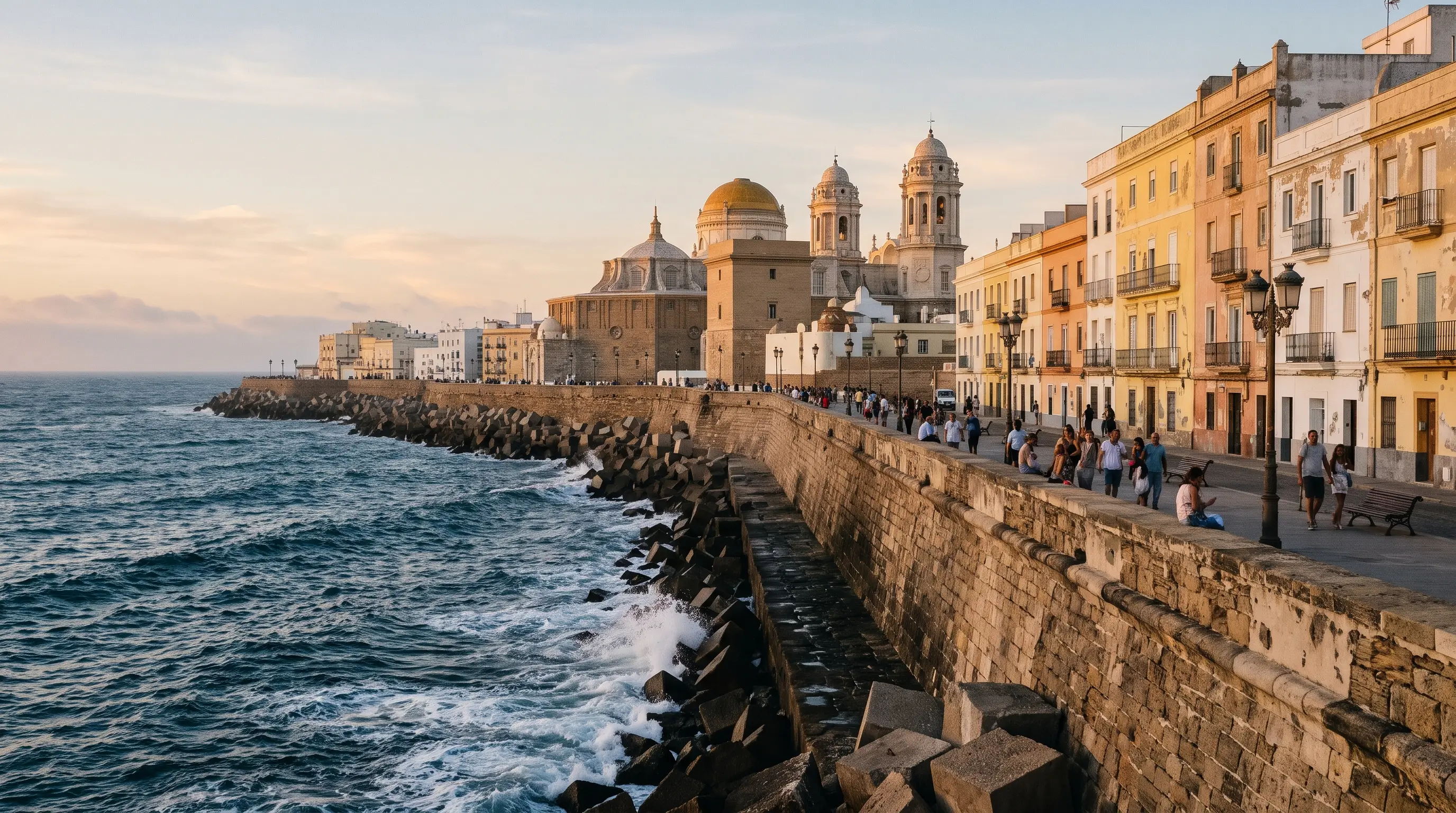
8. The 1755 Lisbon tsunami destroyed the causeway to San Fernando and a parish banner met the flood in La Viña. At 10:00 am on 1 November 1755, the Great Lisbon Earthquake shook Cádiz for five minutes, and at 11:10 am the first of five giant tsunami waves slammed into the Atlantic walls, tearing out 300 varas of stone parapet at La Caleta and completely destroying the Arrecife causeway linking Cádiz to the Isla de León (modern San Fernando)[16]. Inside the bastions, Governor Antonio de Azlor ordered the massive doors of the Puerta de Tierra closed against the surge, while in the low-lying fishing quarter of La Viña, the parish priest of Nuestra Señora de la Palma stepped into the flooded street with the Virgin's banner crying '¡Hasta aquí, Madre mía, y no más!' at the spot where the waters receded[17].
9. Those same Puerta de Tierra ramparts deflected a 1947 naval mine explosion that devastated Extramuros. At 21:45 on 18 August 1947, stacked submarine mines stored at the Base de Defensas Submarinas in San Severiano detonated in the warm night air. Official figures recorded in 1948 counted 152 dead (five of them unidentified), 350 seriously injured, and 5,000 residents affected across the shattered shipyards, orphanage, and villas outside the walls[18]. While the blast flattened the surrounding districts, the 21-metre-high stone curtain of Puerta de Tierra acted as a physical shield that deflected the primary shockwave upward and spared the dense historic core inside.

Sub-Sea Crypts, Tirillas vs Beduinos and Havana on the Atlantic
10. Cádiz Cathedral took 116 years to finish and hides a circular crypt built below sea level. Begun in 1722 during the height of the Americas trade boom and consecrated only in 1838, Cádiz Cathedral required 116 years to complete — long enough for its lower Baroque storeys in Genoese marble and oyster stone to give way to Neoclassical towers and a yellow glazed-tile dome[19]. Directly underneath the high altar, original architect Vicente Acero engineered a flat-vaulted circular crypt below sea level, where the ocean booms faintly against the outer seawall and where Cádiz-born composer Manuel de Falla and writer José María Pemán lie buried side by side[20].
11. Two-thirds of the municipality cannot be built on, splitting locals into 'tirillas' and 'beduinos'. Although the municipal boundary of Cádiz covers 12.3 square kilometres, 66.91% of that territory consists of protected salt marshes and beaches inside the Bahía de Cádiz Natural Park, leaving the entire population compressed onto just 4.4 square kilometres of urban land[21]. That tight geography produced a sharp, affectionate local vocabulary: in everyday speech, a resident born inside the old stone walls (Intramuros) is called a tirilla (after the stiff shirt-collar bands worn in the old commercial centre), whereas anyone living outside Puerta de Tierra along the sandy neck toward Cortadura (Extramuros) is teased as a beduino[22].
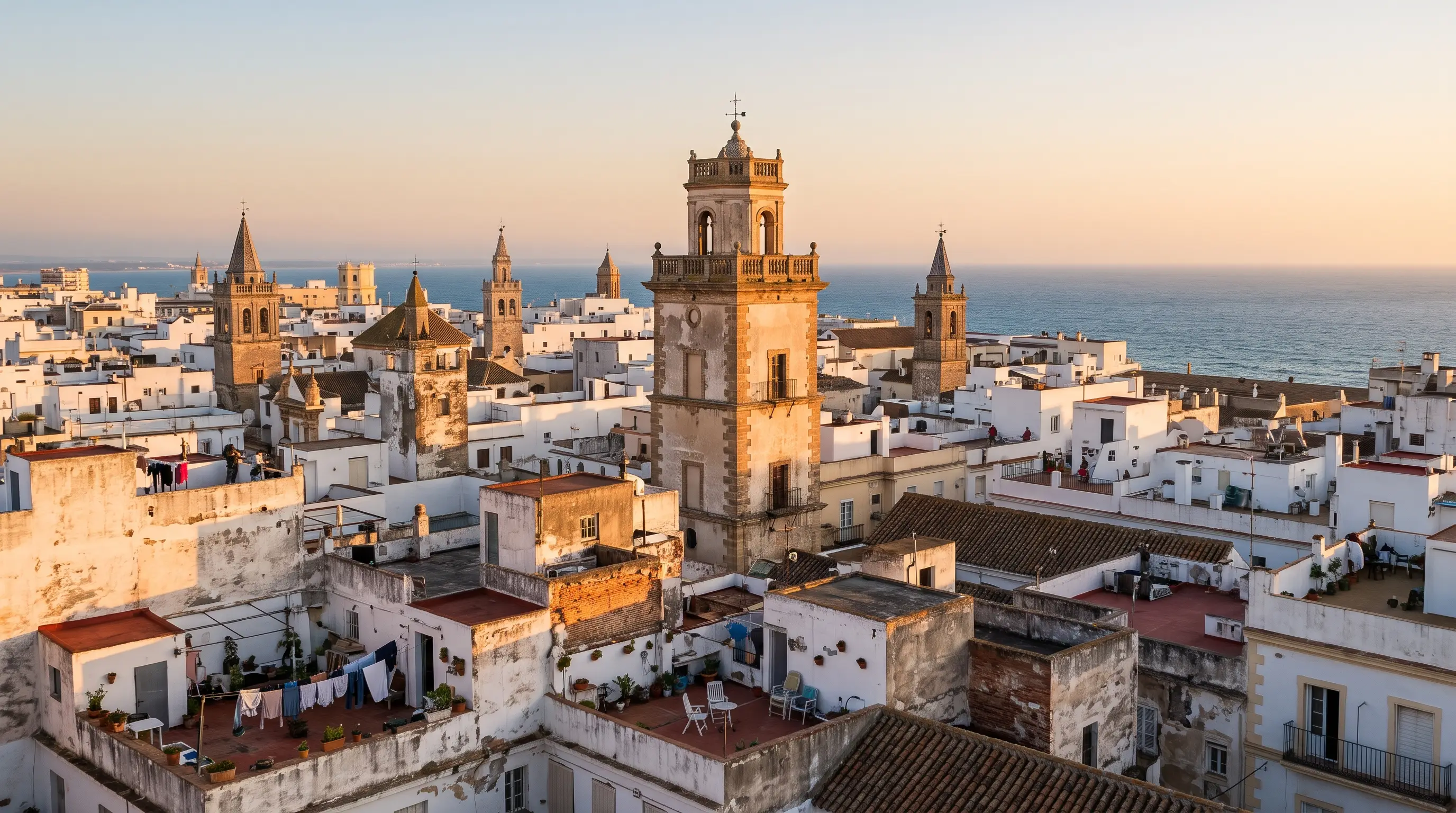
Eighteenth-century cadiz watchtowers and Torre Tavira rising above whitewashed rooftops overlooking the Atlantic

Deep dive · Article

Cádiz Watchtowers and Torre Tavira: Inside the Lookout Network

Why do more than 100 Baroque watchtowers crown the rooftops of Cádiz? Explore Torre Tavira, the 1717 Indies trade monopoly, and where to se…

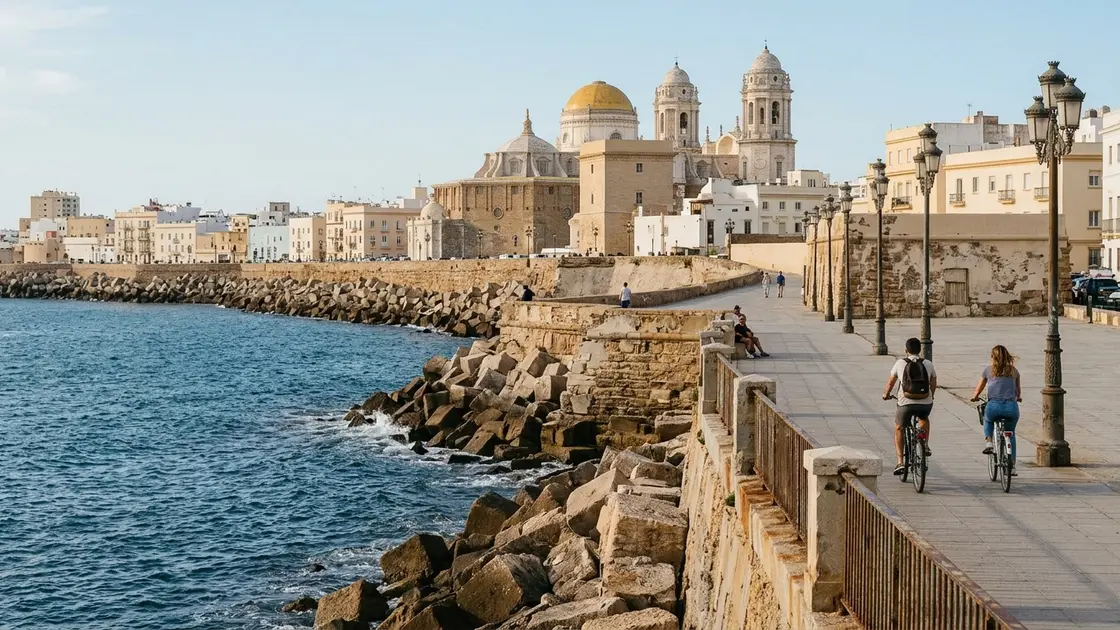
12. The Levante wind blows 165 days a year, and La Caleta doubled for Havana in James Bond. Centuries of shared trade and military engineers made Cádiz and Old Havana architectural twins across the Atlantic. When the producers of the 2002 James Bond film Die Another Day needed a Cuban setting, they filmed along La Caleta, using the twin fortresses of Castillo de San Sebastián and Castillo de Santa Catalina as the coastal clinic at Los Órganos[23]. Anyone walking that same causeway between May and August will likely meet the city's other constant companion: according to state meteorological records from AEMET, the warm easterly Levante wind funnels through the Strait of Gibraltar an average of 165 days a year, peaking across the summer months at roughly 16 days per month[24].