
food-lovershistory-buffscouples
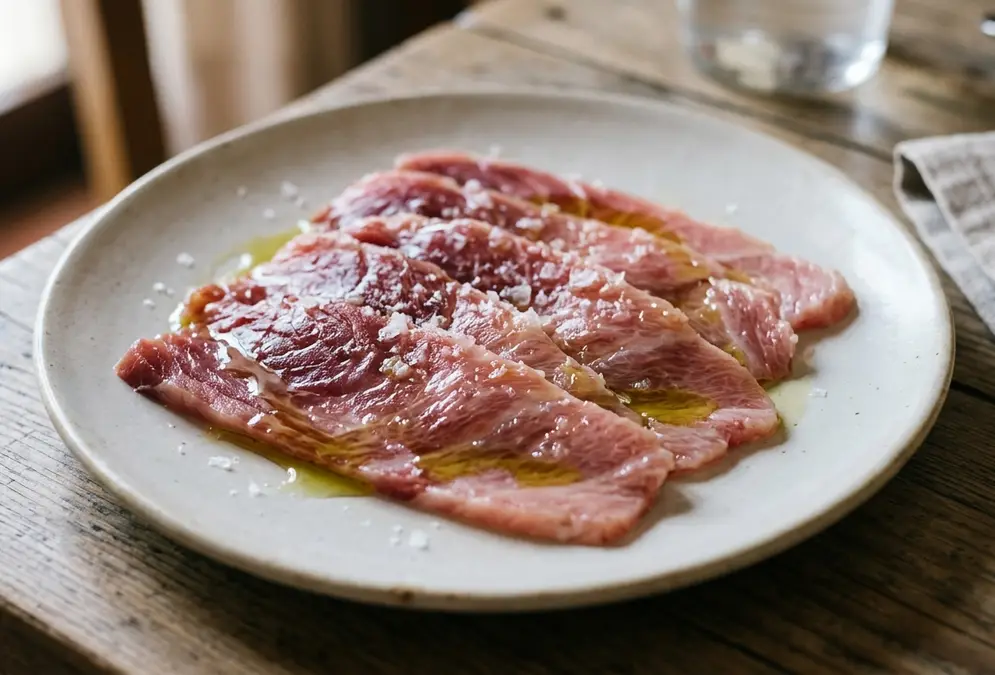
Plate of raw wild bluefin tuna from the Cádiz almadraba, sliced ventresca with olive oil and sea salt on a white plate in a Cádiz restaurant
main-course

Wild bluefin from the almadraba traps of the Cádiz coast

Wild bluefin tuna from the almadraba traps of the Cádiz coast: when the spring season peaks, which cuts to order, and where to eat it in Cádiz's La Viña.

Atún de almadraba is wild Atlantic bluefin caught in fixed traps off the Cádiz coast as the fish migrate into the Mediterranean each spring. It is the dish the province is proudest of: the official Cádiz tourism board calls almadraba tuna, alongside Jerez wine, the gastronomic icon of the province. One thing to settle before you plan a meal: the spring fairs and tuna routes are held at Conil, Barbate, Zahara de los Atunes and Tarifa, so that is where to watch the season. In the city of Cádiz the fish is something you eat, and the bay's own trap history is older than most of it.

What almadraba means

The almadraba is a maze of nets anchored to the seabed that guides the tuna into a final chamber, rather than chasing them with hooks or purse seines. Wikipedia describes it as an elaborate and ancient technique for trapping Atlantic bluefin (Thunnus thynnus). An academic study from the University of Jaén dates the art on this coast to the arrival of the Phoenicians, and the cave at Atlanterra in Zahara suggests people here knew the tuna's cycles in the Palaeolithic. ICCAT, the body that regulates Atlantic tuna, protects the technique as the most sustainable.

The Bay of Cádiz had traps of its own. An almadraba at the Sancti Petri islet is documented from the 15th century; its fishing station was promoted by Rodrigo Ponce de León, Marquis of Cádiz, passed to the Crown in 1493 and stayed active for much of the 16th and 17th centuries.

The traps were also a feudal monopoly. In 1294 King Sancho IV granted Guzmán el Bueno, founder of the House of Medina Sidonia, the privilege of setting almadrabas from the Guadiana to the coast of the Kingdom of Granada. The privileges were abolished for good by royal order on 20 February 1817.

Season and quota

Spring is the season, and May is the month the provincial tourism board names as the star month of almadraba tuna for gastronomy, although tuna cooking runs through the year. The four trap towns hold fairs and a tuna route each spring. Conil's 2025 route ran from 9 May to 9 June with 28 bars and restaurants, and Barbate's 2026 route (22 April to 3 May) offered a tapa and a drink for a promotional 6 EUR. The 2025 quota for the Cádiz almadrabas was 1,292 tonnes of bluefin. Dates and quotas change every year, so check the local route pages before you travel.

How it is cooked and cut

The traditional butchering of the tuna is called the ronqueo. In restaurants you will see the fish served raw (crudos, tartar, tataki), as encebollao, a stew with onions, and as ventresca, the belly. Morrillo appears on menus too; Casa Juanito in Zahara is known for morrillo a la sal. Order a mixed plate if you want to compare the cuts side by side.

Where to eat it in Cádiz city

The Cádiz-city venue we can confirm is El Faro de Cádiz, on calle San Félix in La Viña, open since 1964 and known for marinated tuna cubes with toasted sesame and salicornia. Check the current menu, because tuna cuts follow the catch. For a wider fish meal in the city, pair it with pescaito frito or a plate of ostiones de Cádiz. For the tuna routes themselves, take a day trip to Conil, Barbate, Zahara or Tarifa in May.

Reporter notebook

Insider tips

Best time

Aim for May

May is the month the provincial tourism board names the star month for almadraba tuna. Conil's 2025 route ran from 9 May to 9 June, so plan for the same window, but confirm each year's dates before you book.

Local custom

The tuna routes are on the coast

The spring fairs and tuna routes are at Conil, Barbate, Zahara de los Atunes and Tarifa. If you want that atmosphere, make a day trip there in spring and eat in the city for the rest of your stay. Cádiz's own almadraba story sits in the bay, at the Sancti Petri islet.

What to order

Try the marinated tuna cubes at El Faro

El Faro de Cádiz in La Viña is known for dados de atún marinados with toasted sesame and salicornia. Ask what cuts are on that day, as the menu follows the catch.

Practical information

Origin
Strait of Gibraltar coast of Cádiz; almadraba trap fishing, practised on this coast since the Phoenicians
Main ingredients
Wild Atlantic bluefin tuna, Onion (for encebollao), Sea salt (for morrillo a la sal)
Season
Spring; May is the gastronomic peak month
Allergens
fish

Frequently asked questions

When is almadraba tuna season in Cádiz?

Spring. The provincial tourism board calls May the star month of almadraba tuna for gastronomy, and the trap towns run tuna routes then: Conil's 2025 route ran from 9 May to 9 June. Exact dates change each year.

What is almadraba tuna fishing?

A fixed-trap method that guides migrating Atlantic bluefin into a final net chamber. It has been used on the Cádiz coast since the Phoenician era, and the Medina Sidonia family held the monopoly on it from 1294 until 1817.

Is almadraba bluefin tuna sustainable?

ICCAT, the international commission that regulates Atlantic tuna, protects the almadraba technique as the most sustainable. Catches are also limited by quota: the 2025 allowance for the Cádiz almadrabas was 1,292 tonnes.

What is ronqueo?

The traditional butchering of the almadraba tuna. It is the reason menus name distinct cuts such as ventresca and morrillo.

Where can I eat almadraba tuna in Cádiz city?

El Faro de Cádiz, on calle San Félix in La Viña since 1964, serves tuna dishes, including marinated tuna cubes. Check its current menu before you go, as availability follows the season.

What is the best cut of bluefin tuna, ventresca or morrillo?

It is a matter of taste. Ventresca is the belly, and morrillo is often served a la sal, as at Casa Juanito in Zahara. Ordering a mixed plate lets you compare.

Does Cádiz city have an almadraba?

The spring fairs and tuna routes are at Conil de la Frontera, Barbate, Zahara de los Atunes and Tarifa. The Bay of Cádiz has its own history: an almadraba at the Sancti Petri islet is documented from the 15th century and ran for much of the 16th and 17th. In the city, the tuna reaches the table at bars such as El Faro de Cádiz.

How much does bluefin tuna cost in a Cádiz restaurant?

Prices vary by cut and venue and change with the season, so check the menu. During Barbate's 2026 tuna route (22 April to 3 May), a tapa and drink was offered at a promotional 6 EUR.

Further reading

Sources

18 references Show
  1. Junta de Andalucía (opens in a new tab)

    “que podrían corresponder con la antigua almadraba documentada desde el siglo XV”

  2. Junta de Andalucía (opens in a new tab)

    “La chanca de la almadraba de Sancti Petri fue promovida por Rodrigo Ponce de León, marqués de Cádiz, y quedó bajo jurisdicción de la Corona a partir de 1493. Se mantuvo activa durante buena parte de los siglos XVI y XVII.”

  3. andalucia.org (opens in a new tab)

    “Zahara de los Atunes, Barbate, Conil de la Frontera y Tarifa celebran con ferias y fiestas la llegada del atún salvaje, el más rico, el más versátil, el más sabroso.”

  4. andalucia.org (opens in a new tab)

    “La Comisión Internacional para la Conservación del Atún Atlántico (ICCAT) protege la técnica de la almadraba por ser la más sostenible.”

  5. andalucia.org (opens in a new tab)

    “La Cueva de las orcas o cueva de Atlanterra de Zahara de los Atunes parece constatar que en el Paleolítico, nuestros antepasados ya conocían los ciclos del atún.”

  6. Turismo de Cádiz — Atunprovinciacadiz.pdf (opens in a new tab)

    “Las almadrabas gaditanas tienen autorización para pescar este año 1.292 toneladas de atún rojo.”

  7. Turismo de Cádiz — Atunprovinciacadiz.pdf (opens in a new tab)

    “Este es el mes estrella del atún rojo de almadraba desde el punto de vista gastronómico, pero la cultura del atún está presente en la provincia durante todo el año.”

  8. Turismo de Cádiz — Atunprovinciacadiz.pdf (opens in a new tab)

    “La XXVIII edición de la Ruta Gastronómica tendrá lugar del 9 de mayo al 9 de junio y contará con la participación de 28 bares y restaurantes del municipio.”

  9. larutadelatun.com (opens in a new tab)

    “Disfruta de una genuina y singular ruta del atún a un precio promocional de 6€ tapa y bebida”

  10. investigacion.ujaen.es (opens in a new tab)

    “an ancient fishing art used along the coast of Cadiz since the arrival of the Phoenicians”

  11. Wikipedia — Almadraba (opens in a new tab)

    “is an elaborate and ancient technique for trapping and catching Atlantic bluefin tuna (Thunnus thynnus).”

  12. Wikipedia — Almadraba (opens in a new tab)

    “Guzmán el Bueno, fundador de la Casa de Medina Sidonia, recibió del rey Sancho el Bravo en 1294 el privilegio de armar almadrabas desde el río Guadiana hasta la costa del Reino de Granada.”

  13. Wikipedia — Almadraba (opens in a new tab)

    “Los privilegios de la Casa de Medina Sidonia fueron abolidos de forma definitiva mediante la Real Orden de 20 de febrero de 1817.”

  14. Turismo de Cádiz — Gastronomia (opens in a new tab)

    “Sin duda el vino de Jerez y el atún de almadraba son los iconos gastronómicos de la provincia y también un importante referente turístico.”

  15. directoalpaladar.com (opens in a new tab)

    “En Cádiz, tiramos para La Viña, el céntrico barrio popular en cuya calle San Félix se encuentra, desde 1964, El Faro de Cádiz.”

  16. directoalpaladar.com (opens in a new tab)

    “El atún también está muy presente en su carta, con platos como sus famosos dados de atún marinados, ligeramente picantes con sésamos tostado y salicornia.”

  17. directoalpaladar.com (opens in a new tab)

    “Destacan los crudos, tan demandados en los últimos tiempos, pero también guisos como el encebollao, o la punta de ventresca y el morrillo de atún.”

  18. directoalpaladar.com (opens in a new tab)

    “su famoso morrillo a la sal o el atún encebollado.”