
food-loverscouples
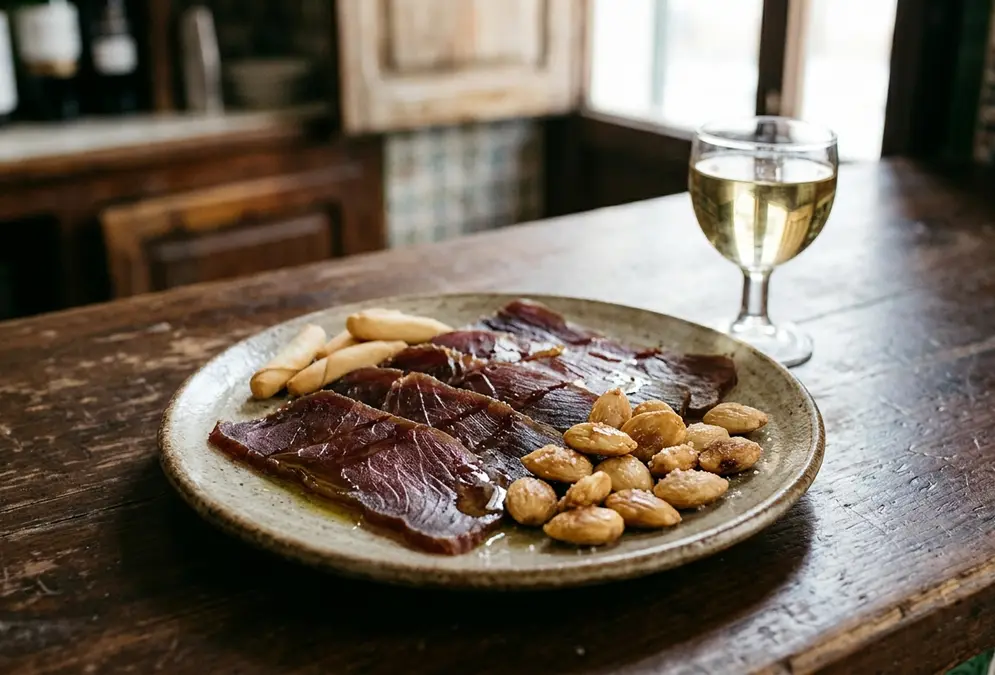
Plate of thinly sliced dark mojama, salt-cured tuna loin, with olive oil and almonds beside a glass of fino on a Cádiz tavern counter
tapa

Salt-cured tuna loin and roe, the cured side of Cádiz's tuna tradition

Mojama and huevas in Cádiz: how Barbate's salt-cured tuna loin and roe are made, how to order them as thin-sliced tapas, and how huevas aliñás differ.

Mojama is tuna loin cured in salt and dried in the air; huevas de atún are the roe of the same fish, cured the same way. Both are sliced very thin and eaten cold as tapas, and both belong to the almadraba tradition that supplies fresh atún de almadraba. Bar menus in Cádiz also carry huevas aliñás, a different dish: boiled roe, often of a fish such as hake, dressed with chopped vegetables.

Three products on one menu line

Menus group these under salazones (salted fish), and the names overlap, so it helps to know what arrives on the plate.

  • Mojama: the loin of the tuna, pressed in coarse salt for a day or two, washed, then air-dried for roughly fifteen to twenty days.
  • Hueva de atún en salazón: tuna roe, salted and air-dried for several weeks into a hard block, then cut very fine.
  • Huevas aliñás: roe that is boiled, sliced and dressed with oil, vinegar and finely chopped vegetables. It is eaten fresh, not cold, and the roe can come from a fish such as hake rather than tuna.

The first two are cured and keep; the third is a fresh tapa. If a menu simply says huevas, ask which fish and which preparation.

Mojama from Barbate

Mojama is the best-known salt-cured product of the tuna, and Barbate is the town most tied to it: salt-curing and wind-drying works sit on its breezy stretch of coast. Since the European Union registered Mojama de Barbate as a Protected Geographical Indication (IGP), the name is reserved for mojama made in Barbate and Vejer de la Frontera, both in Cádiz province, from wild tuna only.

The IGP grades the product. Extra comes from the inner part of the loin next to the spine, which is leaner. Primera comes from the neighbouring zones and carries more fat. On the plate the outside is dark brown, and a cut slice shows the grain of the loin.

Mojama is produced elsewhere too, notably in Huelva, so a label that says only "mojama" is not the Barbate product. Look for the IGP name on a package if that is what you want to buy.

How to order and eat them

Mojama is usually served in slices two to three millimetres thick with olive oil, sometimes with almonds. A dry fino or a cold beer is the classic pairing, and tuna roe goes with beer or amontillado.

Product How it arrives Pairing to ask for
Mojama Wafer-thin slices, olive oil, often almonds Fino or cold beer
Hueva de atún en salazón Fine slices of a dark, hard block Beer or amontillado
Huevas aliñás Sliced boiled roe under a chopped dressing Ask the bar

Portions and prices differ from bar to bar and change with the catch, so check the menu or ask before ordering a larger plate. These are strong, salty flavours: start with a tapa-sized portion to share.

Where to try them in Cádiz

The old town has several taverns that serve salazones. Taberna La Sorpresa lists salted fish including Barbate mojama, Gorrión Wine Bar serves mojama with warm bread, and the counter at Casa Manteca in La Viña is known for mojama as well as chicharrones. Taberna Las Banderas listed salted tuna roe among its salazones on a 2024 menu. Stock rotates, so check what each bar has that day.

For fresh tuna rather than cured, see atún de almadraba; the spring route towns around Barbate also hold a gastronomic tuna week, with dates that change each year. The fried roe that appears next to pescaíto frito is a separate dish again.

Reporter notebook

Insider tips

What to order

Ask which fish the roe comes from

Huevas on a menu can mean cured tuna roe or boiled roe from another fish such as hake. Asking takes a few seconds and tells you whether the plate is firm and salty or soft and dressed.

Local custom

Start with a shared tapa

Salazones are intense. Order a tapa-sized plate to share before committing to a larger portion, and check the menu for current portion sizes and prices.

What to order

Look for the IGP name

If you want to buy mojama to take home, the label should say Mojama de Barbate with the EU IGP logo. A plain mojama label can come from another production area.

Practical information

Origin
Salt-curing of tuna on the Cádiz coast; Mojama de Barbate is a Protected Geographical Indication made in Barbate and Vejer de la Frontera
Main ingredients
Tuna loin (mojama), Tuna roe (hueva de atún), Coarse sea salt, Olive oil
Season
Year-round (cured product); fresh almadraba tuna peaks in spring
Allergens
fish

Frequently asked questions

What is mojama?

Mojama is tuna loin cured in salt and then dried in the air. It is sliced very thin, dressed with olive oil, and eaten cold as a tapa.

What are huevas aliñadas?

Boiled fish roe, sliced and dressed with oil, vinegar and finely chopped vegetables, served fresh but not cold. The roe is often from a fish such as hake, so it is not always tuna.

What is the difference between huevas de atún and huevas aliñás?

Huevas de atún en salazón are tuna roe, salted and air-dried into a hard block that is sliced fine. Huevas aliñás are boiled roe in a fresh dressing. Ask which one a menu means.

Is mojama raw?

It is cured rather than cooked: the loin is salted, pressed, washed and air-dried for roughly fifteen to twenty days, which is why it keeps and slices like a firm, dark ham.

What is Mojama de Barbate?

A Protected Geographical Indication for mojama made in Barbate and Vejer de la Frontera from wild tuna, graded Extra and Primera.

What is the difference between Extra and Primera mojama?

Extra comes from the inner, leaner part of the loin next to the spine. Primera comes from the neighbouring zones and has more fat.

What do you drink with mojama and huevas?

A dry fino or a cold beer is the usual pairing for mojama, and beer or amontillado for tuna roe.

Where can I try mojama in Cádiz?

Several old-town taverns serve it, including Taberna La Sorpresa, Gorrión Wine Bar and Casa Manteca. Check each bar's current menu, as stock changes.

Further reading

Sources

23 references Show
  1. Junta de Andalucía (opens in a new tab)

    “La zona de elaboración son los términos municipales de Barbate y Vejer de la Frontera, ambos de la provincia de Cádiz.”

  2. Junta de Andalucía (opens in a new tab)

    “se clasifica en categoría Extra y Primera.”

  3. Junta de Andalucía (opens in a new tab)

    “pero solo se utilizan para su elaboración atunes salvajes.”

  4. Junta de Andalucía (opens in a new tab)

    “como la Semana Gastronómica del Atún organizada por el Ayuntamiento de Barbate”

  5. Junta de Andalucía (opens in a new tab)

    “La mojama es la más importante salazón que se extrae del atún”

  6. foodswinesfromspain.com (opens in a new tab)

    “Barbate, in Cádiz, is the capital where artisanal salt-curing and wind-drying factories exploit their breezy location in southwestern Andalucía.”

  7. foodswinesfromspain.com (opens in a new tab)

    “or is made into mojama de almadraba, the so-called jamón ibérico of the ocean.”

  8. foodswinesfromspain.com (opens in a new tab)

    “hueva, the fish roe (eggs) of tuna, mullet or ling.”

  9. foodswinesfromspain.com (opens in a new tab)

    “Like mojama, the roe is first salted then air-dried for several weeks to produce compressed, hard blocks; these are very finely sliced or incorporated into salads or fish dishes.”

  10. foodswinesfromspain.com (opens in a new tab)

    “An incredibly popular tapa is a plate of orange-coloured slices of hueva de atún washed down with a chilled beer or amontillado sherry”

  11. foodswinesfromspain.com (opens in a new tab)

    “Some are much appreciated as tapas in wafer-thin slices with a handful of salted almonds and a chilled beer or fino”

  12. Wikipedia — Mojama (opens in a new tab)

    “La mojama suele presentarse cortada en lonchas muy finas (de dos a tres milímetros) y aderezadas con aceite de oliva.”

  13. Wikipedia — Mojama (opens in a new tab)

    “Se meten, prensándolas, durante uno o dos días en sal gorda”

  14. Wikipedia — Mojama (opens in a new tab)

    “para proceder a su secado al aire durante unos quince o veinte días”

  15. Wikipedia — Gastronomía de la provincia de Cádiz (opens in a new tab)

    “Uno de los platos más típicos, subproducto de la actividad pesquera son las huevas aliñás.”

  16. tabernalasbanderas.es (opens in a new tab)

    “HUEVA DE ATÚN EN SALAZÓN”

  17. directoalpaladar.com (opens in a new tab)

    “huevas cocidas y aliñadas.”

  18. directoalpaladar.com (opens in a new tab)

    “Muy frecuente de los tapeos gaditanos y sevillanos”

  19. directoalpaladar.com (opens in a new tab)

    “Consumimos fresco, pero no frío.”

  20. Turismo de Cádiz (opens in a new tab)

    “Este es el mes estrella del atún rojo de almadraba desde el punto de vista gastronómico, pero la cultura del atún está presente en la provincia durante todo el año.”

  21. Junta de Andalucía (opens in a new tab)

    “Categoría Extra : Se clasifica bajo esta categoría la mojama procedente de la parte interior de los lomos, es decir, la que está en contacto con la espina dorsal del atún, que es menos grasa.”

  22. Junta de Andalucía (opens in a new tab)

    “tiene un aspecto exterior marrón oscuro”

  23. Junta de Andalucía (opens in a new tab)

    “Thunnus albacares , denominado comercialmente como atún yellowfin”