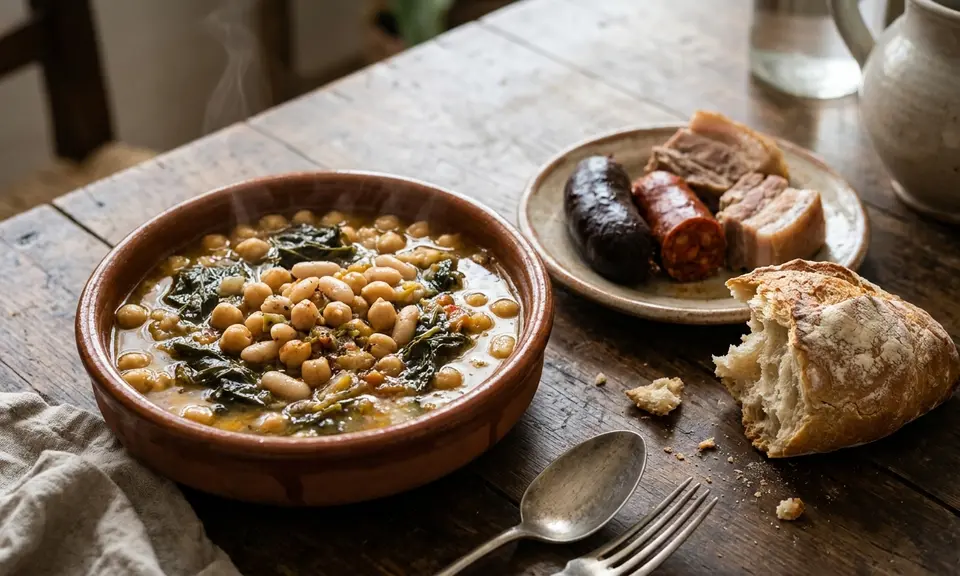

Berza gaditana is the pulses-and-greens stew of Cádiz province: chickpeas and white beans cooked with seasonal vegetables, thickened by their own starch, and served beside a plate of pork and sausage called the pringá. It is a cold-weather dish, and the name misleads, because it is not a cabbage soup.
What is in the pot
A berza is chickpeas and white beans, usually cooked together, with greens and a paprika-and-garlic base. The pringá is the meat and sausage that go in the pot: pork fat, chorizo and morcilla in most versions, with cuts such as trotters, ears or tail in richer ones.
The greens change by season and by town. One Cádiz food publication counts up to nine different vegetables across the province, among them chard, cabbage, wild tagarninas, cardillos, celery, green beans and pumpkin. In Vejer, the local recipe uses cardillos or wild tagarninas and puts morcilla in the pringá. Elsewhere chorizo is the norm. Ask which version a kitchen makes before you order.
Why it is called berza
The name does not come from cabbage. Historian Manuel Ruiz Torres, quoted by Cosas de Comé, reads berza as a general word for greens or vegetables, which is why a stew of pumpkin and green beans still counts. The earliest use of the name he has found for this stew is a newspaper item of 22 November 1885 and he says the name may well be older. A generic cocido of chickpeas, vegetables and meat appears in a Sanlúcar manuscript of 1641, so the dish is plainly older than its name.
Berza, potaje, puchero and cocido
The neighbouring pots are easy to confuse. A potaje puts the vegetable first and usually has no pringá. A puchero has a lighter broth, no paprika and typically poultry instead of chorizo and morcilla. Some towns, Conil among them, call a berza a cocido. A Lenten version, berza de vigilia, leaves the pringá out.
How it is served and eaten
Many cooks serve the pringá on a separate plate. The traditional order is the legumes and greens in broth first and the meat second, though the meat is also chopped small and stirred into the pot. In Vejer the pringá is eaten with pan de telera, and elsewhere it fills a bocadillo with the same bread.
Cooks say the stew improves after a day, when the broth turns creamier, and leftovers are often reheated with rice or thick noodles.
Berza jerezana and berza gitana
The best-known version belongs to Jerez, where it is called berza jerezana, and its richest form, berza gitana, is linked by Cosas de Comé to Roma families who worked as butchers in the city. Wikipedia describes the dish as a rural one that has since moved onto restaurant menus. If you are weighing a trip, the Jerez day trip is the obvious place to look for it.
Finding it in and around Cádiz
Berza is a province dish, so expect more of it in ventas and village bars of the campiña and the bay towns than on the old-town tapas circuit. Cosas de Comé's list of berza bars tags Casa Angelita as a Cádiz city address, which is a starting point rather than a promise. Menus and days change, and many places serve it as a daily special, so confirm with the venue before you plan a meal around it.
It sits best in the colder months, from autumn to spring, so pair it with Cádiz in winter. For the fried side of the local table, see pescaíto frito and tortillitas de camarones, and for the wider picture the Cádiz food guide.