
food-loverscouplesbudget
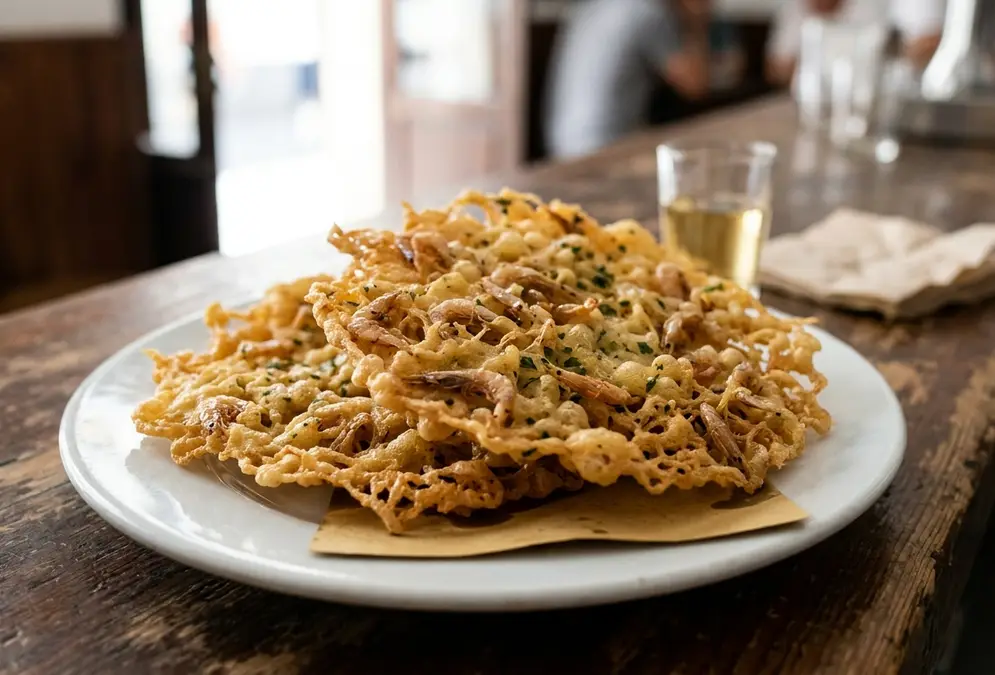
Plate of golden, lacy tortillitas de camarones with tiny whole shrimp visible in the crisp batter, served on a bar counter in Cádiz
tapa

Cádiz's shrimp fritters: thin, lacy and eaten by hand

Cádiz's crisp shrimp fritters, made with chickpea flour and tiny whole camarones. Origins, what makes a good one, and how to order them with manzanilla.

A good tortillita de camarones is closer to lace than to a pancake. The batter is spread so thin that it fries into a crisp, golden disc, and the tiny shrimp inside stay whole, shells and all, which is where the sea-salt crunch comes from. It is the fritter most associated with Cádiz, and it is the first thing worth ordering when you sit down in a tapas bar in the old town.

What goes into it

The batter is wheat flour and chickpea flour, chopped onion or scallion, parsley, water and salt, fried in olive oil. The shrimp are camarones, a very small local species (Palaemon longirostris) that is too fiddly to peel, so it goes in whole. There is no egg in a traditional tortillita. Chickpea flour is the one ingredient every version of the origin story agrees on.

The thinness matters. A thin fritter stays crisp and soaks up little oil, so it tastes of shrimp and salt rather than grease. Three things separate a good one from a bad one: the balance of the two flours, the temperature it reaches you at, and how much whole shrimp shows through the lace. It should arrive hot enough to crackle.

Where it comes from

Nobody agrees, and the argument is part of the dish. San Fernando and Sanlúcar de Barrameda both claim the maternity; the journalist José Oneto holds that the fritters were born in Las Callejuelas, San Fernando's humblest seafaring quarter. Cádiz itself is the other candidate, and most accounts simply say the province.

The dating is just as loose. The dish was well known by the nineteenth century, but it may be much older. The gastronomic critic Manuel Ruiz Torres argues for the sixteenth and seventeenth centuries, when shrimp began to replace fish or vegetables in a chickpea-flour batter, with an Italian parent in the Genoese farinata and a Spanish one in the gachuelas. The Genoese colony in Cádiz goes back to the thirteenth century, and nineteenth-century registers list fry shops run by people with Italian surnames making panizza, a chickpea-flour fritter. Treat any precise founding date you hear in a bar as a story rather than a record.

Where to eat them in Cádiz

The natural hunting ground is La Viña, the seafaring quarter behind La Caleta, where fried food is the point of the evening. El Faro de Cádiz, in the barrio, is named among the restaurants that make tortillitas "de campeonato", and its own page describes five decades of cooking Cádiz produce across three generations. Casa Manteca is another La Viña address often mentioned for fried tapas; check its current menu before you plan around it. If you want the same neighbourhood without the sit-down, the old town's bars around La Caleta and Santa María all do some version.

Order them as a tapa or a half-ración and eat them with your fingers, still hot. They sit naturally beside a plate of pescaíto frito and the other fried seafood of the city. Chickpea flour is the batter question this dish answers best, and our look at flour, chickpeas and the freiduría sets it against the wheat-flour fry.

What to drink with them

The official sherry body pairs tortillitas with manzanilla for their salty flavours, and the logic holds: a very dry, saline, chilled wine against hot fried batter. Fino is the same family and works almost as well. Nothing wrong with a cold beer either, but manzanilla is the pairing worth making a point of.

When to eat them

Tortillitas are a year-round tapa in Cádiz, though consumption rises at Carnival, when the city eats and sings its way through the streets. You do not need to wait for February; the dish does not depend on the season, only on a kitchen that fries to order.

Reporter notebook

Insider tips

What to order

Judge them by the lace

Look at the fritter before you eat it. A good tortillita is thin and lacy, with whole shrimp visible. A thick, doughy disc with a few pink flecks is not what the dish is about.

Pairing tip

Order manzanilla, not a soft drink

The dry, saline manzanilla cuts through the fried batter and echoes the shrimp. Ask for it chilled, by the glass, and a fino if the bar has no manzanilla open.

Local custom

Eat them hot and with your fingers

Tortillitas are meant to go straight from the pan to your hand. If one arrives lukewarm and limp, it has been sitting; say so politely or order another round fresh. Cutlery is not expected.

Practical information

Origin
Cádiz province and the Bay of Cádiz; San Fernando is the most often cited birthplace, but Cádiz and Sanlúcar de Barrameda also claim it
Main ingredients
Camarones (Palaemon longirostris), Wheat flour, Chickpea flour, Onion or scallion, Parsley, Water, Salt, Olive oil
Season
Year-round, with demand rising at Carnival
Allergens
crustaceans, gluten

Frequently asked questions

What are tortillitas de camarones?

They are shrimp fritters from the province of Cádiz, made from wheat flour, chickpea flour, onion, parsley and tiny whole shrimp, fried in olive oil into thin, crisp discs. They are eaten as a tapa, by hand, while still hot.

Where do tortillitas de camarones come from?

The exact origin is disputed. San Fernando and Sanlúcar de Barrameda both claim the dish, and Cádiz is the other candidate. Some historians trace it to the sixteenth or seventeenth century and to a mix of Genoese chickpea-flour fritters and Spanish batters, but there is no single documented founding.

Where to eat the best tortillitas de camarones in Cádiz?

Start in La Viña, the old fishermen's quarter, where fried tapas are the speciality. El Faro de Cádiz is named among the restaurants that make excellent ones. Ask what is freshly fried rather than what is waiting under a lamp, and eat them straight away.

What wine goes with tortillitas de camarones?

Manzanilla is the classic pairing. The official sherry body recommends it for the salty flavour of the fritters. A chilled fino is a close second.

Are tortillitas de camarones gluten free?

No. The batter uses wheat flour alongside chickpea flour, so they contain gluten. They also contain shellfish, so they are not suitable for anyone with a crustacean allergy.

What shrimp are used in tortillitas de camarones?

The local camarón, Palaemon longirostris. It is so small that it is too difficult to shell, so it is cooked whole, which gives the fritter its crunch and flavour.

Do tortillitas de camarones contain egg?

A traditional, good tortillita is made without egg. That is one reason it fries light and crisp rather than soft and doughy.

Why are tortillitas de camarones eaten at Carnival?

They are a year-round tapa in Cádiz, but consumption rises at Carnival. The sources describe the rise rather than explain it, so treat any tidy reason you are given as local colour.

Further reading

Sources

17 references Show
  1. Wikipedia (opens in a new tab)

    “Tortillitas de camarones are shrimp fritters from the province of Cádiz in Andalusia, Spain.”

  2. Wikipedia (opens in a new tab)

    “Because the shrimp are so small it is too difficult to shell them, so they are cooked whole.”

  3. Wikipedia (opens in a new tab)

    “The dish became well known in the nineteenth century, but may have been created as early as the start of the sixteenth century.”

  4. elespanol.com (opens in a new tab)

    “es más que probable que entre los siglos XVI y XVII -y no XIX como se creía- se empezaran a usar camarones en sustitución al pescado o la verdura”

  5. elespanol.com (opens in a new tab)

    “uno italiano por la importante colonia genovesa que existió en Cádiz desde el siglo XIII y otro por la aportación nacional”

  6. esdiario.com (opens in a new tab)

    “José Oneto defiende la teoría de que nacieron en el barrio de “Las Callejuelas”, el más humilde de San Fernando (Cádiz)”

  7. esdiario.com (opens in a new tab)

    “En un padrón del siglo XIX se han encontrado datos sobre freidurías regentadas por personas con apellidos italianos”

  8. esdiario.com (opens in a new tab)

    “En lo que sí están todas de acuerdo es en que para cocinarlas es imprescindible el garbanzo, en harina por supuesto.”

  9. directoalpaladar.com — Donde comer mejores tortillitas camaron sanlucar barrameda otras ciudades cadiz 13 imprescindibles (opens in a new tab)

    “Sin huevo, ligera, crujiente y fina, la clave de una tortillita de camarones de calidad está en tres pasos: el equilibrio de harinas (trigo y garbanzo), la temperatura de servicio y la generosidad de los camarones.”

  10. directoalpaladar.com — Donde comer mejores tortillitas camaron sanlucar barrameda otras ciudades cadiz 13 imprescindibles (opens in a new tab)

    “restaurantes como El Faro de Cádiz o El Faro de El Puerto también hacen tortillitas de campeonato.”

  11. elfarodecadiz.com (opens in a new tab)

    “Abanderado de la gastronomía gaditana, en sus cocinas se escribe la historia de cinco décadas del trato al producto del mar con humildad, pasión y mucho trabajo.”

  12. directoalpaladar.com — Tortillitas camarones mitica receta gaditana (opens in a new tab)

    “Las tortillitas de camarones son un plato gaditano que se toma como tapa durante todo el año, aunque su consumo aumenta en época de Carnaval.”

  13. directoalpaladar.com — Tortillitas camarones mitica receta gaditana (opens in a new tab)

    “Las tortillitas de camarones suelen ser finas para que queden bien crujientes y además, así no atrapan mucha grasa de la fritura, quedando ligeras y sabrosas.”

  14. sherry.wine (opens in a new tab)

    “Tortillitas de camarones famous to the area of Cadiz are the perfect accompaniment to Manzanilla with their salty flavours.”

  15. sherry.wine (opens in a new tab)

    “Fry the tortillitas for about 1 minute on each side, or until they are golden in colour and crispy.”