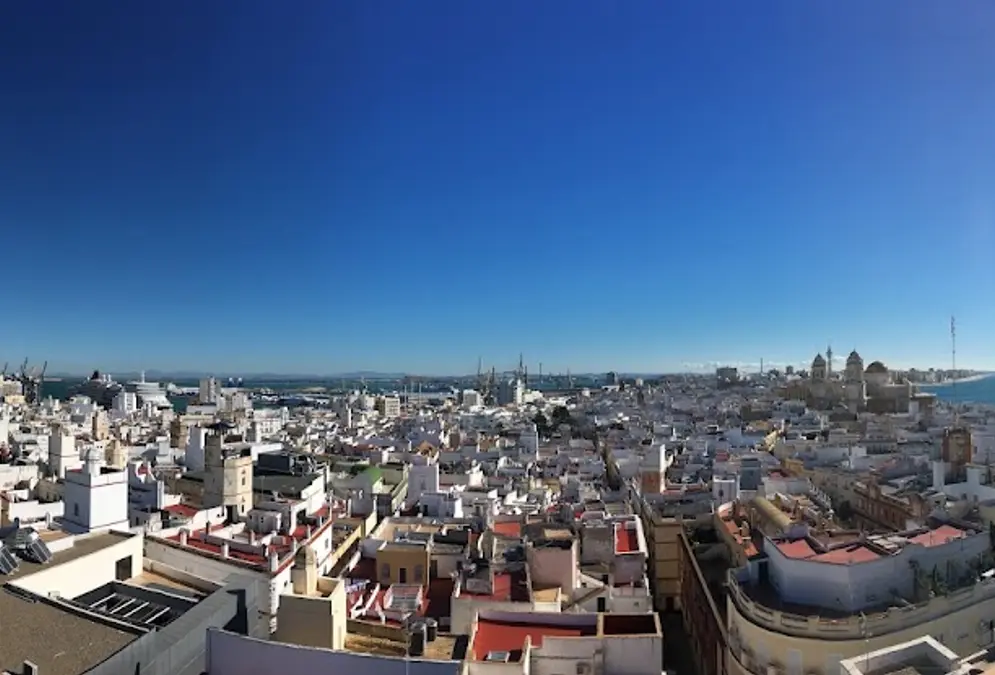
Torre Tavira is the reason so many Cádiz roofs bristle with small towers. In 1778 it was designated the official watchtower of the port, and from its lookout, 45 metres above sea level, a watchman could take in the whole bay and the shipping that made the city rich. Today the same tower gives a 360º view of the old town and holds the first camera obscura installed in Spain.
When to Visit
Visit duration
About 45 minutes
A watchtower for the Indies trade
The tower belongs to the palace of the Marqueses de Recaño, built in 1730 on Calle Marqués del Real Tesoro, at the corner of Calle Sacramento. The Marqués de Recaño had earned his title by sending his own cargo with the Flota de Indias, and he commissioned the Schiaffino brothers to build both the palace and the neighbouring chapel, the Oratorio de San Felipe Neri. The building follows the pattern of the Cádiz casa-palacio: rooms ranged around a central courtyard with galleries and eight Tuscan marble columns. The palace has been a Property of Cultural Interest (BIC) of the Junta de Andalucía since 2005.
The tower is named after its first watchman, the retired frigate lieutenant Antonio Tavira. The post passed down through generations until 1994, when Giordano García became the last watchman.
A note on the height. The official description calls it the highest point of the old town, but the cathedral towers rise higher still. It is best read as the best-placed rooftop vantage point in the centre. To compare the two, see the Cádiz Cathedral.
Book on the official site and check its current rules
The operator asks visitors to arrange their visit through its own website. Some wording on its visit page is still dated, so confirm session and booking details there rather than relying on older guidebooks.
The camera obscura
The camera obscura opened on 22 December 1994. The idea came from the Cádiz entrepreneur Belén González Dorao, who had seen the camera obscura in Edinburgh. The room is painted black and completely darkened. A lens and mirror at the top of the tower throw a live, moving, full-colour image of the streets onto a horizontal curved white screen shaped like a table.
Sessions last about 15 to 20 minutes and run in different languages every half hour. The projection depends on daylight, so a bright day gives a sharper picture than a hazy one.
Before the climb ends, two exhibition rooms cover Cádiz in the 18th and 19th centuries, the trade with the Indies, the 1778 designation and the Cortes of 1812.
Planning your visit
- Hours: October to April 10:00 to 18:00; May to September 10:00 to 20:00. Last admission is one hour before closing.
- Closed: 25 December, 1 January and 6 January.
- Tickets: general €8; reduced €6 for over-65s, students with valid ID, large or single-parent families, groups of more than 10 and people with disabilities. The official page is undated, so confirm prices before you go.
- Duration: about 45 minutes in all.
- Booking: the operator asks visitors to book through its own website, so check there before you go.
The climb is three floors of easy stair sections with places to rest, but there is no lift. The Junta's Heritage Commission refused one, citing visual pollution. Anyone with limited mobility should ask the operator before travelling.
The city council owns the tower and has run it under an administrative concession since 1994. After the public have left, it hosts screenings, concerts and book launches. The palace around it has housed the Casa del Carnaval since spring 2023, when the council converted it.