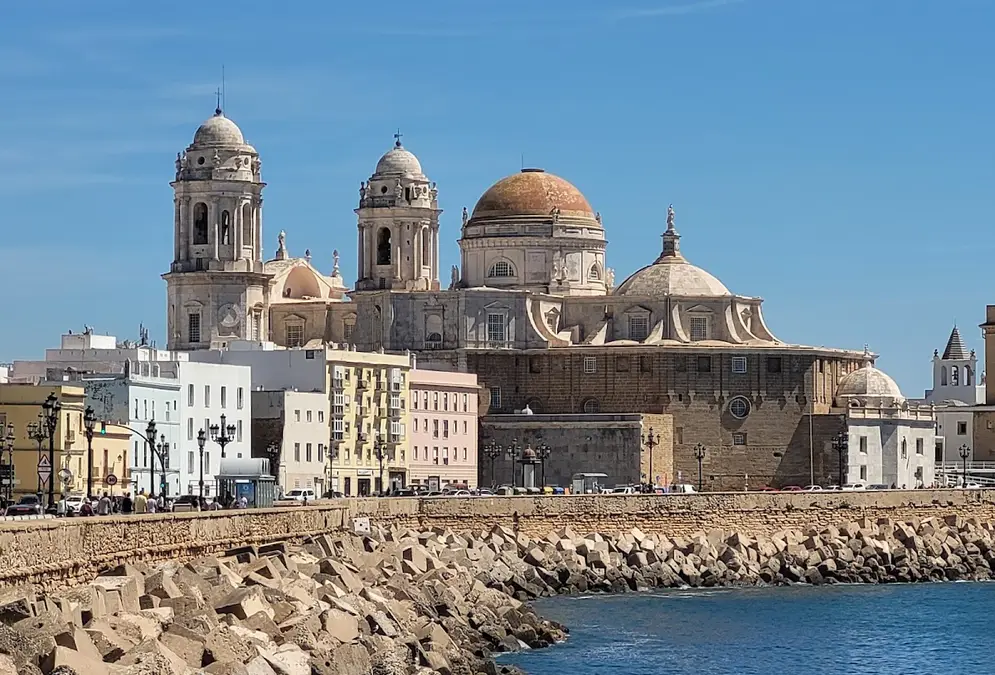
Cádiz Cathedral, the Catedral de la Santa Cruz, sits almost at the water's edge in the old town and can be seen from nearly anywhere in the city. It was built between 1722 and 1838, a span of 116 years that explains why Baroque and Rococo detail gives way to a Neoclassical finish. Its golden-tiled dome, a crypt below sea level and a tower you can climb make it one of the few monuments in the city worth planning an hour around.
When to Visit
Best season
Check the official site for current hours
Visit duration
About an hour for the cathedral and crypt, longer with the tower and museum
Why Cádiz built a second cathedral
The old cathedral, now the Iglesia de Santa Cruz, was in poor repair, and the city had suddenly become important: the Casa de Contratación, the royal body that controlled trade with the Americas, moved here from Seville in 1717. The new building was paid for with money from that trade, which is why it is sometimes called the Cathedral of the Americas.
The first designer was Vicente Acero, the architect who had also worked on Granada Cathedral. He left in 1739, and Gaspar Cayón took over; Cayón's nephew Torcuato Cayón directed the works from 1757, Manuel Machuca from 1790 and Juan Daura from 1832. The building was declared finished on 28 November 1838, although the choir, the presbytery and the towers were still unfinished. Several generations of architects, each with their own taste, are the reason the interior reads as one building in three styles.
Check the official site before you go
Hours and prices are not fixed and the cathedral posts notices ad hoc, for example for delayed visits. Look at catedraldecadiz.com or its online ticket shop on the day rather than relying on an older guide.
What to look at
Outside, the dome of golden tiles over the crossing is the signature, and it is brightest in daylight. The plan is a Latin cross with three naves and a pentagonal ambulatory. Look at the materials: Genoese marble for the altars and doors, jasper, and limestone and the local porous piedra ostionera for the exterior walls, the stone that sea air attacks hardest. Restoration works have been under way since the early 2000s.
Inside, the high altar is a free-standing Neoclassical temple dedicated to the Immaculate Conception. The choir has two organs, and the one on the left originally belonged to the old Santa Cruz church. The two towers beside the façade end as astronomical observatories, an odd choice at a time when the Bourbons discouraged tall towers as easy targets. The Clock Tower was finished in 1845 and the Poniente tower in 1862, and at roughly 54 m above the ground (58 m above sea level) they were the highest points in the city. The cathedral clock was made in 1851 by José Manuel de Zugasti.
The crypt below sea level
Under the high altar the crypt lies below sea level. It is the burial place of two Cádiz-born figures, the composer Manuel de Falla and the poet and playwright José María Pemán, as well as bishops. Its flat central vault produces an unusual sound reverberation, so lower your voice and listen. If Falla's name is new to you, the Gran Teatro Falla on Plaza Fragela is the city's other monument to him.
Climbing the Clock Tower
The official site lists the Clock Tower (Torre del Reloj) as a visitable part of the cathedral ticket; confirm on the day which tower is open, because sources disagree on the naming. The tower climb page has the ticket prices and hours, so they are not repeated here.
The Cathedral Museum and treasury
The museum is the Casa de la Contaduría, on Plaza Fray Félix beside the Old Cathedral, a short walk from the main doors, and the cathedral's general ticket covers it. The rooms are spread over a cluster of 16th-century houses around the tower of the old Santa Cruz church, and they opened in the year 2000. The complex stands on the seating bank of the Roman Theatre, built in the 1st century BC by Cornelius Balbus the Younger, which is why its oldest courtyard feels more like a Cádiz townhouse than a church hall.
The treasury is the Sala de las Custodias. Its goldsmith work runs from the 16th to the 19th century and includes monstrances, trays, pectoral and processional crosses and other sacred vessels, in the techniques of metalworkers such as Enrique de Arfe. The best-known piece is the Custodia del Millón, made in the 18th century by Vicente Gómez de Ceballos and set with precious stones from several parts of the world. The adjoining Sala de la Plata continues with more silver vessels and complete writing sets from the same period.
Beyond the treasury, the rooms worth the walk are:
- Patio Mudéjar: the courtyard built by Dean Rajón in 1500, with brick arches and slim white marble columns, and a large storage jar dug up nearby.
- Sala del Asalto: the English and Dutch attack of 1596, with the "Cruz de Tablas" that survived the burning of the Old Cathedral and a replica of the damaged Virgen Vulnerata.
- Sala 1812: the table where, according to the cathedral, the first copy of the Constitution was signed on 19 March 1812. The Museo de las Cortes de Cádiz covers that story in full.
- Sala de los Marfiles: Philippine ivory figures of Cádiz's patron saints, Servando and Germán.
- Sala de los Ternos and Sala de los Libros Corales: gold-embroidered vestments, the oldest from the 16th century, and choir books with miniatures.
The museum keeps its own timetable. Its page lists Tuesday to Saturday, 10:00 to 16:30, so do the museum earlier in the day and confirm Sunday and Monday opening with the cathedral before you plan around it.
Planning your visit
Opening hours and ticket prices change and the official notices are issued ad hoc, so check catedraldecadiz.com or its online ticket shop before you go rather than trusting an older guide. Tickets include a virtual-reality experience according to the official site, and special guided visits are sometimes sold in limited groups of 25. Allow time for the nave, the crypt and the tower; a quick look at the main floor alone takes much less.
The Plaza de la Catedral also holds the Baroque Santiago church, built in 1635. From here it is a short walk through the old town to Torre Tavira for the view over the rooftops, and the neighbouring El Pópulo quarter leads past the 1685 Casa del Almirante to Plaza de San Juan de Dios.