history-buffsarchitecture
The Oratorio de San Felipe Neri, Cádiz
baroque cortes-de-cadiz constitution-1812

The Oratorio de San Felipe Neri, Cádiz

Baroque oratory in Cádiz where the Cortes sat from 1811 and the 1812 Constitution was promulgated. Elliptical plan, rococo altar; hours and €5 ticket listed.

Mon-Fri 10:30-16:00 (last entry 15:30); Sat 10:00-14:00 (10:30-14:00 in July and August; last entry 13:30); Sun Mass only
General €5; €4 for over-65s, under-25s and people with a disability under 60%; groups of more than 15 people €3; free for children under 12 and people with a disability over 60% (Cádiz city council).
Directions

The Oratorio de San Felipe Neri is the Baroque church in which Spain's Cortes met from 24 February 1811 until 25 September 1813, in the old town of Cádiz. The Constitution that came out of those sessions, nicknamed La Pepa, was promulgated on 19 March 1812 and repealed by Ferdinand VII in 1814. If you want to understand why Cádiz sits at the centre of Spanish liberal history, this is the room.

It is also a handsome building in its own right, with an oval nave that is unusual for the city. The city council's tourism page lists weekday and Saturday opening hours and a €5 general ticket, set out under Visiting below.

A Baroque church on an ellipse

The oratory is a Baroque church on an elliptical plan, built between 1685 and 1719 and credited to Blas Díaz. Around the oval run seven rectangular chapels, each with a barrel vault and rich decoration. The dome did not last: the 1755 Lisbon earthquake ruined it, and it was rebuilt in 1764 by the master Pedro Luis Gutiérrez de San Martín, known as Pedro Afanador.

Over the high altar stands a rococo retable that includes an Immaculate Conception credited to Murillo. Treat the attribution as the traditional one rather than a settled fact; the church is better enjoyed for its plan and its chapels than as a Murillo stop.

Check the day before you walk over

The council lists visiting Monday to Saturday only: Sunday is Mass only and public holidays are closed. Last entry is 30 minutes before closing, so on a weekday arrive by 15:30.

Where the Cortes sat

Between 1810 and 1814 the Cortes counted 702 deputies. Four of the leading figures were Agustín Argüelles, Juan Nicasio Gallego, Antonio Capmany and the Conde de Toreno. Their work ended abruptly when Ferdinand VII repealed the Constitution in 1814, though it returned in 1820 to 1823 and briefly in 1836.

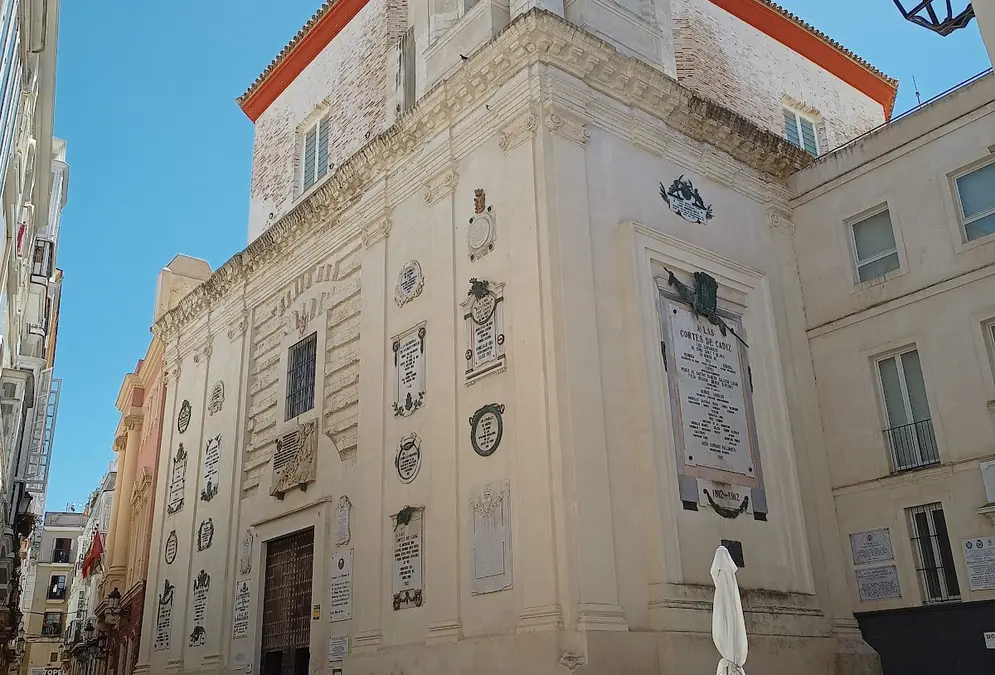
Outside, plaques on the exterior pilasters honour the deputies of 1812, the doceañistas. They are readable from the street at any hour, which makes them the easy part of the visit.

The Constitution's influence travelled: it shaped Portuguese constitutional ideas, the emergence of the Italian state and several American countries. More recently, a procedure has been opened under the 2022 Democratic Memory Law to declare the Oratorio, together with the Cortes monument in Cádiz, a lugar de memoria.

Visiting

The Oratorio stands in the old town, a short walk from Cádiz Cathedral and the neighbouring Oratorio de la Santa Cueva, so it combines easily with a morning in the Casco Antiguo. For the other end of the old town's story, the Puerta de Tierra is the surviving land gate.

The city council's tourism page lists the Oratorio open Monday to Friday from 10:30 to 16:00 (last entry 15:30) and Saturday from 10:00 to 14:00 (10:30 to 14:00 in July and August, last entry 13:30). On Sunday it lists only Mass, from 12:00 to 13:00, and it is closed on public holidays. A general ticket costs €5, €4 for over-65s, under-25s and people with a disability below 60%, and €3 per person for groups of more than 15. Children under 12 go free, and a free slot runs Monday to Thursday from 9:30 to 10:30, requested through cadizsacra.es.

Reporter notebook

Insider tips

Local custom

Read the plaques on the outside first

The plaques to the doceañista deputies on the exterior pilasters are free to read at any hour. They tell you who sat here before you go in.

Money tip

Know the ticket tiers

A general ticket is €5. The €4 rate covers over-65s, under-25s and people with a disability below 60%, and children under 12 go free.

Practical information

Opening hours
Mon-Fri 10:30-16:00 (last entry 15:30); Sat 10:00-14:00 (10:30-14:00 in July and August; last entry 13:30); Sun Mass only, 12:00-13:00; closed on public holidays. Free slot Mon-Thu 09:30-10:30, requested via cadizsacra.es (Cádiz city council).
Admission
General €5; €4 for over-65s, under-25s and people with a disability under 60%; groups of more than 15 people €3; free for children under 12 and people with a disability over 60% (Cádiz city council).
Address
C. San José, 36, 11003 Cádiz, Spain View on Google Maps

Tags

baroque cortes de cadiz constitution 1812 church history liberalism

Frequently asked questions

Why is the Oratorio de San Felipe Neri important in Spanish history?

The Cortes met here from 24 February 1811 to 25 September 1813. The Constitution of 1812 was promulgated on 19 March 1812 during that period.

Where was the 1812 Spanish Constitution signed or proclaimed?

The Cortes sat in the Oratorio when the Constitution was promulgated on 19 March 1812. Accounts differ on exactly where the promulgation ceremony took place, so the Oratorio is best described as the seat of the Cortes.

Can you visit the Oratorio de San Felipe Neri and how much does it cost?

Yes. The city council's tourism page lists it open Monday to Friday from 10:30 to 16:00 and Saturday from 10:00 to 14:00, with a general ticket of €5 (€4 reduced, €3 for groups of more than 15, free for children under 12). Sunday is Mass only, and it is closed on public holidays.

What is La Pepa?

La Pepa is the nickname of the Constitution of 1812, promulgated on 19 March 1812 by the Cortes sitting in Cádiz. Ferdinand VII repealed it in 1814.

Who painted the Immaculate Conception in the Oratorio?

The canvas over the rococo high altar is credited to Murillo. The attribution is traditional, so treat it with some care.

Why does the Oratorio have an elliptical floor plan?

The church was built on an elliptical plan between 1685 and 1719. That it suited a debating chamber is a later interpretation, not a documented reason.

Where did the Cortes meet before the Oratorio?

Before the sessions in the Oratorio began in February 1811, the Cortes had opened in September 1810 on the Isla de León, now San Fernando.

Further reading

Sources

22 references Show
  1. congreso.es (opens in a new tab)

    “A partir del 24 de febrero de 1811y hasta el 25 de septiembre de 1813 se reúnen en el Oratorio de San Felipe Neri, en la ciudad de Cádiz.”

  2. congreso.es (opens in a new tab)

    “la tramitación de la Constitución, promulgada el 19 de marzo de 1812. Fernando VII la deroga en 1814”

  3. Wikipedia (opens in a new tab)

    “Se trata de un templo de estilo barroco de planta elíptica construido entre 1685 y 1719 por Blas Díaz.”

  4. Wikipedia (opens in a new tab)

    “existen siete capillas rectangulares, todas ellas de bóveda de cañón y ricamente decoradas, distribuidas a lo largo de su planta elíptica.”

  5. Wikipedia (opens in a new tab)

    “sería reconstruida poco después, en 1764, por el maestro Pedro Luis Gutiérrez de San Martín (Pedro Afanador).”

  6. Wikipedia (opens in a new tab)

    “retablo mayor del templo de estilo rococó y que incluye un lienzo que representa a la Inmaculada Concepción, obra de Murillo”

  7. congreso.es (opens in a new tab)

    “Entre 1810 y 1814 forman parte de ellas 702 diputados”

  8. congreso.es (opens in a new tab)

    “Cuatro de los principales fueron Agustín Argüelles, Juan Nicasio Gallego, Antonio Capmany y el Conde de Toreno.”

  9. congreso.es (opens in a new tab)

    “la tramitación de la Constitución, promulgada el 19 de marzo de 1812. Fernando VII la deroga en 1814”

  10. Wikipedia (opens in a new tab)

    “numerosas lápidas dedicadas a los diputados doceañistas”

  11. diariobahiadecadiz.com (opens in a new tab)

    “traspasó fronteras influyendo en las ideas constitucionales portuguesas, en el surgimiento del Estado italiano o en numerosos países americanos.”

  12. diariobahiadecadiz.com (opens in a new tab)

    “están el Oratorio de San Felipe Neri y el monumento a Las Cortes de 1812 en Cádiz”

  13. Turismo de Cádiz (opens in a new tab)

    “De Lunes a Viernes: 10:30 a 16:00 h. (Último acceso a las 15:30 h.)”

  14. Turismo de Cádiz (opens in a new tab)

    “Sábado: 10:00 a 14:00 h. (Último acceso a las 13:30 h.)”

  15. Turismo de Cádiz (opens in a new tab)

    “Sábado: 10:30 a 14:00 h. (Último acceso a las 13:30 h.)”

  16. Turismo de Cádiz (opens in a new tab)

    “Domingo: Santa Misa de 12:00 a 13:00 h.”

  17. Turismo de Cádiz (opens in a new tab)

    “Mayores de 65, personas con discapacidad menor al 60% y jóvenes menores de 25 años: 4€”

  18. Turismo de Cádiz (opens in a new tab)

    “Grupos (+15 personas): 3€.”

  19. Turismo de Cádiz (opens in a new tab)

    “Entrada gratuita: niños menores de 12 años y personas con discapacidad mayor al 60%”

  20. Turismo de Cádiz (opens in a new tab)

    “De Lunes a Jueves 09:30 a 10:30 h. (Solicitar a través de la web cadizsacra.es)”