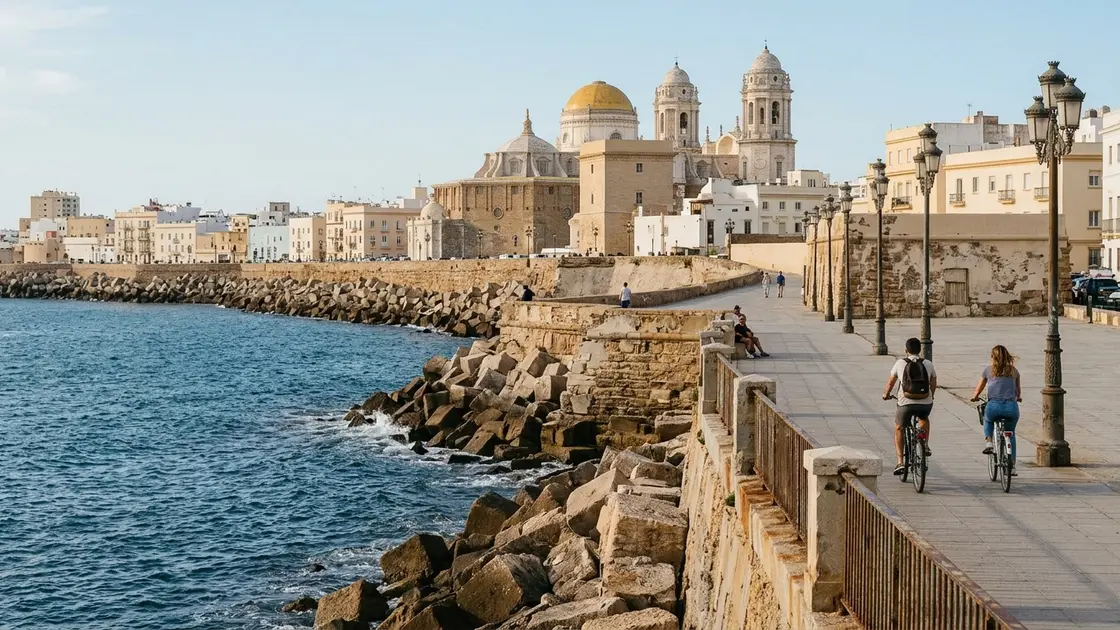
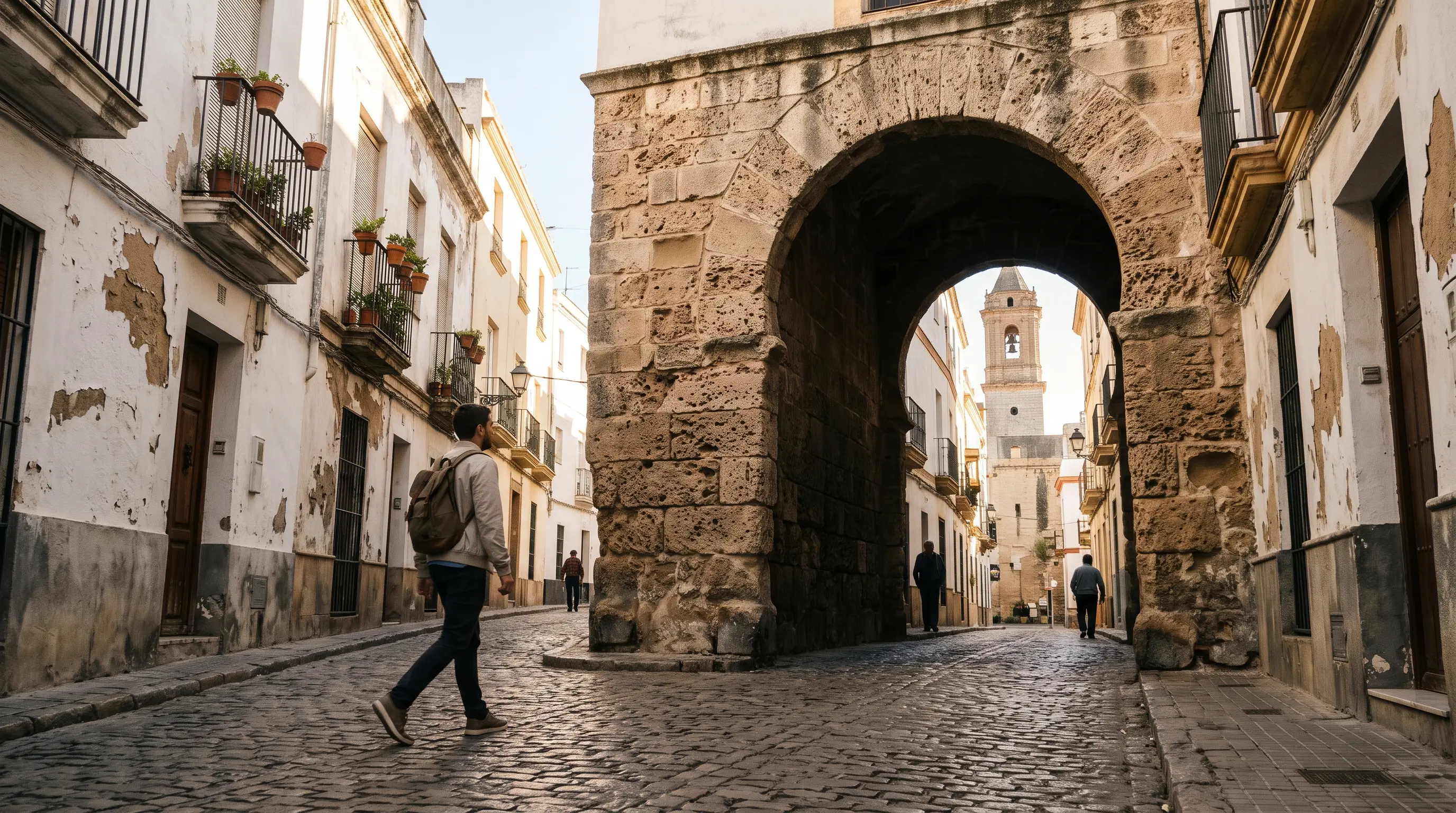
Cádiz and the Atlantic Trade: When One Port Held the Indies
How Cádiz won Spain's monopoly on trade with America in 1717, grew rich on it and shaped two Gaditanos: the writer José Cadalso and the physician Mutis.
Historian specialising in Cádiz's ancient, colonial and constitutional heritage.
Published
From 1717 Cádiz was the only legal centre of Spain's trade with America, after the Casa de Contratación and the merchants' guild left Seville.[1] The monopoly ran until the free-trade rules of 1778[2], and the port stayed Spain's main gateway to the colonies long afterwards.[3] The city that trade made left its mark on the skyline in merchant watchtowers, and on two Gaditanos: the soldier-writer José Cadalso and the physician José Celestino Mutis.
Cádiz monopoly years
1717 to 1778
Cádiz held the legal monopoly on American trade between these dates[2]
Voyages to America
1,188 vs 930
Outward sailings in 62 years of Cádiz monopoly, against 930 in Seville's last 50[4]
Residents of Cádiz, 1791
77,500
Up from 30,000 in 1709 as merchants settled from Spain and abroad[5]
In this article
Jump to a section
⌄
Why the Indies trade left Seville
Seville had housed the Casa de Contratación, the office that regulated trade with the Indies, since 1503, and it did not lose the business quietly.[6] The two cities argued over the Casa for years. The Guadalquivir supplied the practical case against Seville: ships were getting bigger, the river was hard to sail, and merchants knew that the bay of Cádiz offered better chances for smuggling.[7]
Cádiz had been climbing the system for decades, and Seville watched it happen. The head of the Indies fleets officially moved there in 1679.[8] In March 1717 José Patiño took up the post of Marine intendant of Cádiz, two months before the official transfer of the Contratación.[9] The Consulado de Cargadores, the guild of merchants who loaded goods for the Indies, travelled south with the Casa, and together they made Cádiz the commercial and financial centre of the Carrera de Indias.[10]
Timeline
1503
Seville gets the Casa
The Casa de Contratación takes its seat in Seville.
1679
Fleets start from Cádiz
The head of the Indies fleets is officially moved to the city.
1717
Casa and Consulado move
The Casa de Contratación and the Consulado de Cargadores transfer to Cádiz.
1778
Free trade
The Reglamento de Libre Comercio ends the Cádiz monopoly.
By Seville's standards the Cádiz monopoly was brief. It ran from 1717 to 1778[2], and the decrees of 1765 and 1778 had already loosened the single-port system before the Reglamento de Libre Comercio took over.[11]
What the monopoly built in Cádiz
The monopoly filled a walled peninsula with newcomers. Cádiz grew from 30,000 people in 1709 to 77,500 in 1791[5], among them hundreds of merchants, Spanish and foreign, who came from places as far apart as Ireland, Russia and the American colonies.[12] The departure and arrival of the fleets through the bay was a public spectacle that nobody ignored.[13]
400%
Growth in Cádiz's exports between 1778 and 1788, the decade after the monopoly formally ended.
Counting outward expeditions to America shows how the trade moved:
3,949 in the 42 years of free trade that followed[14]
The jump came with free trade, not with the monopoly. Between 1778 and 1788 exports from Cádiz grew by 400 per cent and reached 72 per cent of Spain's legal exports to the colonies[3], though by the early nineteenth century the city had slipped from terminal port to intermediate port on the American routes.[15]
Merchants reinvested their gains in buildings and noble titles, and also in the trade itself, lending money at risk to finance voyages.[16] One nineteenth-century traveller pictured the merchant of earlier times climbing to his rooftop mirador to catch sight of ships returning from America.[17]
José Cadalso, a merchant's son who wrote about Spain
José Cadalso was born in Cádiz on 8 October 1741, the son of a merchant who had left for America while his wife was still pregnant and did not return until 1754.[18] The family was rich enough for him to study with the Jesuits in Paris and Madrid and to make the Grand Tour that a young gentleman of the period was expected to make.[19]
He chose the army. Cadalso was promoted colonel in 1782 and died fifteen days later at the siege of Gibraltar.[20] Between his Grand Tour and that death he wrote satire, poetry and the Cartas marruecas, a book of letters among three invented correspondents: Gazel, an Arab who arrives in Spain with a diplomatic mission, the Christian Spaniard Nuño Núñez and the old Moorish sage Ben Beley.[21]
The letters look at the situation of Spain and the Spaniards through foreign eyes[22], and they reached print as a book in 1793, eleven years after the author's death.[23]
In Los eruditos a la violeta an old father tells his son, about to travel, that it would be absurd to inspect foreign countries before knowing his own.[24] Cadalso grew up with a father who had spent more than a decade across the ocean.
José Celestino Mutis, the Gaditano who crossed the ocean
José Celestino Mutis trained in Cádiz, Seville and Madrid[25], then went in 1760 to the New Kingdom of Granada in South America[26] and stayed for nearly 50 years.[27]
Recommended tours
Tours are selected for quality, not commission. We earn a small fee if you book, at no extra cost to you.
A modern study of his life describes a biography that runs between natural history and commerce.[28] Cargoes of quina and silver, along with a superb record of American plants, reached Europe after passing through his hands.[29]
In 1783 the archbishop-viceroy Caballero Góngora made real a wish Mutis had held for twenty years, a botanical expedition.[30] Mutis presided over it for 25 years, until his death in 1808[31], and its herbarium came to hold more than 24,000 plants.[32] The entomologist Edward O. Wilson found that his field notes make him the first person in the New World to study ants and their behaviour in detail.[33] Spain's government could not afford to print the Flora de Bogotá that grew out of the work, with its more than 6,000 illustrations.[34]
He is better remembered as an organiser than as a theorist. A review of his biographer's work finds no significant contribution to any single branch of science[35], but a notable mark left on Spanish science by his leadership and his gift for spreading ideas.[36]
Where the merchant city still stands
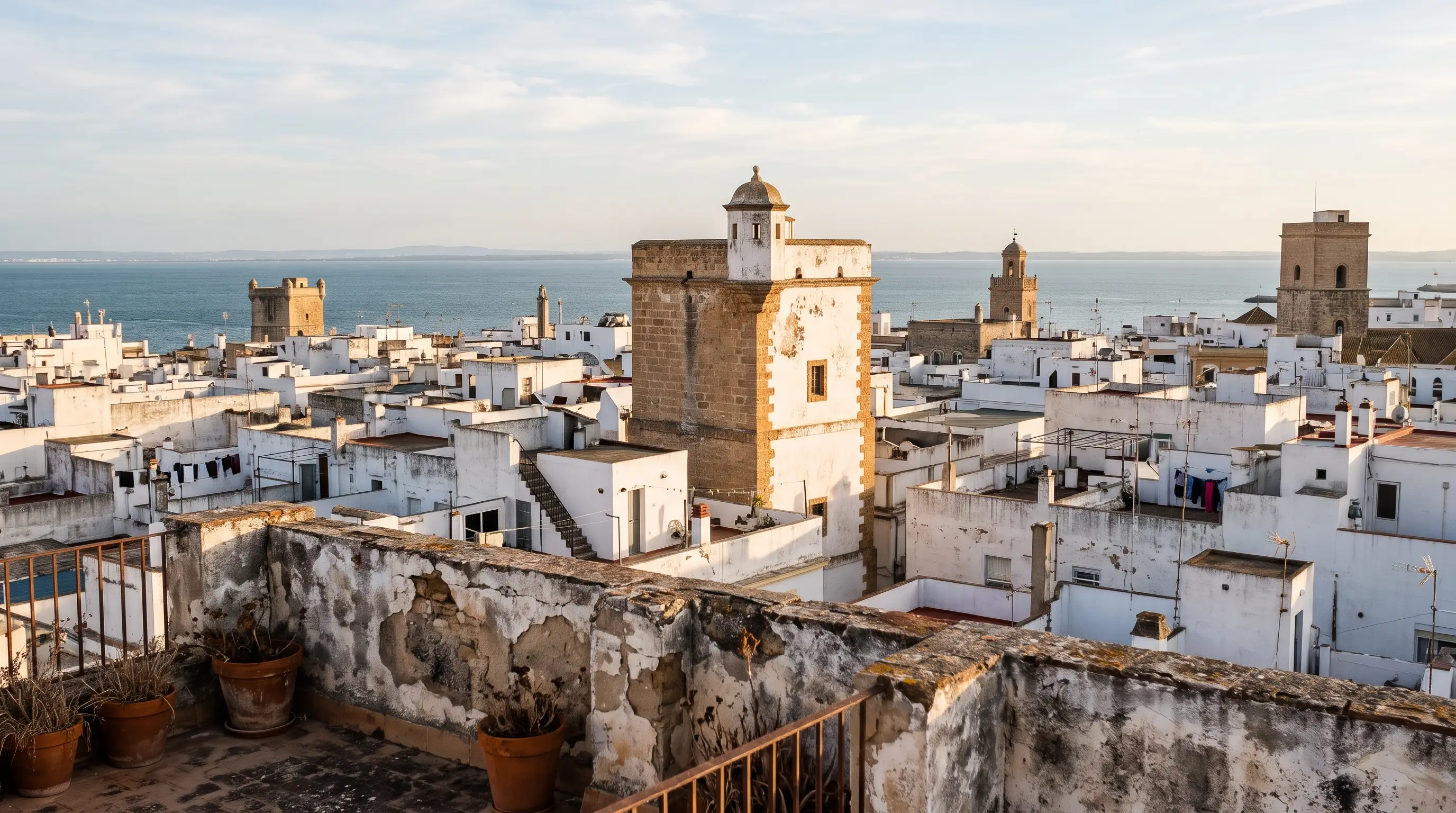
Torre Tavira is the easiest place to see the trade from above. It belongs to the palace of the Marqués de Recaño, built in 1730, and was used to monitor shipping in the bay and warn the town of approaching ships.[37] The marquis had won his title by sending his own cargo with the Flota de Indias.[38] The palace later housed a drawing school from 1787 and, in 1812, the first seat of Spain's Supreme Court.[39]
The tower stands 45 metres above sea level[40], and in 1778, the year of the free-trade rules, it was designated the official watchtower of the port.[41]
The Casa de las Cuatro Torres, built between 1736 and 1745, shows the same ambition at street level.[42] Urban ordinances allowed one lookout tower per house, so the owner built four independent houses inside one building and got four towers.[43] Rooms there were let to people waiting in the city for their ships.[44]
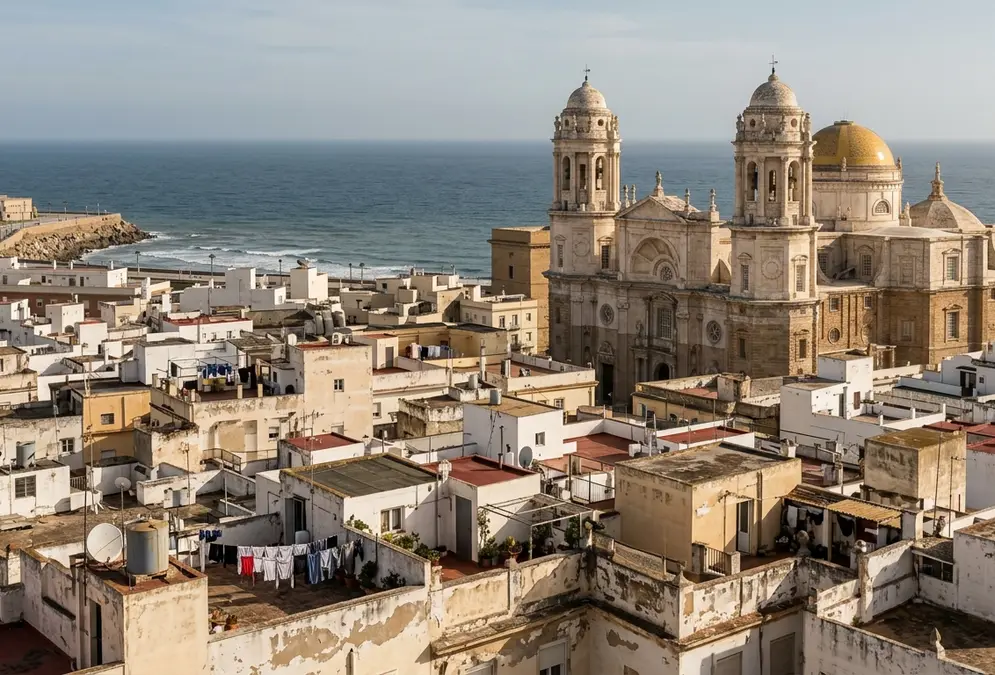
The old town walk includes Torre Tavira. Torre Tavira's own site speaks of 134 watchtowers[45], and the roofline outside the tower is the best summary of what the monopoly paid for.
Frequently asked questions
What is the history of the Atlantic trade in Cádiz?
Seville held the American trade through the Casa de Contratación from 1503. Cádiz became the head of the fleets in 1679 and the only legal centre of the monopoly in 1717, when the Casa and the merchants' guild moved there. The monopoly gave way to free-trade rules in 1778, but the port went on shipping most of Spain's legal exports to the colonies.
When did the Casa de Contratación move from Seville to Cádiz?
The official transfer came in 1717, with the Consulado de Cargadores moving at the same time. José Patiño had been named Marine intendant of Cádiz two months earlier.
Did the Cádiz monopoly end in 1778?
The legal monopoly did, since trade with America came under the Reglamento de Libre Comercio that year, and the decrees of 1765 and 1778 had already loosened it. Cádiz exports grew by 400 per cent between 1778 and 1788, so the port did not decline at once.
How was José Cadalso linked to the Indies trade?
Cadalso was born in Cádiz in 1741 to a merchant who had gone to America before the birth and did not return until 1754. He became a soldier and writer, and he died at the siege of Gibraltar in 1782.
What did José Celestino Mutis do in New Granada?
Mutis, a Cádiz-trained physician, went to the New Kingdom of Granada in 1760 and stayed for nearly 50 years. He led the botanical expedition approved in 1783 until his death in 1808, and its herbarium held more than 24,000 plants.
Can you still see merchant towers in Cádiz?
Yes. Torre Tavira, 45 metres above sea level, was the official watchtower of the port from 1778, and the Casa de las Cuatro Torres, built between 1736 and 1745, carries four lookout towers. Torre Tavira's own site speaks of 134 watchtowers.
“Cádiz became the only legal center allowed to administer the Spanish monopoly of trade with America from the establishment in 1717 of the Casa de Contratación (House of Trade) and Consulado de Comercio (Mercantile Association).”
“con lo que se cerraba la etapa del monopolio sevillano y se abría una nueva era, la del monopolio gaditano, que iba a extenderse entre dicha fecha de 1717 y 1778”
“Between 1778 and 1788 exports from Cádiz increased 400 percent and came to represent 72 percent of all legal exports sent from Spain to its American colonies.”
“durante los últimos cincuenta años del monopolio sevillano se contabilizan 930 expediciones a América, mientras que durante los 62 años de vigencia del monopolio gaditano se hicieron 1.188 expediciones (o viajes de ida)”
“el aumento del tonelaje de los buques, las dificultades técnicas de la navegación del rio Guadalquivir y la presión de los comerciantes que sabían de las mayores posibilidades que para el contrabando ofrecía la bahía gaditana”
“El traslado de la Casa de Contratación y del Consulado de Cargadores [2] a Cádiz en 1717 convirtió además a Cádiz en el centro comercial y financiero de la Carrera de Indias.”
“composed of hundreds of merchants from the rest of Spain, France, Italy, Ireland, England, Germany, Russia, the Low Countries, Portugal, and the American territories”
“Cádiz había pasado en esos años finales del siglo XVIII y principios del siglo XIX de ser un puerto terminal en las rutas marítimas, a convertirse en un puerto intermedio”
“Estos comerciantes rentabilizaron los intercambios con las Indias reinvirtiendo sus ganancias, no solo en la adquisición de bienes inmuebles, o títulos de nobleza, sino en la propia financiación del comercio mediante préstamos a riesgo.”
“El 8 de octubre nace Cadalso en Cádiz, hijo del comerciante José M.ª Cadalso y Vizcarra y de Josefa Vázquez y Andrade. Su padre partió para América cuando su mujer aún estaba embarazada, y no regresó hasta 1754.”
“Tres corresponsales ficticios intercambian una correspondencia: Gazel, árabe que llega a España como miembro de la misión diplomática de su país; Nuño Núñez, español, cristiano y amigo de Gazel; y Ben Beley, viejo sabio moro, amigo del primero.”
“no pocos cargamentos de quina y de plata y una soberbia representación iconográfica de la rica Naturaleza americana alcanzaron Europa tras pasar por sus manos”
“After serving as the Recaño family palace, in 1787 the Free School of Drawing, Arithmetic, and Geometry moved in. In 1812 it became the initial headquarters of the Supreme Court of Spain”
“As in the date of construction of the building the urban ordinances prohibited that the houses had more than one lookout tower the owner had built four independent houses within the same building.”