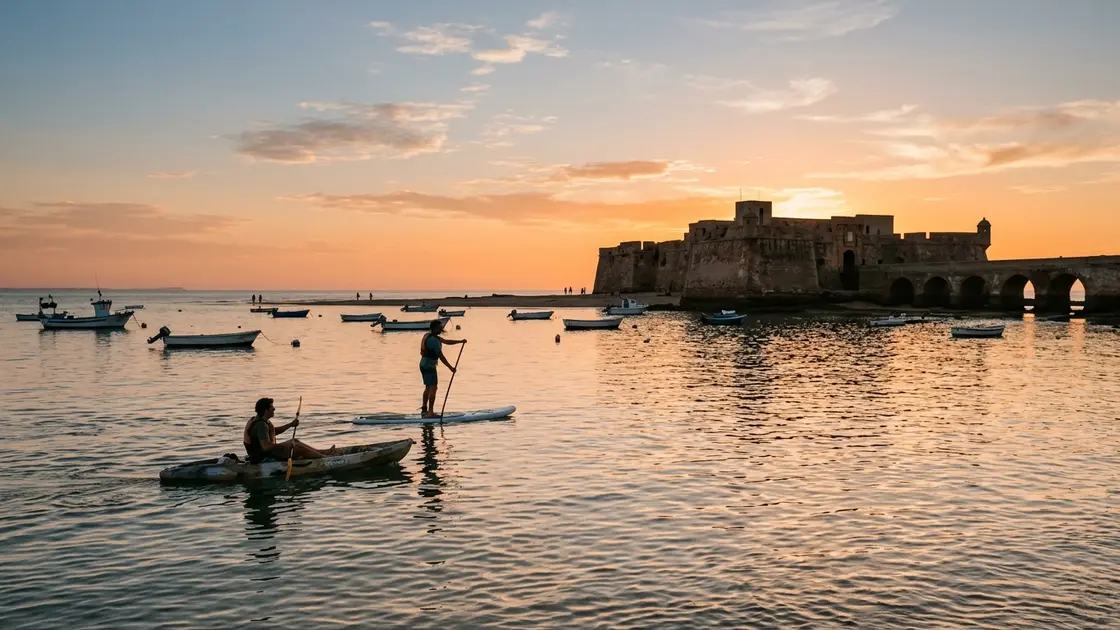
The natural place for a sunset paddle in Cádiz is La Caleta, a small, sheltered cove with a fortress at each end. This page is about the water itself, the rules that apply, and what to confirm before you launch or book with an operator.
Where the paddle happens
La Caleta is a golden-sand beach of 450 m, and the tourism board lists its bathing conditions as calm water. The cove is closed at either end by a castle: Castillo de Santa Catalina at one end and Castillo de San Sebastián on the islet at the other. Staying between the two keeps you in the most protected water in the old town and gives you both silhouettes against the sky.
Santa Catalina is a star-shaped fort designed by Cristóbal de Rojas after the Anglo-Dutch sack of 1596. San Sebastián took its present form later: a castle went up on the islet in 1706 to strengthen its defences. From a board or a kayak you see their bastions at water level, which a walk along the seafront cannot show you.
Before you book anything
No operator, price, duration or launch point has been verified for this page, so none is quoted. Guided sessions and rentals come and go with the season. Before paying, check the operator's current schedule and ask:
- whether the price includes the board or kayak, paddle, buoyancy aid and a guide
- where the session starts and ends, and how far the group paddles
- the minimum age and experience, and what happens if the sea is too rough
- whether a cancellation is refunded when conditions change
A session that offers no answer to the last two is worth skipping. If you would rather not book, the safest way to enjoy the same view is on foot: the seafront walk passes both castles.
Sea conditions and safety
The city's beach rules prohibit sport outside the zones and hours set aside for it, so confirm with the operator or the municipal beach services that the area and time you plan to use are permitted. The same rules ban bathing in the areas used by boats to enter and leave the water; keep clear of any boat lane, and do not cross the mouth of the cove.
Flags are written for bathers, but they are the best public signal on the sand:
| Flag | Meaning on the beach |
|---|---|
| Green | Good bathing conditions |
| Yellow | Caution when bathing |
| Red | Bathing banned |
Treat a red flag as a no-go for a paddle too, and think twice on yellow if you are new to the sport. For anything beyond the cove, the Spanish meteorological agency publishes a marine forecast with wind and wave-height maps; its warnings cover 48 hours. If a current pulls you out, do not paddle against it; move parallel to the shore until it releases you. In an emergency, alert the lifeguards, the municipal police on 091 or the 112 line.
Timing the sunset
Sunset shifts through the year, so look up the exact time for your date in a sunrise and sunset table rather than trusting a rule of thumb. Plan to be back on the sand while there is still light. Castillo de San Sebastián is open daily from 9:00 until sunset, with hours that change according to weather conditions, which makes a good fixed point for an evening: walk out along the causeway before or after you paddle.
Wear sun protection on the water. The city's advice is to avoid the hours of strongest radiation, 14:00 to 18:00, so an evening session is already on the gentle side. Bring a hat, water and a waterproof pouch for your phone, and leave valuables ashore.
Making a night of it
The La Caleta neighbourhood is right behind the sand, so a post-paddle drink or a plate of fried fish is a short walk away, and the comparison of Cádiz's four urban beaches compares the city's four beaches if you want a different launch spot. Allow time to dry off and to watch the light drop on the castles from the sand, which costs nothing and needs no booking.