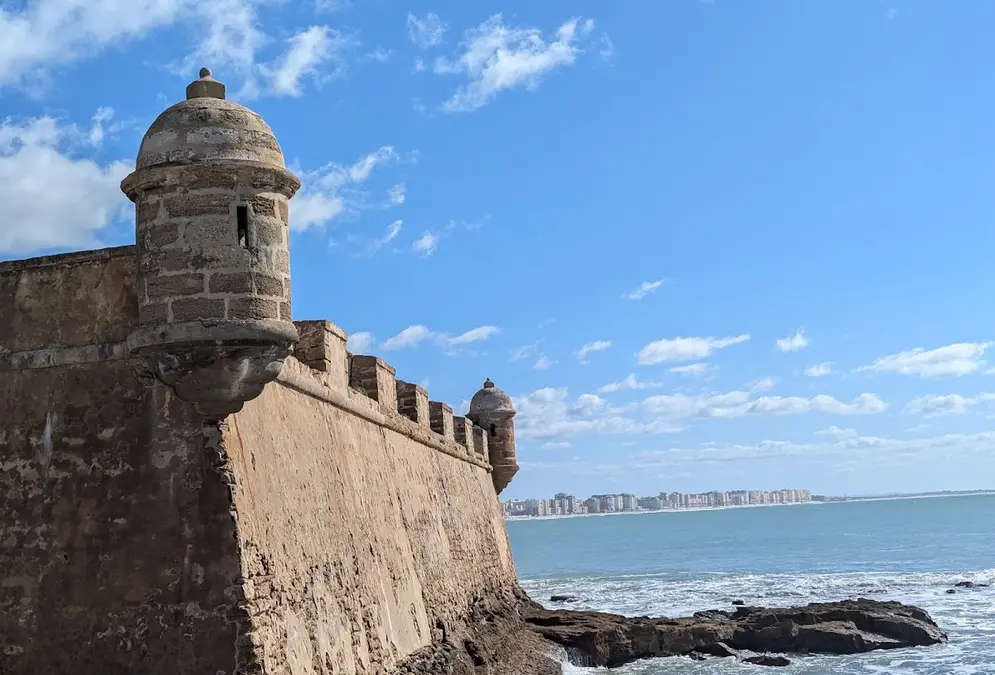
The Castillo de San Sebastián is a nine-sided sea fortress on its own rock at the northern end of La Caleta, reached on foot along a long causeway from the beach. A lighthouse rises from its seaward end, and the whole outline reads as a stone ship moored off the old town. It is the more exposed and more photogenic of the city's two sea castles, and the one whose doors have been the least predictable.
A chapel, a watchtower, then a fortress
The story starts small. A chapel was raised on the island in 1457 by a Venetian ship's crew recovering from the plague. A watchtower replaced it in 1613, and in 1706 the present castle went up: an irregular nine-sided plan with parapets, gun ports and two water moats crossed by drawbridges. Its job was to defend the northern flank of the city, the side where the Atlantic and an enemy fleet could arrive together.
The walls are ashlar of ostionera stone laid in lime mortar over a rubble core, and the sea is the building's main enemy. After storm damage, the Spanish government approved an emergency repair of sea-damaged wall sections in October 2023, budgeted at €865,000. The castle is catalogued as a Bien de Interés Cultural and belongs to the state, not the city: ownership stays with the Ministry for Ecological Transition.
The causeway is later than the castle. A levee linking island and city was built in 1860, which is why you now walk out dry-shod rather than arrive by boat.
Go for the last hour of daylight
The council lists the castle as open until sunset, and the walk out along the causeway is at its best as the light drops behind the old town. Check the sunset time for your date, because the castle closes with the light.
Prison, lighthouse and film set
The fort has done more than shoot at ships. It held Juan Bautista Azopardo, a prisoner of the Buenos Aires junta, from 1811 until 1815, when his captors suspected a leak and moved him to the military prison in Ceuta. Later uses ran from University of Cádiz facilities to occasional exhibitions and summer concerts, and it has also served as a film set, including for Die Another Day.
The lighthouse is a separate piece of engineering. Its iron structure was designed by Rafael de la Cerda in 1908 and was the second electric lighthouse in Spain; the tower stands 41 metres above the sea. From the shore it is the vertical line that tells you where the castle ends.
Visiting: what to know before you go
The castle was closed from March 2018, after a storm left the access path unusable. It reopened on Monday 12 August 2024, at first only for walking the inner esplanade and taking in the views, free of charge, and more than 100,000 people came between the reopening and the end of September. The city council's tourism page now lists it open every day from 9:00 until sunset, with free entry, and says the hours are subject to change with the weather.
Sunset comes early in winter, so go in the morning or early afternoon. Expect an esplanade and a view, not a museum: the interior is half-restored, and the building is reported to share space with the University of Cádiz's marine research laboratory.
The approach is the pleasure in itself. Start at the end of La Caleta beach and follow the Paseo Fernando Quiñones out along the causeway, with the water on both sides. The other sea castle, the Castillo de Santa Catalina, stands at the opposite end of the same beach, so the two make a natural pair. The causeway is exposed, so choose a calm day: it was a storm that cut the route in 2018.