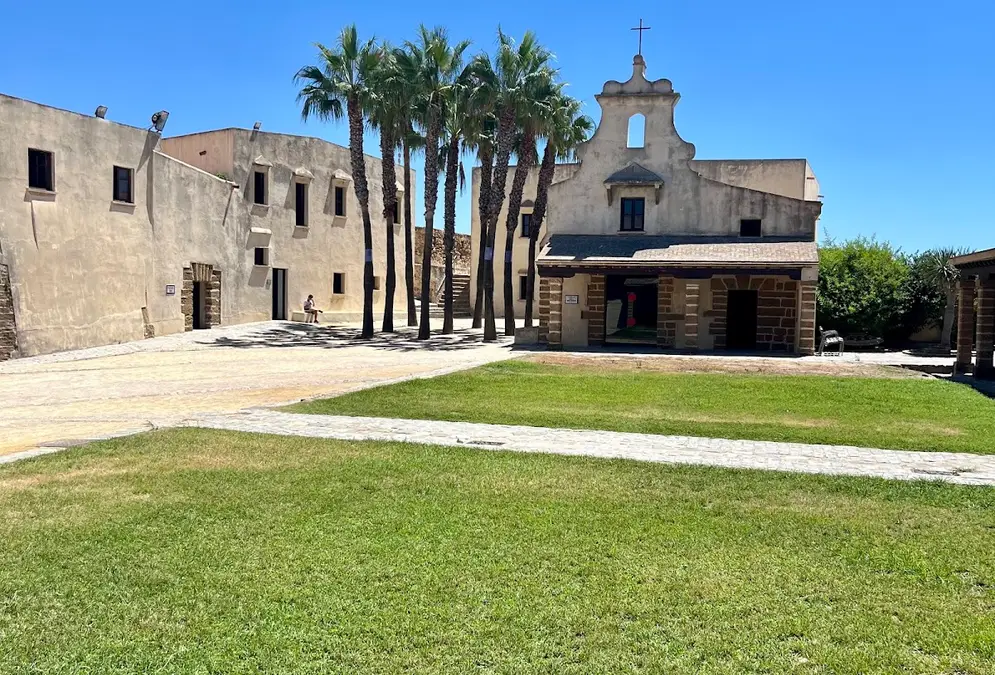
The Castillo de Santa Catalina is the star-shaped fortress that closes the north end of La Caleta, pushing its points out into the Atlantic on breakwaters. It is a Habsburg answer to a specific humiliation: after the Anglo-Dutch assault on Cádiz in 1596, Philip II ordered the engineer Cristóbal de Rojas to design a defensive fortress by Real Cédula, an order dated to the end of the 1590s.
The plan is pentagonal and Italian in inspiration, with the angled bastions that make the castle look like a star from the air. Rojas died before finishing his project, which is why what stands is more modest than what was drawn. It is a free visit and one of the few places in Cádiz where you can walk a seaward rampart without a ticket.
When to Visit
Visit duration
About one hour
A fortress that became a prison
The castle was a working defence first and a place of confinement second. A chapel and sacristy were added under Charles II in 1693, dedicated to St Catherine of Alexandria and the Immaculate Conception. In 1769 Charles III turned the fortress into a military prison for prominent prisoners.
The best-known of them is the Mexican independence leader Mariano Abasolo, who died here of tuberculosis on 14 April 1816, aged 32. The Ministry of Defence stopped using the castle in 1991, and the city has since run it as a cultural venue.
The castle is free, but events may not be
Entry is free except for announced events. Check the programme before you go: a concert or special exhibition can be ticketed, while an ordinary day costs nothing.
What you see inside
Inside the walls are pavilions, barracks and cisterns, originally powder stores. Today they hold three rotating exhibition rooms and a permanent display set above the sea, and the parade ground hosts concerts and events. The schedule changes, so what is on depends on the week you arrive.
The detail most visitors remember is a window cut in the wall that frames the beach of La Caleta, the 600-metre curve of sand the locals use. Stand there before you walk back along the promenade.
How it pairs with San Sebastián
The castle is the northern anchor of La Caleta, and the Castillo de San Sebastián holds the opposite end. Seeing both takes under half a day at a gentle pace: the promenade between them is flat. Both appeared in Die Another Day (2002), when Cádiz stood in for Havana and the two castles served as the film's DNA clinic.
Planning your visit
Entry is free except for previously announced events, so check the programme if you are going for a concert. The city council lists winter hours (1 October to 31 March) as 11:00 to 19:00 and summer hours (1 April to 30 September) as 11:00 to 19:30, every day, with summer hours subject to the concerts and other activities programmed. The fortress is a protected Bien de Interés Cultural, and it has briefly closed for safety checks after stonework came loose from the façade, so a short closure is possible.