How Roman Gades Rose on Balbus Money and Salted Fish
Roman Gades went from federate city to Roman municipium in 49 BC. Meet the Balbus family, the garum trade and Columella, the farming writer born there.
Historian specialising in Cádiz's ancient, colonial and constitutional heritage.
Updated ·Published
Gades became a Roman municipium in 49 BC[1], but the Roman city people remember was paid for by fish: salted tuna and garum made it rich enough to count five hundred knights[2], a number no Italian town matched except Padua. Two members of the Balbus family, uncle and nephew, carried that prosperity into Roman politics, with a consulship in 40 BC[3], and back into Cádiz as a New Town[4].
Knights counted at Gades
500
Equestrian citizens in Strabo's census; only Padua matched it[2]
Artificial heap used as the city's dump from the mid-1st century BC[5]
In this article
Jump to a section
⌄
A federate city that became Roman in 49 BC
Gades began its Roman career as a federate city, an ally that sided with Rome against the rebel Sertorius in Spain.[6] In his day its laws and its language were still Phoenician.[7] The change came in 49 BC, when the city took on a new legal status as the municipium Gaditanum and gradually adopted Italic customs.[1]
Outsiders took longer to notice than the paperwork did. Strabo still called the people of Gades Phoenicians, while Columella, some years later, called them Romans.[8] Augustus then made the city the head of one of the four divisions of the province of Baetica.[9]
Two men gave that legal change a face and a budget. Both were called Lucius Cornelius Balbus, they were uncle and nephew, and both came from Gades.
Balbus the Elder, the banker who became consul
Lucius Cornelius Balbus the Elder is the one Cicero defended in court, and the speech survives. The prosecution's only real complaint, Cicero said, was that Balbus had been born at Gades, which nobody denied.[10] Pompey had already rewarded his service against Sertorius with Roman citizenship for Balbus, his brother and his brother's sons, a grant ratified in 72 BC.[11] Balbus went on to advise Caesar and to finance part of his campaigns.[12]
Success drew enemies. In 56 BC he was prosecuted over the legality of his naturalization, and Pompey, Crassus and Cicero stood up for him.[13][14] He was acquitted, and in 40 BC he became the first naturalized Roman to hold a consulship.[3] When he died, after 32 BC, he left 25 denarii to every citizen.[15]
Timeline
72 BC
Pompey grants citizenship
Balbus the Elder, his brother and his nephews become Roman citizens.[11]
56 BC
Trial of Balbus the Elder
Cicero, Pompey and Crassus defend him; he is acquitted.[14]
The first naturalized Roman to hold the office.[3]
The Elder's path shows how far a Gaditane could go once the city's status changed. His nephew would spend the standing that path earned on Gades itself.
Balbus the Younger and the New Town
Balbus the Younger turned the family's standing into building work. He was the first naturalized Roman, and the last man not related to an emperor, to celebrate a triumph,[16] and he gave Gades a "new city" that reshaped the old Phoenician town to suit Roman tastes.[4] Strabo describes a small island city that had added a New Town, and a sea-port on the opposite mainland built by Balbus.[17][18]
The best-known piece of that project is the Roman Theatre, the Theatrum Balbi. It went up in the 1st century BC[19] and, according to a University of Cádiz exhibition, was the first theatre in Hispania to import marble from the quarries of Luni, modern Carrara.[20] The same Balbus built one of the three theatres of Rome itself.[21]
Strabo's picture is of a city that lived on the water: its people fitted out more of the largest ships than any other, for the Mediterranean and the ocean alike.[22] That seafaring shows up everywhere in Roman Gades, most of all in what the city sold.
Salted tuna, garum and five hundred knights
Strabo heard that a census of his own time listed five hundred Gaditane citizens of equestrian rank, a total that no Italian city equalled except Padua.[2] Equestrian status carried a minimum census of 400,000 sesterces.[23] That is serious money for a town on a strip of rock, and the tuna on its coins points to one source.
Excavators have found several salting factories in Cádiz, recognisable by the vats where the catch was macerated.[24] The one the Junta de Andalucía shows to visitors processed fish into salted fish and sauces, among them garum.[25] The business left four kinds of trace:
Recommended tours
Tours are selected for quality, not commission. We earn a small fee if you book, at no extra cost to you.
Garum was no casual condiment. It took several weeks of maceration[29] and the better grades could be aged for up to four years.[30] The type made from tuna blood was kept for the wealthier municipal elites.[31] The tuna itself still reaches the table in Cádiz as mojama, salt-cured and sliced thin.
Columella and the Gaditane elite
By the Flavian age the notables of Gades had reserved seats in the Colosseum,[32] and the mother of Emperor Hadrian, Domitia Paulina, came from the city.[33] The writer among them is Columella.
Columella was born in Gades around AD 4[34] and served as a soldier, then took up farming himself and wrote in the hope of arousing a love of country life.[35] His De re rustica runs to twelve books[36] and a University of Cádiz exhibition calls it the most important treatise on agriculture, animal husbandry and veterinary medicine that Antiquity left us.[37]
Gades is never far from the text. When Columella names the fish of its waters he speaks of the city as our municipium, which is the best evidence that he was born there.[38] He also tells of his uncle's experiment with African rams, shipped to Gades for the amphitheatre games and crossbred.[39] Fish and sheep sit side by side in his pages, which fits a city whose wealth ran from the sea to the pasture.
What survives of Roman Gades in Cádiz
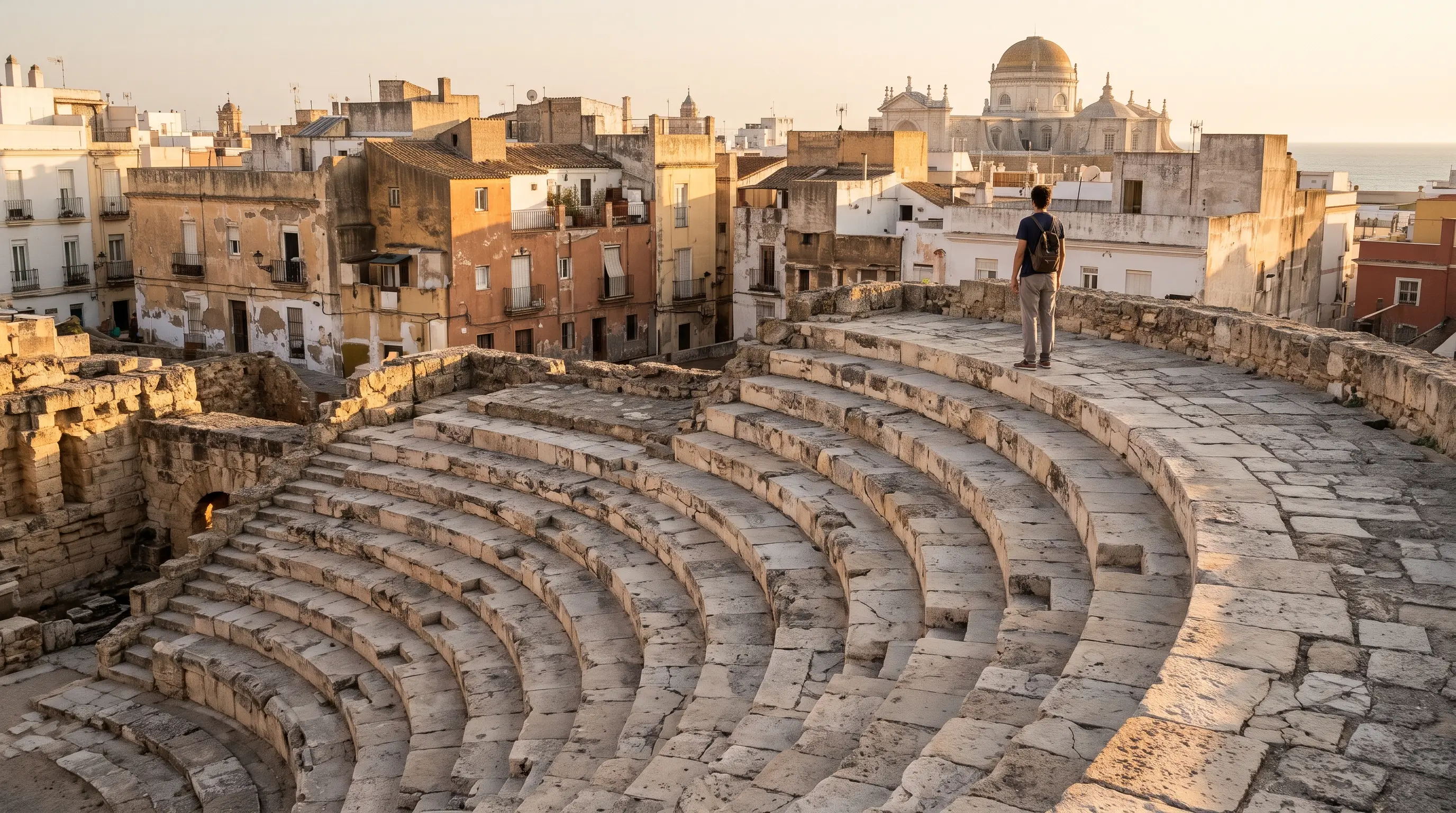
Little of Roman Gades is visible, because the old town grew over it. The theatre is the clearest case. Its stage building and the portico behind it have never been excavated, and their ruins lie under the houses of El Pópulo.[40] The building was abandoned at the end of the 3rd century AD and plundered from the next century on.[41] The Junta de Andalucía says that access to the excavated area is temporarily restricted while expansion works go on, so check before you plan around it.[42]
The salting factory is the second anchor. The building dates from the 1st century BC and stayed in use until the 5th century AD.[43] The Junta de Andalucía lists it as open Monday to Friday from 10:00 to 13:30[44] and at weekends from 10:00 to 14:00,[45] but check before you go. Two more factories, under the former Teatro Andalucía and the Teatro Cómico, stand on what was once the shore of the strait between the two ancient islands and are now museums.[46]
For objects, the archaeology rooms of the Museo de Cádiz take the story on from Phoenician Gadir through Roman Gades, although it is worth checking which rooms are open before you go. And a replica of the Columella sculpture stands in the Plaza de las Flores.[47]
Frequently asked questions
What was Roman Gades and where was it?
Roman Gades was the Roman-era city on the site of today's Cádiz, a former Phoenician-Punic port on the islands of the bay. It became the municipium Gaditanum in 49 BC and later headed one of the four divisions of the province of Baetica.
Who was Lucius Cornelius Balbus?
He was a banker and politician born in Gades who gained Roman citizenship from Pompey, advised Caesar and became consul in 40 BC, the first naturalized Roman to hold the office. His nephew of the same name is known as Balbus the Younger.
What is the difference between Balbus the Elder and Balbus the Younger?
The Elder was the consul and Caesar's adviser. The Younger, his nephew, celebrated a triumph and is credited with the New Town of Gades, its harbour and the Theatrum Balbi.
Was garum made in Roman Gades?
Yes. Several salting factories have been excavated in Cádiz, and the city's products were salted fish and sauces such as garum. The tuna on the local coins shows how central the trade was.
Who was Columella and was he really from Cádiz?
Columella was a Roman soldier and farmer who wrote the twelve books of De re rustica. His birth in Gades rests on his own text, where he calls the city our municipium, and a replica of his statue stands in the Plaza de las Flores.
Where can you see Roman Gades in Cádiz today?
The Roman Theatre and the salting factory, both run by the Junta de Andalucía, are the two main sites. Check opening and access before you go, because expansion works at the theatre have restricted the excavation area.
“I have heard that in a census taken within our own times, there were enumerated five hundred citizens of Gades of the equestrian order, a number equalled by none of the Italian cities excepting that of the Patavini.”
“that Pompey conferred the Roman citizenship upon him, his brother, and his brother's sons and this act of Pompey was ratified by the law of the consuls, Cn. Cornelius Lentulus and L. Gellius, B. C. 72.”
“was a Roman soldier and farmer who wrote extensively on agriculture and kindred subjects in the hope of arousing a love for farming and a simple life”
“The most monumental area of the complex, the stage and the portico behind it, have not been unearthed and their ruins remain hidden under the El Pópulo neighbourhood.”
“Las obras de ampliación que se ejecutan actualmente en el enclave afectan al yacimiento arqueológico, cuyo acceso se encuentra temporalmente restringido.”
“with notable examples being those at the former Teatro Andalucía and the Teatro Cómico, both located on the shores of the inter-island strait and now museums.”