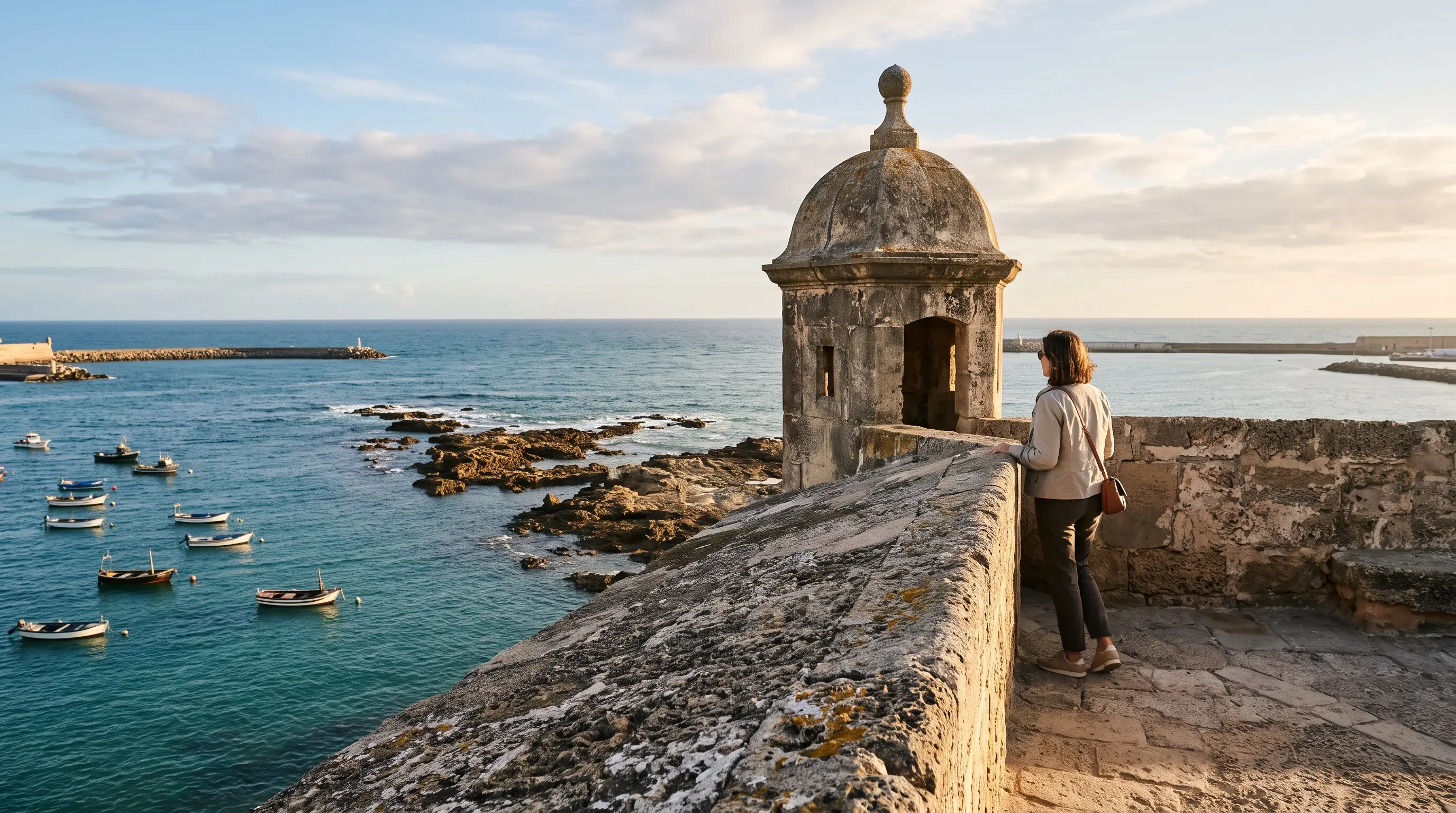

Why Francis Drake attacked Cádiz in April 1587
Drake sailed for Cádiz in April 1587 to strike the invasion fleet and supplies that King Philip II had begun assembling against Queen Elizabeth I the previous year.[2][6] Admiral Álvaro de Bazán, Marquis of Santa Cruz, had proposed a combined land and sea invasion of England, and in 1586 the Spanish Crown approved the plan.[6] Casks, ammunition and hulls gathered across Iberian ports, with Cádiz Harbour serving as one of the main assembly anchorages.
London answered with a joint-stock raid. Drake departed Plymouth on 12 April 1587 aboard the Elizabeth Bonaventure, one of four Royal Navy galleons owned by Elizabeth I, who claimed 50 per cent of the venture's profits while London merchants financed the remaining vessels.[2][7] Royal Museums Greenwich counts 23 warships in Drake's squadron, whereas a contemporary manuscript plan drawn by his second-in-command, William Borough, puts the attacking fleet at 27 ships.[1][8]
At dusk on 19 April 1587, the English ships entered the Bay of Cádiz flying no flags.[1][9] The warships in the port under Pedro de Acuña's command (referred to in English accounts as Pedro de Acuña's galleons) sailed out to confront Drake and were driven back into the roadstead.[9] At the inner-bay narrows of Puntales, only a small battery armed with five cannons stood on the spit to contest the passage.[10] Fighting through the night and the next day under shore fire, Drake failed to take or plunder the town itself, yet Borough's chart records 22 vessels burned or sunk and Royal Museums Greenwich counts 33 destroyed, alongside captured provisions and ammunition.[1][8]
From singeing the King's beard to the 1596 armada
The April 1587 raid delayed the Spanish Armada by a full year, an exploit Drake called singeing the King of Spain's beard.[2] Before the repaired fleet could sail, the Marquis of Santa Cruz died suddenly on 30 January 1588.[11] Philip II handed the command to Alonso Pérez de Guzmán, 7th Duke of Medina Sidonia, with Admiral Juan Martínez de Recalde as his deputy.[11]
Nine years later, Medina Sidonia faced a much larger English fleet on his own coast. On 13 June 1596 an expeditionary force sailed from Plymouth with 150 English ships, including 17 Royal Navy warships, divided into four squadrons carrying 6,360 paid soldiers, 1,000 English volunteers and 6,772 sailors.[12] Command was split between Admiral Charles Howard, Lord Effingham, at sea and Robert Devereux, 2nd Earl of Essex, on land, with squadrons under Lord Thomas Howard, Sir Walter Raleigh and Sir Francis Vere.[13]
| Feature | 1587 Cádiz raid | 1596 capture and sack |
|---|---|---|
| Date at Cádiz | 19 April 1587[1] | 30 June to 15 July 1596[4][15] |
| Commanders | Sir Francis Drake, William Borough[1][8] | Earl of Essex, Charles Howard[13] |
| Attacking fleet | 23 to 27 ships (4 Royal Navy galleons)[1][7][8] | 150 English ships (17 Royal Navy)[12] |
| Spanish ships lost | 22 to 33 vessels burned or sunk[1][8] | 2 captured, 2 grounded, 32 burned at Puerto Real[3][16] |
| Fate of the city | Port raided; town not taken[8] | Occupied, ransomed and 290 houses burned[4][5][17] |
On board sailed the naval constructor and cartographer Robert Dudley, the young poet John Donne, the chronicler William Slyngisbie and Essex's cartographer, who mapped the assault.[14] When the ships appeared off Cádiz on 30 June 1596, the bay held roughly 40 Spanish warships (galleys and galleons) plus 16 unarmed naos of the Indies fleet waiting to sail for America, which immediately sought shelter inside the bay at Puerto Real.[15]
How Essex took Cádiz and Medina Sidonia burned the Indies fleet
The 150-ship English fleet forced the entrance of the bay at 8:00 a.m. on 30 June 1596 and captured the city before 5:00 p.m. that afternoon.[12][16][18] In the morning artillery duel, the outnumbered Spanish warships fell back toward the inner bay; the English captured the galleons San Andrés and San Mateo, while the captains of the San Felipe and Santo Tomás ran their ships aground and set them alight rather than surrender them.[16]
At 2:00 p.m., no more than 2,000 English soldiers landed at El Puntal.[18] The Spanish defenders sent out to hold the isthmus went into action with nobody in command, broke before the English advance, and left the approaches open.[18] Within three hours the vanguard held the town with scant resistance.[18] Rather than let the attackers seize the merchant convoy and warships sheltering at Puerto Real, the Duke of Medina Sidonia ordered the Spanish fleet destroyed: 32 vessels, including the armada galleys and the unarmed Indies naos, were burned at anchor.[3]
On 3 July 1596, civil and church authorities agreed to evacuate the townspeople toward the Puente Zuazo wearing only the clothes on their backs, against a promised ransom of 120,000 ducats and the release of 51 English prisoners from earlier campaigns.[17] Essex, Sir Francis Vere and the commanders wanted to garrison Cádiz permanently, but when the ransom went unpaid the occupiers set fire to the town on 14 July and sailed out on 15 July taking the hostages with them.[4]
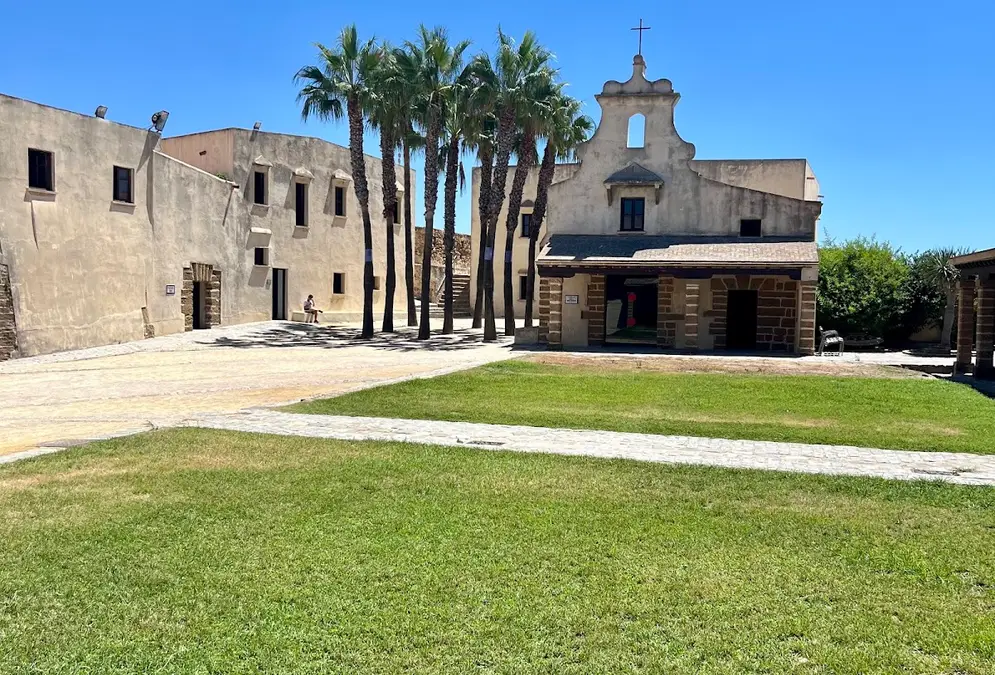
Don't miss · Monument
Castillo de Santa Catalina
Star-shaped sea fortress at the north end of La Caleta, built after the 1596 Anglo-Dutch sack. Free entry, exhibition rooms and a past as a…
The two-week sack left the medieval port in ashes. Beyond its churches and hospitals, fire consumed 290 of Cádiz's 1,303 houses.[5] Among the ruined buildings stood the Old Cathedral of Santa Cruz, originally founded in Gothic-Mudéjar style with three aisles and a coffered wooden ceiling, then modified in 1572 before the 1596 fire forced a complete rebuild in 1606 as a hall church with Tuscan columns.[19]
Why Philip II chose Cristóbal de Rojas over abandoning Cádiz
After the English sailed away on 15 July 1596, the Spanish Crown debated whether to dismantle Cádiz altogether and move the city across the bay to El Puerto de Santa María.[20] Four military engineers, Luis Bravo de Laguna, Tiburzio Spannocchi, Peleazzo Fratín and Cristóbal de Rojas, submitted competing plans for the ruined peninsula.[20] Philip II chose to stay and rebuild.
Recommended tours
Tours are selected for quality, not commission. We earn a small fee if you book, at no extra cost to you.
Rojas judged that the most urgent task was to close the exposed western anchorage at Santa Catalina bay.[21] On 25 October 1597, Philip II commissioned him to build Castillo de Santa Catalina on the rocks at the northern end of La Caleta; an inscription above the main gate records the start of work in 1598, and the fortress was completed on 5 September 1621.[22] Built on a pentagonal plan, it turned a three-pointed star toward the Atlantic and two semi-bastions with a moated drawbridge toward the town.[23]
Deep dive · Article
Why Christopher Columbus Sailed From Cádiz in 1493 and 1502
Christopher Columbus sailed from Cádiz on his 17-ship Second Voyage in 1493 and his Fourth Voyage in 1502. Trace his fleets and medieval El…
From 1598 the Crown also rebuilt the city's bastioned landward wall along the line of the Puerta de Tierra and overhauled the fort at El Puntal.[24] The test came on 1 November 1625, when a new English fleet carrying 10,000 men entered the bay and forced the surrender of El Puntal, only for its landing troops to be harassed and driven back to their ships leaving 2,000 men dead or drowned.[25] The post-1598 fortifications held against further attacks in 1640 and 1656, securing the harbour that later anchored Cádiz and the Atlantic trade.[24]
Where to see the 1596 sack and rebuild in Cádiz today
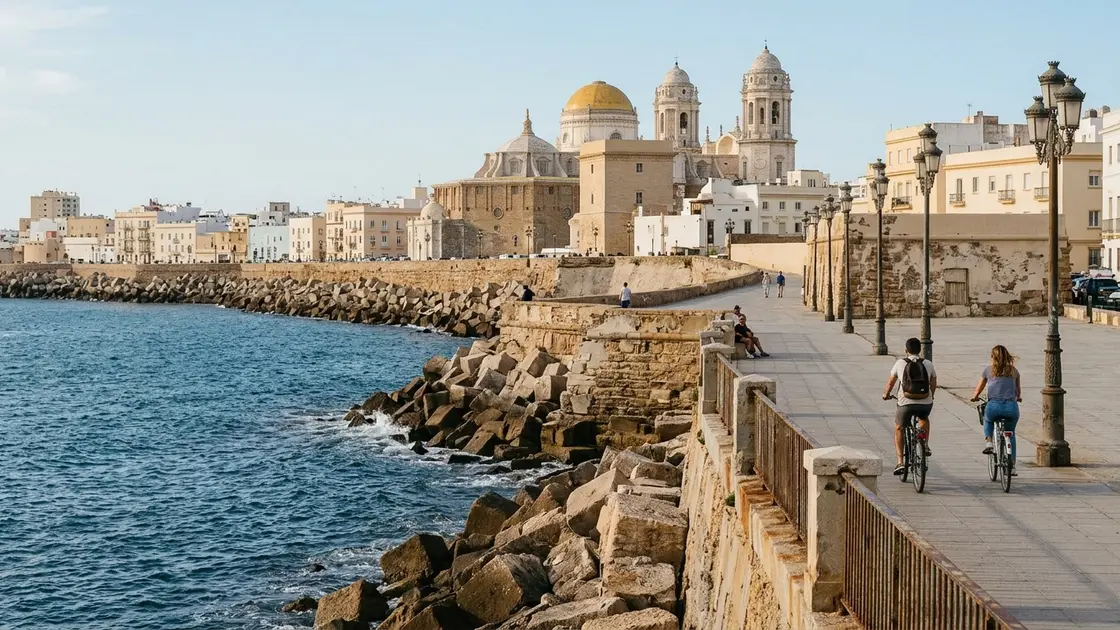
Four stops in the old town trace the destruction of July 1596 and the fortress programme that followed, starting on the Atlantic rocks of La Caleta and ending in the medieval streets of El Pópulo.[19][21][23] Because virtually every medieval church and house roof burned when the occupiers torched the city on 14 July 1596, what survives on the ground today is the post-1598 military shell and the 17th-century rebuilding inside it.[4][24]
- Castillo de Santa Catalina (La Caleta): Rojas's pentagonal fortress begun in 1598 and completed in 1621 stands at the northern end of La Caleta beach, where its three-pointed ocean star and drawbridge moat can be walked today.[21][22][23]
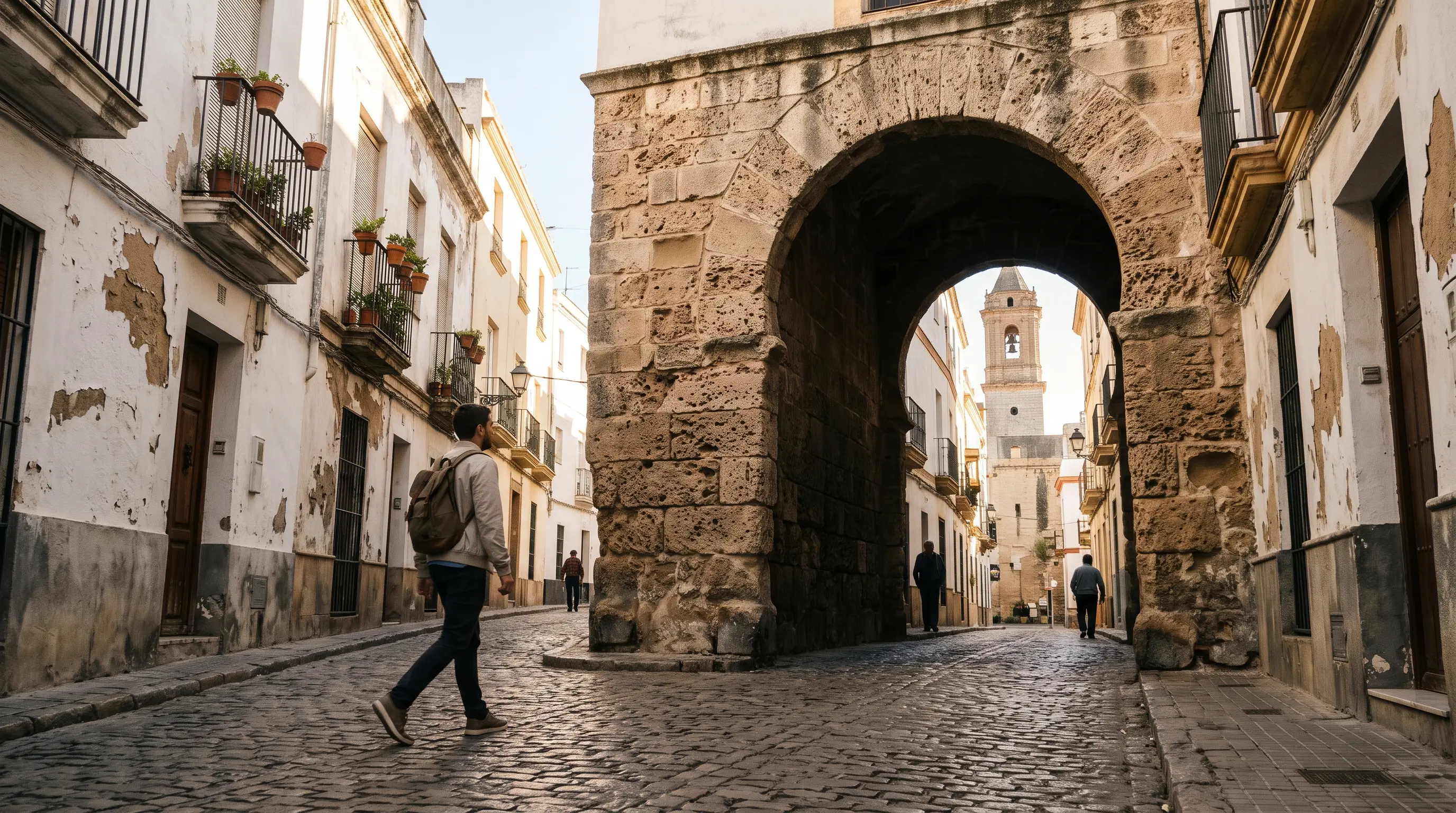
- Arco del Pópulo (El Pópulo): When you pass through the vaulted entrance of the medieval quarter from the harbour side, notice that the original portcullis (rastrillo) from the gate of Castillo de Santa Catalina was later reused here.[23]
- Iglesia de Santa Cruz / Catedral Vieja (Plaza de Fray Félix): Inside the oldest parish church in Cádiz, the three-aisled hall plan (Hallenkirche) and Tuscan columns supporting round arches belong to the 1606 reconstruction carried out after the 1596 fire gutted the Gothic-Mudéjar church.[19]
- Castillo de San Lorenzo del Puntal (Puntales narrows): Located on the inner-bay spit where a five-gun battery faced Drake in 1587 and where 2,000 English soldiers came ashore on 30 June 1596, the site remains a military zone visible from the bay side.[10][18]