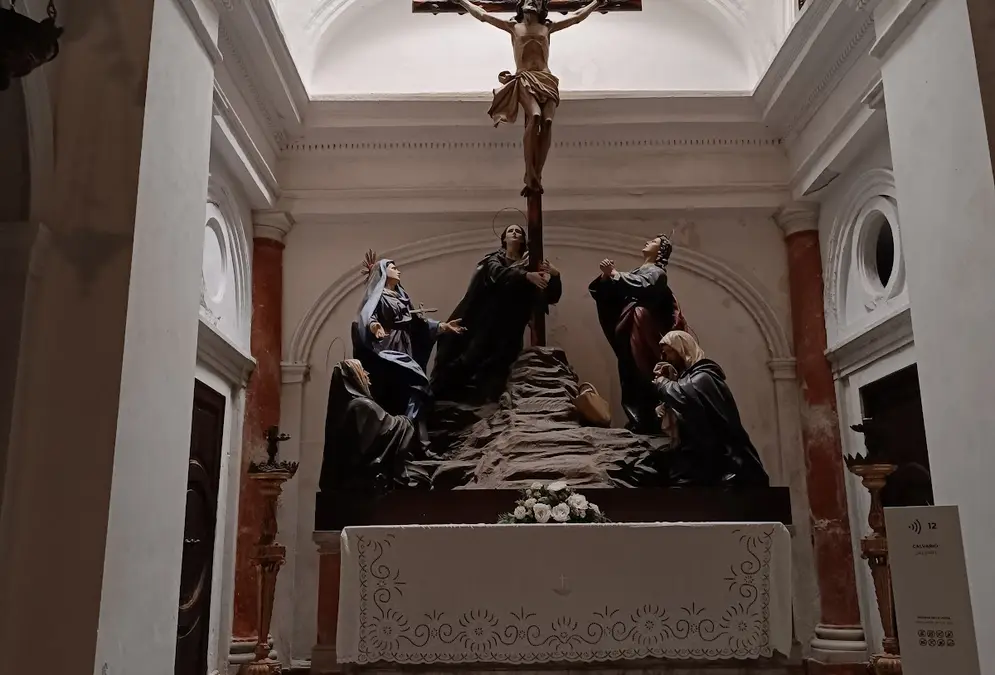
The Oratorio de la Santa Cueva is a small neoclassical oratory in Cádiz's old town, built in two levels for a lay brotherhood. The lower chapel is austere and underground; the upper one is an oval room lit and decorated for the Eucharist, with three paintings by Francisco de Goya among its five canvases. The paintings hang in the room they were made for, not in a museum gallery.
When to Visit
Quietest hours
Free slot Monday to Thursday, 09:30 to 10:30 (requested online)
Visit duration
About 30 to 45 minutes
Two chapels, two moods
The Spanish heritage record describes an upper chapel of extraordinary richness and light above an underground lower chapel of greater austerity and recollection. The lower room holds a polychrome wooden calvary by Vaccaro and Gandulfo.
The upper chapel is an oval, organised around seven adjoining arches on pilasters. Its architect, Torcuato Benjumeda, chose the oval in the Mannerist tradition that the Counter-Reformation favoured for a single, unified space. Two stucco high-reliefs by Cosme Velázquez complete the Eucharistic programme.
Ticket price and discounts
General entry is €5. Over-65s and under-25s pay €4, groups of 15 or more pay €3 each, and children under 12 go free. Carry ID if you expect a reduced rate.
Who built it, and when
The oratory replaced the original Santa Cueva, an underground chapel where the Cofradía de la Madre Antigua held its meetings. The founder and patron was José Sáenz de Santamaría, Marquis of Valde-Íñigo. In 1781 he commissioned the underground oratory from Torcuato Cayón de la Vega and his pupil Benjumeda, and it opened on Holy Thursday 1783. Work on the upper chapel began in 1793, and Bishop Antonio Martínez de la Plaza consecrated it on 31 March 1796.
Some sources, including the Spanish Wikipedia infobox, give 1771 as the start date. The Andalusian heritage institute (IAPH) documents 1781, 1783 and 1793-96, and this page follows it. The marquis also commissioned Haydn's The Seven Last Words of Our Saviour on the Cross for the Good Friday preaching of Christ's seven last words. The oratory was declared a national Historic-Artistic Monument in 1981.
The Goya paintings
The three Goyas are The Parable of the Wedding Guests, The Multiplication of the Loaves and Fishes and The Last Supper. The other two canvases are by Zacarías González Velázquez and José Camarón. They are oil on canvas, not frescoes, a mistake that is common on older web pages. The Goya Foundation gives c. 1796 as the most probable date, when the artist was back in the region. Goya made preparatory sketches, and two survive: Loaves and Fishes and The Last Supper. The paintings belong to the Diocese of Cádiz and Ceuta.
In 1997 the Junta de Andalucía, the Caja Madrid Foundation and the World Monuments Fund agreed to restore the canvases, which went to the Prado for the work. The Prado and the Museo de Cádiz staged an exhibition on them from 6 April to 11 June 2000.
Tickets and planning your visit
The council's tourism page lists €5 general entry, €4 for over-65s, under-25s and people with a disability under 60%, and €3 per person for groups of 15 or more. Children under 12 and people with a disability of 60% or more go in free. A free slot is offered Monday to Thursday, 09:30 to 10:30, and has to be requested online.
Visiting hours are Monday to Friday 10:30 to 16:00 (last entry 15:30) and Saturday 10:00 to 14:00 (last entry 13:30). In July and August Saturday opens at 10:30. Public holidays are closed and the listing shows no Sunday hours. The page is undated, so confirm before you go.
Combine it with the Oratorio de San Felipe Neri, a short walk away, then continue to the Cádiz Cathedral and the quarter of El Pópulo.