history-buffsart-loversarchitecturephotographerscouples
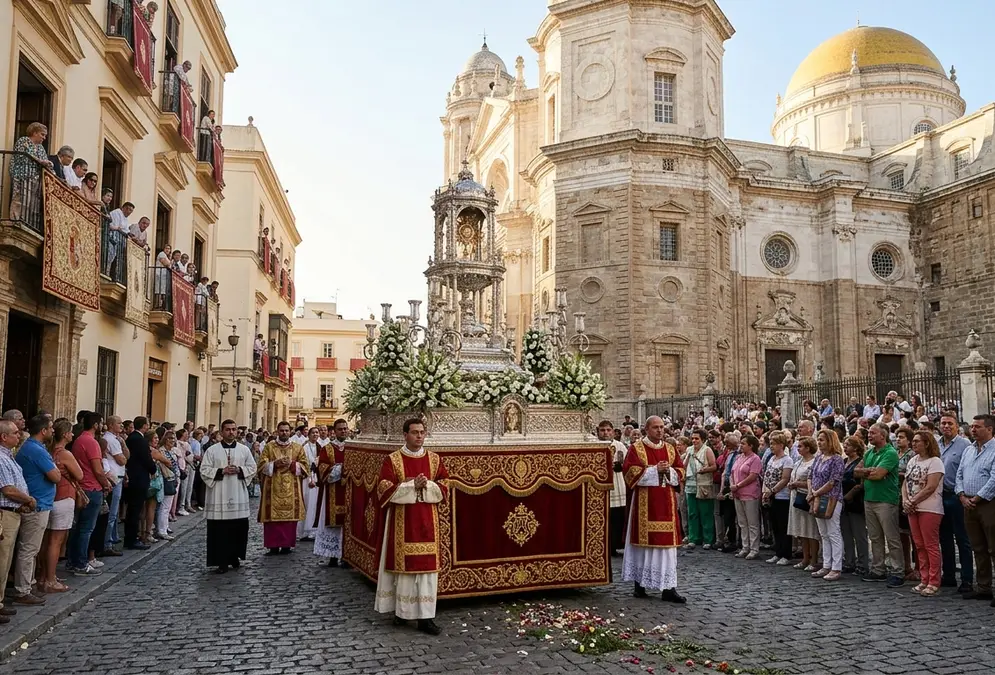
Ornate silver processional monstrance gleaming in the morning sunlight outside the Baroque facade and yellow dome of Cádiz Cathedral during the Corpus Christi procession through the historic centre
May or June Free Religious procession

Corpus Christi in Cádiz: Silver Monstrances & Procession

Corpus Christi en Cádiz

Corpus Christi in Cádiz brings 16th-century sacred metalwork and patron saints San Servando and San Germán from Cádiz Cathedral to Plaza San Juan de Dios.

Late May or June 2027 (dates TBA)
Weekend (Vísperas & Corpus Sunday)
Cádiz Cathedral, Plaza de la Catedral, Plaza de San Juan de Dios, El Pópulo
All events
Portrait of Lucía Barbera Quintero
Written by

Historian specialising in Cádiz's ancient, colonial and constitutional heritage.

Updated
Districts El Pópulo centro-historico

On this page

Jump to a section

Every spring, Cádiz Cathedral opens its doors on the Atlantic front, where its yellow-tiled dome faces the Campo del Sur beside the Roman Theatre and the Old Cathedral[4], to carry its sacred metalwork through the walled historic centre for the Solemnity of Corpus Christi. In the Spanish liturgical calendar, the feast falls on the Sunday after Trinity Sunday (sixty days after Easter Sunday). Because the Andalusian labour calendar sets Jueves Santo on 25 March 2027[9] (placing Easter Sunday on 28 March 2027), the liturgical solemnity of Corpus Christi falls in late May 2027, while the official 2027 municipal programme dates are TBA.

Sacred goldsmithing and the Sala de las Custodias

What sets Cádiz's Corpus Christi apart is the metallurgical wealth accumulated during the city's monopoly on the Indies trade. Year-round, that treasury resides in the Sala de las Custodias inside the Museo Catedralicio (Casa de la Contaduría) on Plaza Fray Félix, right next to the Catedral Vieja[5][8].

Treasury Highlight Period & Makers Where to See It
Sacred monstrances, trays & processional crosses 16th to 19th centuries, including master silversmith Enrique de Arfe[5] Sala de las Custodias & Corpus Christi procession
Custodia del Millón 18th century, crafted by Vicente Gómez de Ceballos under patron Miguel Calderón de la Barca (Council of the Indies), set with precious stones from across the world[6] Sala de las Custodias (Museo Catedralicio)
San Servando and San Germán Chryselephantine (gold and ivory) sculptures of Cádiz's patron martyrs, carved in the Philippines by artisans of Chinese origin[7] Sala de las Custodias (Museo Catedralicio)

Plaza de San Juan de Dios and the civic route

From the Cathedral, the solemn procession winds into the ceremonial heart of the city at Plaza de San Juan de Dios in medieval El Pópulo. Used since the 16th century as Cádiz's main urban square opening onto the port, the plaza is presided over by the Ayuntamiento de Cádiz[2]. On the lower square storey of the city hall façade stand the statues of the patron martyrs San Servando and San Germán[3], whose feast and civic patronage have long been intertwined with the Cathedral's Eucharistic cortège.

Historically, the religious feast was paired with a popular secular fair known as the Velada del Corpus. Held in the former Plaza de Isabel II and Calle de la Aduana (the old fish market), that civic festival was relocated in 1869 to the spacious Paseo de las Delicias (now Parque Genovés) and moved to the first half of August as the Velada de Nuestra Señora de los Ángeles[1].

How to see the monstrances year-round

If your visit falls outside the late May or June procession weekend, you do not have to miss the metalwork:

  • Combined ticket: A single admission ticket to Cádiz Cathedral grants entry to the Museo Catedralicio (Casa de la Contaduría) on Plaza Fray Félix[8].
  • Location: Walk around the flank of the Baroque Cathedral toward the Old Cathedral on Plaza Fray Félix to enter the museum rooms[4][8].
  • Schedule check: Confirm the official 2027 municipal and Cathedral chapter decree in spring for the exact morning procession departure and eve (víspera) concert times.

Highlights

  • Solemn morning Eucharistic procession departing from Cádiz Cathedral through the historic centre
  • 16th-to-19th-century sacred metalwork heritage including works by Enrique de Arfe
  • 18th-century Custodia del Millón by Vicente Gómez de Ceballos in the Cathedral Museum
  • Civic ceremonial passage across 16th-century Plaza de San Juan de Dios before the Ayuntamiento
  • Year-round access to the Sala de las Custodias in the Casa de la Contaduría with the Cathedral ticket

Stages and venues

Cádiz Cathedral (Santa Iglesia Catedral)

Corpus Sunday morning

Baroque and neoclassical cathedral facing the Campo del Sur where the solemn mass and procession begin.

Museo Catedralicio (Casa de la Contaduría)

Year-round museum hours

Houses the Sala de las Custodias, displaying Enrique de Arfe metalwork, the Custodia del Millón, and Filipino-Chinese ivory sculptures.

Plaza de San Juan de Dios

Morning procession route

16th-century civic square open to the port, presided over by the Ayuntamiento and its statues of San Servando and San Germán.

Key moments

Eve of Corpus Christi (dates TBA) Evening

Traditional víspera preparations in the historic centre ahead of the Sunday morning solemnity.

Corpus Christi Sunday (dates TBA) Morning

Liturgical solemnity on the Sunday after Trinity Sunday, with the Cathedral procession passing through Plaza de San Juan de Dios.

Year-round exhibition Cathedral opening hours

The Sala de las Custodias in the Casa de la Contaduría displays the Cathedral's monstrances and sacred silverwork on a single combined ticket.

Practical information

Hours

The main procession takes place on Corpus Christi Sunday morning (official 2027 municipal timetable TBA).

Best time

Morning along Plaza de la Catedral and Plaza de San Juan de Dios, or year-round inside the Casa de la Contaduría.

Tips

Keep your Cádiz Cathedral ticket stub: it includes entry to the Museo Catedralicio on Plaza Fray Félix where the Custodia del Millón is kept.

Getting there

Walk from the train or bus station at Plaza de Sevilla straight into Plaza de San Juan de Dios.

Price

Free street procession; Cathedral & Museo Catedralicio year-round entry ticketed

Tags

corpus christi religious festival procession free tradition cathedral sacred art

Reporter notebook

Insider tips

Money tip

Use your Cathedral ticket to enter the Casa de la Contaduría

Many visitors leave Plaza de la Catedral without realising their standard Cathedral entry ticket also admits them to the Museo Catedralicio on Plaza Fray Félix, where the Custodia del Millón and Enrique de Arfe metalwork are exhibited.

Photo spot

Watch the cortège enter Plaza de San Juan de Dios

Opened in the 16th century as the city's portside civic square, Plaza de San Juan de Dios gives the widest framing of the procession with the neoclassical Ayuntamiento and its statues of San Servando and San Germán in the background.

Local custom

Look for the Hispano-Philippine ivory carvings in the treasury

Inside the Sala de las Custodias, don't just look at the silver monstrances: check the gold-and-ivory (chryselephantine) statues of San Servando and San Germán, carved in the Philippines by Chinese craftsmen during Cádiz's overseas trade era.

Frequently asked questions

When is Corpus Christi in Cádiz in 2027?

In the Spanish liturgical calendar, the Solemnity of Corpus Christi falls on the Sunday after Trinity Sunday (sixty days after Easter). With Jueves Santo on 25 March 2027 and Viernes Santo on 26 March 2027 in the official Andalusian holiday calendar, Easter falls on 28 March 2027 and the liturgical Sunday of Corpus Christi falls in late May, while the official 2027 municipal programme dates are TBA[9].

Where can I see Cádiz Cathedral's monstrances if I miss Corpus Christi?

They are displayed year-round in the Sala de las Custodias inside the Museo Catedralicio (Casa de la Contaduría), located on Plaza Fray Félix beside the Old Cathedral[5][8]. The same admission ticket you buy for Cádiz Cathedral covers entry to the museum[8].

What is the Custodia del Millón in Cádiz?

The Custodia del Millón is an 18th-century monstrance crafted by Vicente Gómez de Ceballos under the patronage of Miguel Calderón de la Barca of the Council of the Indies[6]. Kept in the Sala de las Custodias, it is set with precious stones brought from across the world[6].

Who are San Servando and San Germán in Cádiz's Corpus Christi tradition?

San Servando and San Germán are the patron martyrs of Cádiz. Their statues flank the first storey of the Ayuntamiento façade on Plaza de San Juan de Dios, and the Cathedral Museum preserves chryselephantine (gold and ivory) sculptures of the two saints crafted in the Philippines by artisans of Chinese origin[3][7].

What was the Velada del Corpus in Cádiz?

The Velada del Corpus was the popular civic fair originally held alongside Corpus Christi in Plaza de Isabel II and Calle de la Aduana[1]. In 1869 the city council moved the celebration to the spacious Paseo de las Delicias (now Parque Genovés) and shifted it to the first half of August as the Velada de Nuestra Señora de los Ángeles[1].

Further reading

Sources

9 references Show
  1. Ayuntamiento de Cádiz — 1869 relocation of the Velada del Corpus (opens in a new tab)

    “En 1869, “ a causa de lo espacioso y bien urbanizado del parque”, se traslada al mismo la celebración anual de la Velada de Nuestra Señora de los Ángeles (Velada del Corpus), que hasta entonces tenía lugar en la Plaza de Isabel II y la Calle de la Aduana (antiguas Pescaderías), durante la primera quincena del mes de agosto.”

  2. Turismo de Cádiz — 16th-century Plaza de San Juan de Dios (opens in a new tab)

    “En el siglo XVI ya se utilizaba como centro de actividad urbana, abierto al puerto y presidido por el ayuntamiento.”

  3. Turismo de Cádiz — Ayuntamiento statues of San Servando and San Germán (opens in a new tab)

    “El primer cuerpo es de planta cuadrada, a los lados se destacan las estatuas de los patronos de la ciudad: San Servando y San Germán.”

  4. Spain.info — Cádiz Cathedral on the Atlantic front (opens in a new tab)

    “En la fachada atlántica se alza la cúpula de azulejos amarillos de la Catedral, que mira al Campo del Sur. De corte barroco y neoclásico, su cripta guarda los restos del compositor Manuel de Falla. A su lado se encuentran el antiguo teatro romano y la catedral vieja.”

  5. Cádiz Cathedral — Sala de las Custodias & Enrique de Arfe (opens in a new tab)

    “En ella se custodian auténticas obras de arte sacro sublimes, que abarcan la técnica de afamados artesanos del metal, como Enrique de Arfe, desde los siglos XVI al XIX condensados en la delicada factura de custodias, bandejas, cruces pectorales y procesionales y demás vasos sagrados.”

  6. Cádiz Cathedral — 18th-century Custodia del Millón (opens in a new tab)

    “Un ejemplo de ello es la llamada Custodia del Millón, realizada en el siglo XVIII por Vicente Gómez de Ceballos bajo el patronazgo de Miguel Calderón de la Barca, del Consejo de Indias, enriquecida con piedras preciosas procedentes de diversos lugares del mundo.”

  7. Cádiz Cathedral — Chryselephantine sculptures of San Servando and San Germán (opens in a new tab)

    “Destacan en esta sala las soberbias esculturas crisoelefantinas de los santos mártires patronos de Cádiz, san Servando y San Germán, realizadas en Filipinas por artesanos de origen chino”

  8. Cádiz Cathedral — Combined entry to Museo Catedralicio (Casa de la Contaduría) (opens in a new tab)

    “La misma entrada a la Catedral sirve para acceder al Museo Catedralicio o Casa de la Contaduría, situado en la plaza Fray Félix, junto a la Catedral Vieja.”