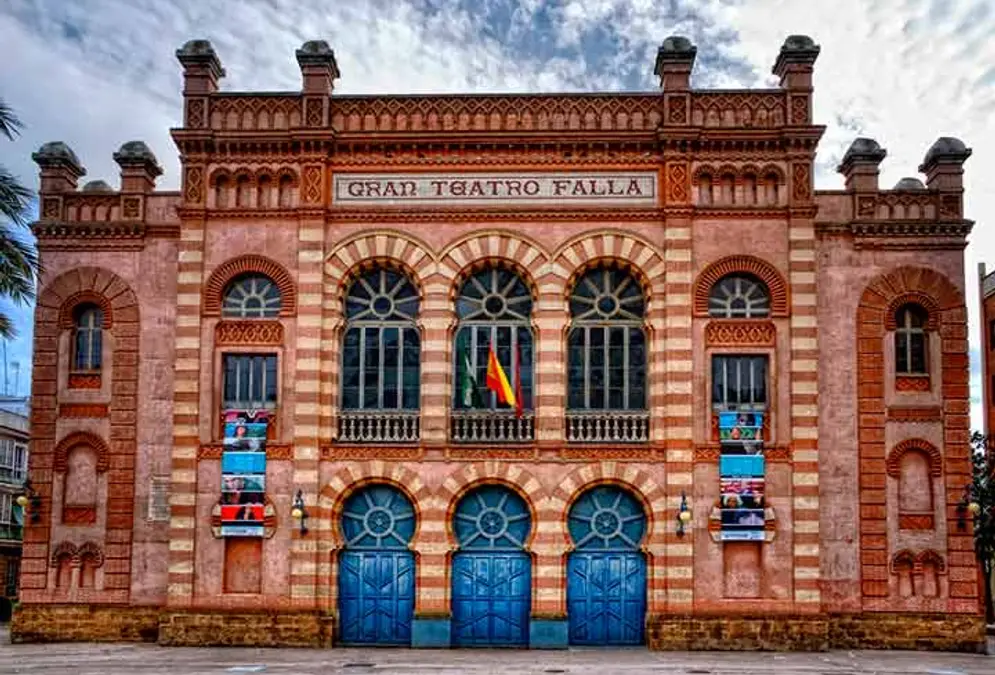
The Gran Teatro Falla is Cádiz's municipal theatre, a red-brick Neo-Mudéjar building on Plaza Fragela that doubles as the stage of the city's February Carnival song contest. It was built between 1884 and 1905 on the ashes of an earlier wooden theatre, and its horseshoe-arched façade is one of the most photographed in the old town.
The interior is not a museum you can wander through at will. Treat it as a working theatre: you go in for a performance, and the programme decides when.
A theatre built twice
The first Gran Teatro de Cádiz was a wooden building by García del Álamo, put up in 1871 and burned down in 1881. Construction of its replacement began in 1884 to plans by the architect Adolfo Morales de los Ríos. The city government took over the works in 1886 and they advanced in fits and starts for lack of funds. By the time the building was finished in 1905, municipal architect Juan Cabrera de la Torre had made significant changes to Morales's drawings. The theatre was inaugurated in January 1910, which is why the centenary was celebrated in 2010.
Until 1926 it was simply the Gran Teatro. That year it was renamed for Manuel de Falla, the composer the city treats as its favourite son.
Treat a visit as a ticket for a show, not a sightseeing stop
The interior is normally closed unless there is a programmed event. Check the programme first, or call the box office on 956 22 08 34, rather than turning up on Plaza Fragela hoping to be let in.
What to look at
Start outside, on Plaza Fragela. The main façade has three horseshoe-arched doorways with alternating red and white voussoirs, set in red brick: the Neo-Mudéjar vocabulary borrowed from Andalusian Islamic architecture, applied to a nineteenth-century civic building.
Inside, the auditorium follows a horseshoe plan and holds roughly 1,100 to 1,200 people; sources differ on the exact figure. The ceiling carries an allegory of Paradise by Felipe Abarzuza. The stage is about 18 m wide and 25.5 m deep, and under the pit there is a hidden resonance well, a cistern that was built to help the acoustics.
Carnival, February and the rest of the year
Every February the theatre hosts the competitions of the Carnival of Cádiz, the COAC, where the chirigotas, comparsas, coros and cuartetos compete. Carnival first sounded in the theatre in 1927, when the chorus Los Pelotaris of Manuel López Cañamaque performed. In 1960 the contest organisers changed the rules to create the comparsa modality for the lyricist and composer Paco Alba, whose Los Pajeros was his first official comparsa on this stage. During the 1987-1991 repair works the contest moved to the now-defunct Teatro Andalucía.
Outside Carnival, the programme covers music, theatre, cinema and major festivals. That programme is how most visitors get inside.
Visiting
The interior is generally closed unless an event is scheduled. The council's tourism page lists visits by prior request, and dramatised visits appear among the theatre's listed events, but no regular tour schedule or admission price is published. Check the programme and call the theatre on 956 22 08 34 before you plan around a visit. The building stands on Plaza Fragela in the old town, a short walk from the Cádiz Cathedral and the Oratorio de San Felipe Neri.