
food-loversfamiliesbudgetsolo
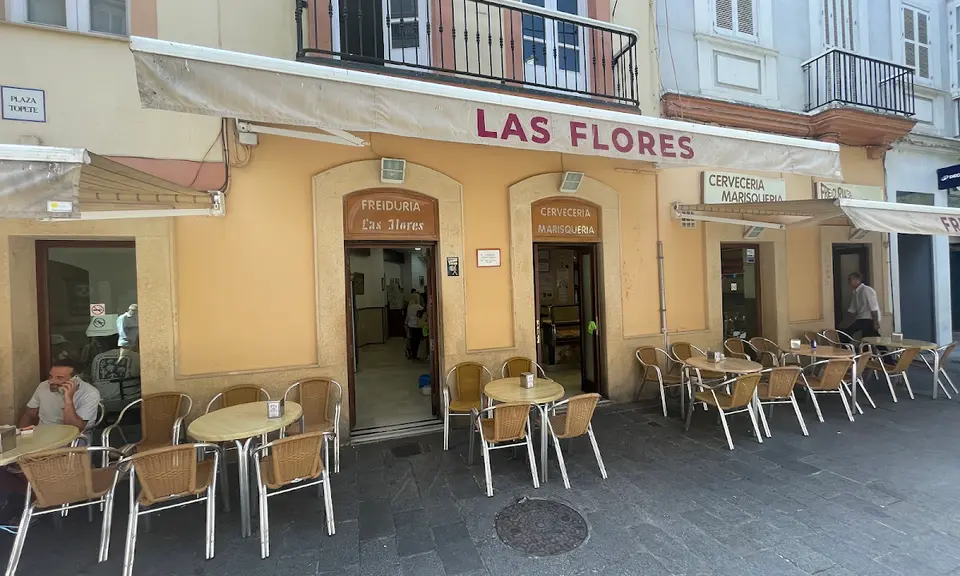
Glass counter and terrace of Freiduría Las Flores on Plaza Topete in Cádiz serving paper cones of pescaíto frito
Fried fish (freiduría)

Cádiz's benchmark paper-cone fried-fish counter and square-side terrace on Plaza de las Flores

Freiduría Las Flores on Plaza Topete 4 in Cádiz serves pescaíto frito and cazón en adobo by the 250g paper cone or at terrace tables since the late 1800s.

Why Freiduría Las Flores earns its place on the square

Freiduría Las Flores I stands at Plaza Topete 4—the square everyone in Cádiz calls Plaza de las Flores—just steps from the Mercado Central where morning shoppers crowd the stalls. Operating here since the late nineteenth century, it is the city's benchmark traditional freidor and what the local press calls the "kilometre zero" for pescaíto frito. Where some old-town squares trade on postcard scenery and tired oil, Las Flores keeps two distinct rhythms moving at once: a street-facing glass display counter (escaparate de cristal) weighing out hot fish into brown-paper cones for takeaway, and an adjoining bar, indoor dining room (salón), and outdoor terrace for sit-down plates.

How the paper-cone counter works

A traditional Cádiz freidor is built around its street window rather than a formal dining room. You look through the glass at the trays of freshly fried fish stacked under the lights, choose your mix, and buy it by weight on the spot. The standard unit at a freidor is un cuarto (250 grams), served hot inside a cone rolled from papel de estraza (stiff brown butcher's paper). That brown paper is practical rather than nostalgic: it wicks away excess frying oil while keeping the batter crisp as you walk across the square or perch on a bench beneath the trees.

What to order at the counter or terrace

Whether you are queuing at the takeaway window for a papelón or sitting down in the salón and terrace with a cold beer, the core order centres on the house frying pans:

  • Cazón en adobo (bienmesabe): pieces of school shark marinated in a sharp bath of vinegar and spices before hitting the hot oil.
  • Chocos fritos: strips of tender cuttlefish fried until crisp on the outside and soft inside.
  • Fritura variada: a mixed selection of the day's fried fish for sharing across the table or packing into a cone.
  • The classic papelón mix: local food writers at Cosas de Comé point out that a proper Cádiz paper cone combines cazón en adobo, slices (tajaitas) of pescadilla (whiting), chocos, huevas (fried roe), and a few croquetas—always ordered with the time-honoured excuse that they are for the children.

If you want a fuller tour of traditional Cádiz tavern cooking alongside your fish, pair a cone here with a stop for lacy tortillitas de camarones at one of the old-town bars nearby, or compare the sit-down seafood repertoire at El Faro de Cádiz in La Viña.

Opening hours, address, and the two branches

The flagship Freiduría Las Flores I at Plaza Topete 4 opens Monday to Sunday from 11:30 to 16:30 and from 19:30 to 23:30, and the municipal tourism board classifies its prices as economical. For takeaway or table enquiries, the venue's listed phone number is +34 678 08 20 12. Take care not to confuse this historic old-town address with its modern sister branch, Las Flores II, out on Calle Brasil along the Paseo Marítimo in the newer part of the city. During Carnival in February, Plaza de las Flores is one of the epicentres of street singing and the square fills completely; arrive at least half an hour before the kitchen opens at 11:30 or 19:30 if you want a table, or join the takeaway line and eat your cartucho standing on the cobbles.

House specialities

Pescaíto fritoCazón en adobo (bienmesabe)Chocos fritosFritura variadaCartucho de papel de estraza (takeaway cone)

Reporter notebook

Insider tips

What to order

Order by the cuarto in a brown-paper cone

Skip the wait for a terrace table when the square is busy and go straight to the glass street counter. Ask for un cuarto (250 grams) mixed between cazón en adobo and chocos fritos; the stiff papel de estraza cone drains the oil and keeps the batter crisp while you eat on the square.

Best time

Arrive 30 minutes before service during Carnival

Lunch opens at 11:30 and evening service at 19:30 seven days a week. During February's Carnival, Plaza de las Flores is one of the busiest spots in Cádiz, so turn up half an hour before opening if you want a sit-down table.

Local custom

Pair with a morning walk through the Mercado Central

Plaza Topete sits right next to the Mercado Central de Abastos. Browse the wet-fish stalls in the market hall late in the morning, then step onto Plaza de las Flores at 11:30 as the first batch of pescaíto frito comes out of the fryer.

Practical information

Cuisine
Fried fish (freiduría), Cádiz seafood
Average price
€ (Economical, sold by the 250g cuarto or ración)
Opening hours
Daily: 11:30–16:30, 19:30–23:30
Phone
+34 678 08 20 12 tel:+34 678 08 20 12
Address
Plaza Topete 4, Cádiz View on Google Maps

Frequently asked questions

Where is Freiduría Las Flores in Cádiz?

The flagship Freiduría Las Flores I is at Plaza Topete 4 (universally known as Plaza de las Flores) in the Centro Histórico of Cádiz, right next to the Mercado Central de Abastos.

What should you order at Freiduría Las Flores?

Order the cazón en adobo (bienmesabe), chocos fritos (fried cuttlefish), and the fritura variada (mixed fried fish). At the takeaway counter, a classic Cádiz cone mixes cazón, slices of pescadilla, chocos, huevas, and croquetas.

Can you get takeaway fried fish in a paper cone at Freiduría Las Flores?

Yes. The street-facing counter sells fried fish by weight, traditionally measured in cuartos of 250 grams, served hot in a brown-paper cone (cartucho de papel de estraza) that absorbs excess oil while you eat on Plaza de las Flores.

What are the opening hours of Freiduría Las Flores in Cádiz?

Freiduría Las Flores I is open daily from Monday to Sunday, from 11:30 to 16:30 for lunch and from 19:30 to 23:30 for dinner.

Further reading

Sources

11 references Show
  1. Turismo de Cádiz (opens in a new tab)

    “Tipo de establecimiento: FreidorZona: Mercado CentralDirección: Plaza Topete, 4Teléfono: 678 08 20 12”

  2. Turismo de Cádiz (opens in a new tab)

    “La Freiduría Las Flores I, en la Plaza de Topete (Plaza de las Flores), es una freiduría emblemática de Cádiz, con barra, salón y terraza, donde sirven pescado y marisco frito fresco a precios económicos desde finales del siglo XIX.”

  3. Turismo de Cádiz (opens in a new tab)

    “Horario: Lunes a domingo 11:30 - 16:30 y 19:30 - 23:30Especialidad: Pescaíto frito”

  4. codigocarnaval.com (opens in a new tab)

    “El «kilómetro cero» del pescaíto frito en Cádiz, en la Plaza de las Flores.”

  5. codigocarnaval.com (opens in a new tab)

    “Qué pedir: Cazón en adobo (bienmesabe), chocos fritos y su fritura variada.”

  6. codigocarnaval.com (opens in a new tab)

    “Consejo: Pide tu cartucho para llevar y cómetelo en la plaza, o siéntate en sus mesas: en Carnaval conviene ir media hora antes del servicio.”

  7. codigocarnaval.com (opens in a new tab)

    “Para pescaíto frito, Freiduría Las Flores; para tapeo con solera, Casa Manteca o Taberna Las Banderas; para alta cocina, Código de Barra o Mare (ambos con Estrella Michelin).”

  8. cadiz.cosasdecome.es (opens in a new tab)

    “Los freidores (ver que son y su historia aquí) suelen vender el pescado frito en cartuchos de papel de estraza. Se hace un cono con este papel, que además tiene la virtud de absorber el aceite sobrante y en su interior se pone el pescado.”

  9. cadiz.cosasdecome.es (opens in a new tab)

    “El pescado se vende al peso. Se suele medir por cuartos (250 gramos) y lo suyo es comerlo caliente.”

  10. cadiz.cosasdecome.es (opens in a new tab)

    “El freidor tradicional es un despacho que tiene como característica más representativa que el pescado se expone en un escaparate de cristal que se puede ver desde el exterior.”

  11. cadiz.cosasdecome.es (opens in a new tab)

    “El papelón perfecto del freidor debe tener cazón en adobo, unas tajaitas de pescadilla, los chocos, las huevas y, aunque siempre se dice que son “pa los niños”, sus poquitas de croquetas”