food-lovershistory-buffsarchitecturefamilies
The Mercado Central de Abastos, Cádiz
market neoclassical food-market

The Mercado Central de Abastos, Cádiz

Cádiz's 1838 Doric-colonnaded central market on Plaza de la Libertad, with 173 fish and produce stalls, the Rincón Gastronómico and free morning admission.

Traditional stalls: Mon-Sat 09:00-15:00 (Sun closed). Rincón Gastronómico: Mon-Fri 09:00-15:30
Free admission (Entrada libre)
Directions

The Mercado Central de Abastos is the oldest working market hall in Cádiz, an 1838 neoclassical quadrangle framed by four-metre Doric columns on Plaza de la Libertad, just behind Plaza de las Flores. Locals still call it simply La Plaza. Between the perimeter colonnade and the central pavilion sit 173 stalls, where fishmongers unpack bay seafood and bluefin tuna each morning while the outer aisles pour thin Cádiz churros, sherry and lunchtime tapas.

Unlike food halls that have surrendered their floor entirely to tourist bars, Cádiz's market splits the day in two. Mornings belong to the working fish, meat and vegetable counters, while lunch and Tuesday-to-Saturday evenings shift to the communal tables of the Rincón Gastronómico.

When to Visit

Visit duration

45 minutes to 1.5 hours

From Franciscan orchard to Doric peristyle

The market sits on the former orchard of the Convento de los Franciscanos Descalzos, land confiscated during the 1830s ecclesiastical expropriations (desamortización) of Juan Álvarez Mendizábal. The city council leased the plot for 15,000 reales a year during the first decade and 20,000 reales thereafter, voting in 1837 to erect a permanent civic provisioning square. Torcuato Benjumeda drew the plans for a rectangular neoclassical plaza enclosed by a Doric peristyle, and after Benjumeda died before work could begin, architect Juan Daura laid the foundation stone on 27 April 1837 and saw the building through to its December 1838 inauguration.

Construction came to 371,447 pesetas, which the municipality raised by raffling the 72 perimeter stalls among interested traders as each bay between the columns was finished. Every stall had its own ground-floor shop, mezzanine and cellar, leaving the open courtyard in the middle for street pedlars and, during city festivals, circus acts and theatrical performances.

That open courtyard lasted nearly ninety years. Between 1926 and 1929, on a project initiated under Mayor Agustín Blázquez with a budget of 10,607,247.68 pesetas and completed under Mayor Ramón de Carranza, Seville architect Juan Talavera filled the centre with a covered pavilion split into two large naves for fish and meat. Work began on 11 December 1926 and hit delays when builders struck active underground cisterns (aljibes) beneath the planned foundations; Talavera also added permanent exterior churro kiosks to clear freestanding stalls from the surrounding streets. A three-year refurbishment by Carlos Riaño costing €9,390,214, during which vendors traded from a temporary tent on Calle Libertad from 2 October 2007 until the building reopened on 15 December 2009, replaced the 1920s naves with a single central fish hall, pared 250 stalls down to 173, and preceded the market's declaration as a Bien de Interés Cultural on 16 December 2019.

Come before 11:30 for the fish hall, or after 13:30 for tapas

The 54 fish stalls are at their liveliest between 09:30 and 11:30 Tuesday to Saturday. If you are coming for the Rincón Gastronómico, arrive around 13:00 before the communal high tables fill up.

The 173 stalls and the fish hall

Riaño's renovation kept the historic Doric colonnade intact while reorganising the floor by trade across the central body and outer ring:

  • 57 fruit and vegetable stalls, some sharing the ends of the central pavilion and peeling fruit to order for older shoppers.
  • 54 fish, crustacean and mollusc stalls occupying the main central hall.
  • 44 meat and pork-product stalls, alongside 7 frozen-food counters and 4 bread and pastry stalls.
  • Single specialist counters for olives (1), paper and bags (1) and fishing tackle (1), plus a first-floor café.

Several counters have become city institutions in their own right. In the fish hall, Coucheiro has traded since 1961, supplying Cádiz's top restaurant kitchens and specialising in atún de almadraba sourced from Petaca Chico and the Algarve alongside bay delicacies like ostiones de Cádiz. Under the colonnade and in the meat aisles, Curro's sons Iván and Isaías slice chicharrones and spread manteca colorá, Matías stuffs olives by hand, and Pan de Aida sells long-fermented sourdough loaves. Outside the perimeter wall, the kiosk La Guapa works through more than 60 kilograms of dough a day to fry thin, crisp Cádiz-style churros twisted into loops.

The Rincón Gastronómico

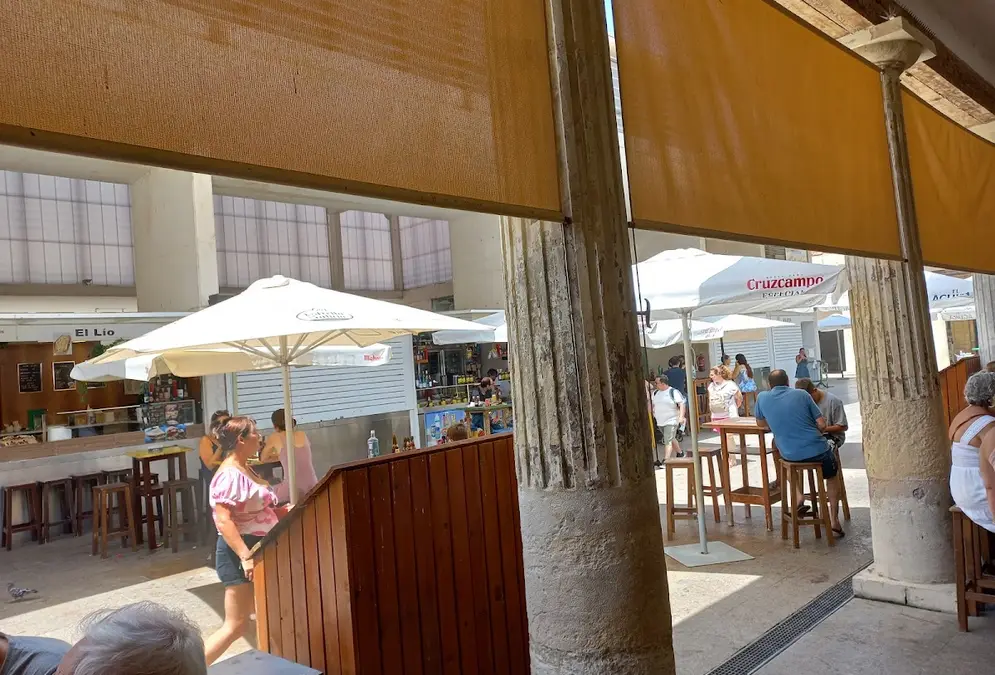
Around the outer galleries, the Rincón Gastronómico operates as an open-air food court under the Doric portico. The rule is simple: you buy plates or cones from any kiosk, including cazón en adobo, Basque-Cádiz pintxos at Aupa Kadi, Argentine empanadas from Jorge Marcelo, Japanese nigiri made with local fish at Gadisushi, or cured mojama y huevas, and carry them to any of the shared high tables in the courtyard. It is an easy stop to pair with an evening walk to Torre Tavira and the nearby Yacimiento Arqueológico Gadir, a daytime Cádiz tapas tour or a broader crawl through the nearby fishing quarter of La Viña.

Visiting and opening hours

Admission is free (entrada libre) with step-free access from Plaza de la Libertad. Because the building serves both morning shoppers and evening tapas crowds, the two halves of the market keep different timetables:

  • Traditional produce, meat and fish stalls run Monday to Saturday from 09:00 to 15:00 and close on Sundays.
  • Rincón Gastronómico daytime service runs Monday to Friday from 09:00 to 15:30 and Saturday from 09:00 to 16:00.
  • Rincón Gastronómico evening service runs Tuesday to Thursday from 20:00 to 00:00 and Friday and Saturday from 20:00 to 01:00 (hours vary slightly between winter and summer schedules, so check before a Sunday or Monday evening visit).

For the sharpest view of the fish counters in action, arrive between 09:30 and 11:30 on a Tuesday through Saturday morning, when the ice beds are full and the Rincón Gastronómico kiosks are not yet crowding the colonnade.

Reporter notebook

Insider tips

What to order

Start outside at La Guapa before entering the colonnade

Pick up a paper twist of thin, crisp Cádiz churros at the exterior kiosk La Guapa—which fries over 60 kg of hand-worked dough a day—before doing a circuit of the inside stalls.

Local custom

Mix and match plates across the Rincón Gastronómico

The courtyard tables under the Doric columns are shared across all kiosks, not tied to individual bars. One person can queue for fried fish while another fetches sushi from Gadisushi or pintxos from Aupa Kadi.

Practical information

Opening hours
Traditional stalls: Mon-Sat 09:00-15:00 (Sun closed). Rincón Gastronómico: Mon-Fri 09:00-15:30, Sat 09:00-16:00; evenings Tue-Thu 20:00-00:00, Fri-Sat 20:00-01:00.
Admission
Free admission (Entrada libre)
Address
Plaza de la Libertad, s/n, 11005 Cádiz, Spain View on Google Maps

Tags

market neoclassical food market bic 19th century free entry tapas

Frequently asked questions

What are the opening hours of the Mercado Central de Abastos in Cádiz?

The traditional fish, meat and fruit stalls open Monday to Saturday from 09:00 to 15:00 and close on Sundays. The Rincón Gastronómico tapas stalls open Monday to Friday 09:00 to 15:30, Saturday 09:00 to 16:00, and return in the evening Tuesday to Thursday 20:00 to 00:00 and Friday to Saturday 20:00 to 01:00.

Is the Mercado Central in Cádiz open on Sundays and in the evening?

The traditional fresh-produce stalls are closed on Sundays and every afternoon after 15:00. For evening drinks and tapas, the Rincón Gastronómico opens Tuesday to Saturday nights from 20:00 until midnight (01:00 on Fridays and Saturdays), though seasonal winter hours can occasionally add Sunday afternoon service.

Is entry to the Mercado Central de Cádiz free?

Yes, admission to the Mercado Central de Abastos is completely free, and the market has step-free access from Plaza de la Libertad.

Who designed the Mercado Central de Cádiz and when was it built?

Torcuato Benjumeda designed the neoclassical Doric-colonnaded plaza on the confiscated orchard of the Descalzos convent. After Benjumeda died, architect Juan Daura laid the first stone on 27 April 1837 and inaugurated the market in December 1838.

What should you eat at the Mercado Central de Abastos in Cádiz?

Look for thin Cádiz churros at the exterior kiosk La Guapa, sliced chicharrón and manteca colorá from the stalls of Curro's sons, hand-stuffed olives at Matías, and fresh almadraba tuna at Coucheiro. In the Rincón Gastronómico, you can mix fried fish, Gadisushi tuna nigiri, Aupa Kadi pintxos and Argentine empanadas at the communal tables.

Where is the Mercado Central de Abastos located in Cádiz?

It occupies Plaza de la Libertad, s/n (11005 Cádiz), immediately behind Plaza de las Flores and the main post office in the historic centre.

Further reading

Sources

21 references Show
  1. Turismo de Cádiz (opens in a new tab)

    “El proyecto del Mercado Central de Cádiz fue obra de Torcuato Bejumeda, quien propuso una plaza cuadrilátera de estilo neoclásico encerrada por el pórtico dórico, ubicada en los terrenos del convento de los Descalzos, hoy Plaza de la Libertad, expropiada en el década de 1830.”

  2. Turismo de Cádiz (opens in a new tab)

    “El histórico mercado ubicado en la Plaza de la Libertad fue inaugurado en 1838 y las reformas se iniciaron en poco más de un siglo. En 1928 se llevó a cabo una reestructuración del conjunto, impulsada por el alcalde Ramón de Carranza, gracias a la cual se construyó el pabellón que ocupaba el espacio central.”

  3. Turismo de Cádiz (opens in a new tab)

    “El mercado, tras la reforma, que ha conservado el diseño original del complejo, cuenta con 57 puestos de frutas y verduras, 54 de pescados, crustáceos y moluscos, 44 de carnes, 7 de congelados, 4 de pan y bollería, 1 de aceitunas , 1 de bolsas y papel, 1 de artículos de pesca y una cafetería en el primer piso.”

  4. Turismo de Cádiz (opens in a new tab)

    “Además, todos los días de la semana se organiza el Rincón Gastronómico, un lugar donde es posible degustar los productos típicos de la Gaditana, cocina nacional e internacional.”

  5. Turismo de Cádiz (opens in a new tab)

    “De lunes a sábado de 09.00 h a 15.00 h”

  6. Turismo de Cádiz (opens in a new tab)

    “Tarifas: Entrada libre”

  7. mercadocentralcadiz.com (opens in a new tab)

    “El Mercado Central empieza a vivir su historia en 1837. Es en este año cuando el Ayuntamiento decide erigir un edificio para abastecer a los ciudadanos de productos, en los terrenos que había adquirido años antes, tras la desamortización de Mendizábal.”

  8. mercadocentralcadiz.com (opens in a new tab)

    “El solar situado próximo a la Plaza de las Flores, se adquirió por 15.000 reales anuales durante la primera década, incrementado después a 20.000 reales. El lugar había sido una antigua huerta perteneciente al convento de los Franciscano Descalzos.”

  9. mercadocentralcadiz.com (opens in a new tab)

    “El arquitecto Juan Daura, siguiendo los planos de Torcuato Benjumeda, que no pudo llevar a cabo las obras por su fallecimiento, será el encargado de terminar el edificio. Fue el 27 de abril de 1837 cuando se colocó la primera piedra.”

  10. mercadocentralcadiz.com (opens in a new tab)

    “El importe de la construcción se elevó a 371.447 pesetas. Para sufragar los costos el Ayuntamiento ideó la fórmula de rifar los puestos entre los interesados a medida que estos se concluían.”

  11. mercadocentralcadiz.com (opens in a new tab)

    “En diciembre de 1838 se inauguró la plaza porticada de estilo neoclásico, de planta rectangular y su interior en forma de peristilo con columnas dóricas de 4 metros de altura.”

  12. mercadocentralcadiz.com (opens in a new tab)

    “En el intercolumnio se construyeron 72 puestos, con espacios interiores donde se distribuían la tienda, un altillo y el sótano. En el centro quedaba un amplio espacio destinado para la venta ambulante, utilizándose también en la fiestas para representaciones teatrales, circenses y otros actos lúdicos.”

  13. mercadocentralcadiz.com (opens in a new tab)

    “El arquitecto sevillano Juan Talavera fue el encargado de dirigir los trabajos. Se dotó al edificio de un pabellón central cubierto, dividido en dos grandes naves, una para los puestos de pescaderías y otra para carnes y recovas. En el exterior se construyeron los puestos fijos de churros, suprimiéndose los kioscos de la vía pública.”

  14. mercadocentralcadiz.com (opens in a new tab)

    “En la nueva transformación se reduce los 250 puestos que existían, quedando un total de 173 puntos de ventas. Las antiguas naves de pescados y recovas son derribadas y se alza en su lugar un gran cuerpo central donde se distribuyen las pescaderías y en sus extremos conviven algunas fruterías.”

  15. mercadocentralcadiz.com (opens in a new tab)

    “Concretamente el martes día 15 del mismo mes, “La Plaza” volvió a abrir sus puertas al público.”

  16. institucional.cadiz.es (opens in a new tab)

    “En el solar de la huerta del convento de los Descalzos, hoy Plaza de la Libertad, desamortizado en la década de 1830; Torcuato Benjumeda proyectó un cuadrilátero neoclásico a modo de plaza porticada dórica. En 1928 se ocupa el gran espacio central con dos pabellones de mercado proyectados por Juan Talavera.”

  17. guiarepsol.com (opens in a new tab)

    “Los churros de 'La Guapa', el chicharrón de los hijos de Curro o el puesto de pescado de Coucheiro son algunos de los clásicos que resisten en el Mercado Central de Abastos de Cádiz, un lugar custodiado por columnas dóricas donde se sirve fruta pelada a los mayores.”

  18. guiarepsol.com (opens in a new tab)

    “Una de las ventajas que tiene el Rincón Gastronómico es que te puedes sentar en todas las mesas con comida de cualquier puesto. Así puedes diseñarte el menú que quieras.”

  19. guiarepsol.com (opens in a new tab)

    “Está en el puesto de 'Coucheiro', que lleva aquí desde 1961. Especializado en el atún, aunque no es lo único que vende, Fernando Coucheiro sirve a los mejores restaurantes de la ciudad.”

  20. Wikipedia (opens in a new tab)

    “16 de diciembre de 2019”

  21. Wikipedia (opens in a new tab)

    “Juan de Talavera, encargado de la obra comenzó el 11 de diciembre de 1926, respetando la antigua estructura con columnas dóricas de cuatro metros. Se iniciaron las obras en el exterior. La presencia de aljibes todavía en uso en el lugar donde debían ir varios de los nuevos cimientos provocaron retrasos en la ejecución.”