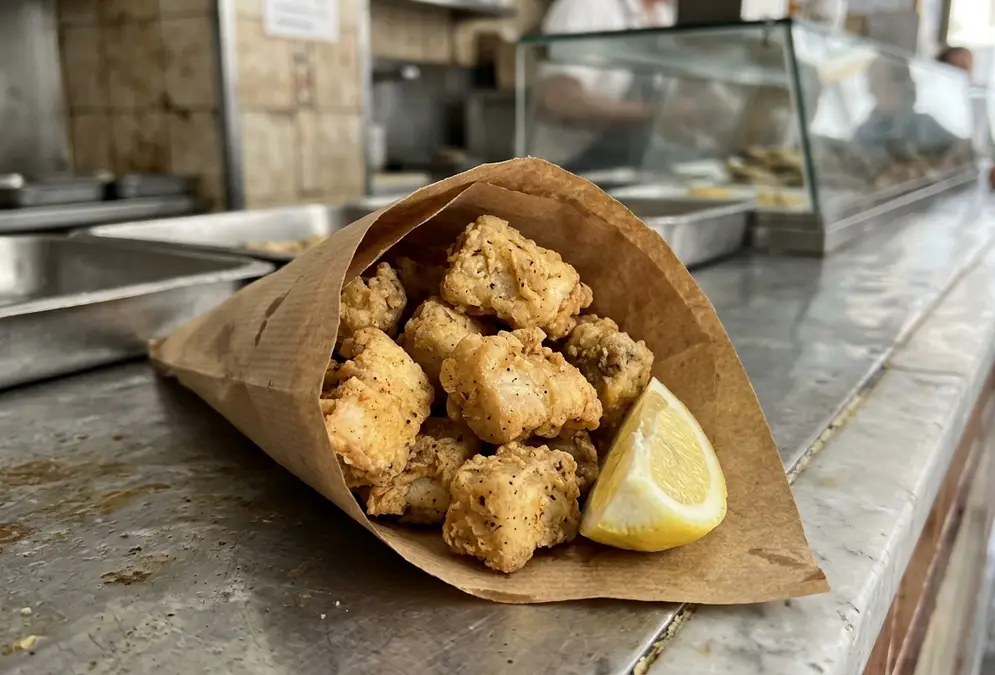

Cazón en adobo — also known across the Bay of Cádiz as bienmesabe or simply el adobo — is the sharp, aromatic anchor of a traditional Cádiz freiduría. Finger-thick slices of shark sit for 4 to 8 hours in a crushed mortar paste (majao) of garlic, sweet paprika, oregano, cumin and white wine or Jerez sherry vinegar before being dredged in flour and dropped into hot olive oil. What comes out of the fryer is crisp and rust-gold on the outside, juicy and vinegar-tangy against the central bone within. Alongside pescaíto frito, tortillitas de camarones, papas aliñás and chicharrones de Cádiz, a paper cone of freshly fried adobo is one of the defining flavours of the old town.
Cazón, caella and the bone-in tajaita
Strictly speaking, cazón is the school shark or tope shark (Galeorhinus galeus), a relatively small member of the shark family with firm, meaty white flesh. In practice, traditional Cádiz freidores very often use a related species called caella (blue shark or tintorera, Prionace glauca), which costs less at the fish market and fries to a noticeably softer, more tender bite.
Whichever fish the fryer buys that morning, the cut is the same. The shark is sliced crosswise into tajaitas: pieces roughly one finger thick with the round, cartilaginous central bone left intact in the middle (con el hueso que lleva enmedio sin quitar). Because shark skeletons are cartilage rather than fine rib bones, eating a tajaita from a paper cone in the street is effortless: you bite the meat cleanly off the central ring without worrying about stray pin bones.
The majao marinade: cazón en adobo vs San Fernando bienmesabe
The technique behind the dish is nearly five centuries old. In 16th-century Spain, marinating fish and meat in adobo was a standard method of preservation before refrigeration, exported from Andalusian ports to the Americas and the Philippines. Alonso de Herrera's Agricultura General (1513) already defined an adobo of garlic, oregano, salt, water and vinegar, and Cádiz culinary researcher Manuel Ruiz Torres traces local recipes back to the first third of the 16th century in La Cocina de los Jesuitas.
In a Cádiz kitchen or freidor, the marinade starts in a mortar. Garlic cloves are pounded into a majao with sweet Spanish paprika (pimentón), dried oregano, cumin and coarse salt, then loosened with white wine vinegar or Vinagre de Jerez and water. After soaking for 4 to 8 hours, the slices are drained well, coated in frying flour, shaken so no thick batter clings, and fried in olive oil.
| Style | Primary spice profile | Typical Bay of Cádiz setting |
|---|---|---|
| Cazón en adobo (Cádiz city) | Blend of dried oregano and cumin (or oregano-forward) with garlic, pimentón and vinegar | Traditional old-town freidurías and tapas bars |
| Bienmesabe (San Fernando) | Cumin-dominant aromatic majao with garlic, pimentón and vinegar | Neighbouring San Fernando (La Isla), though both names are used across the Bay |
How to order at a freiduría: cuartos and papel de estraza
At a classic Cádiz freidor, fried fish is sold by weight (al peso) rather than by the plate. The standard unit of measure is the cuarto (250 grams, a quarter of a kilo), and you ask at the counter for a cuarto or medio kilo of adobo on its own or mixed with chocos (cuttlefish) and hake.
Your order is twisted into a cone of brown butcher paper called a cartucho de papel de estraza (or papelón). That rough, porous paper is functional, not nostalgic: it absorbs excess olive oil while allowing steam to escape so the thin flour crust stays crisp. Sealing hot adobo inside a plastic bag or non-porous box traps condensation and turns the coating soggy within minutes.
If you prefer to sit down at a bar or terrace, you can also order cazón en adobo on a plate as a tapa, media ración or ración. Locals regularly balance the hot, vinegar-spiced fish with cold starters such as papas aliñás, roasted peppers (pimientos asados), Russian salad (ensaladilla), papas alioli or a chopped vegetable piriñaca, washed down with an ice-cold caña of beer or a dry Fino or Manzanilla sherry.
Where to eat cazón en adobo in Cádiz
Cádiz's municipal records already counted 108 bodegones and freidores across the city in the early 19th century, and several historic fryers and specialist bars in the Centro Histórico still set the standard today:
- Freiduría Las Flores I (Plaza de Topete 4, on Plaza de las Flores): an emblematic Cádiz freiduría operating since the late 19th century, open Monday to Sunday from 11:30 to 16:30 and 19:30 to 23:30 (+34 956 22 61 12). It serves freshly fried fish and seafood at economical prices at the takeaway cartucho counter, the bar, the indoor dining room or the square's terrace.
- Freiduría Cervecería Europa (Calle Hospital de Mujeres 21, near the central market and La Viña): a local institution founded in 1954 (+34 956 22 73 05), celebrated for generous portions of fried fish and adobo at good prices to eat at the bar, at tables or in a paper cone to go.
- Bodeguita El Adobo (Calle Rosario 4, Centro Histórico): a traditional tapas bar (+34 636 81 46 75) that specialises expressly in Bay of Cádiz pescaíto frito, cazón en adobo and morena en adobo (marinated moray eel), alongside home-style stews.
- Freidor El Veedor (Calle Veedor 10, in Barrio del Mentidero): a historic neighbourhood fryer run by José Baro and Mercedes Rey, on the exact street where an anonymous 1813 manuscript already documented an operating freiduría.
- Traditional tabancos and bars in La Viña: on a classic bar crawl through La Viña, including stops like Casa Manteca, pescado en adobo shares the counter with tortillitas de camarones, chicharrones and papas aliñás.