Saying Cádiz in Spanish: stress, vowels and the last letter
Start with the stress. It falls on the first syllable, CÁ-diz, and the written accent says so. Spanish spelling puts an accent on any word stressed on its second-to-last syllable when it ends in a consonant other than -n or -s[5]. Cádiz ends in -z, so the mark is required. The d in the middle is soft, a fricative that the narrow transcription writes as ð[1], closer to the th of "this" than to an English d.
The vowels are short and clean. The first a is open, close to the one in "father" but briefer, the i is a plain "ee", and nothing glides. In most of Spain the final z is a soft th, which gives the standard IPA transcription /ˈkadiθ/, close to KAH-dith[1]. Much of Latin America ends the word with an s instead, as /ˈkadis/[6].
On the ground in Andalusia you will hear more than the dictionary form. Local speech often drops the final consonant, so the word can come out as something like KAH-dee, or even a clipped KAH-ee[7]. Three versions are worth recognising:
- KAH-dith, the standard form in most of Spain
- KAH-dis, the form heard across Latin America
- KAH-dee, the relaxed local form in Andalusia
Any of them will be understood. The one thing that changes the word is moving the stress off the first syllable.
Saying Cádiz in English: where the stress moves
English dictionaries settle on kuh-DIZ, with the stress on the second syllable[2]. Spanish never does that: the stress sits on the first syllable every time[3]. American dictionaries also record a first-syllable form, KAY-diz[8], which keeps the Spanish stress but loses its vowels.
Part of the drift comes from spelling. English has traditionally written the name without the accent, as Cadiz[9], which removes the one visible clue to where the stress belongs. A reader who has only seen the plain form has to guess, and the second syllable is the usual guess.
For a visitor, copying the Spanish stress is the one change that matters most. The ending is more forgiving. A clean s is a real Spanish pronunciation of the word in much of the Spanish-speaking world[6], so a visitor who finds the th awkward has no reason to worry.
Gadir: a Phoenician word for a walled enclosure
The name is older than Spanish and older than Latin. Cádiz was traditionally founded as Gadir by Phoenician merchants from Tyre as early as 1100 BCE, and the word meant "an enclosure"[4]. Readings of the Phoenician root give "wall", "compound" or, by extension, "stronghold"[10].
The same root lives on in North Africa. Berber borrowed the word, and it became the agadir found in many North African place names[11]. The Moroccan city of Agadir is the best-known cousin of the Cádiz name. Ancient Gadir itself occupied two small islands, one used mainly for living and the other for cemeteries and sanctuaries[12], so an "enclosure" in the sea is easy to picture.
Don't miss · Activity
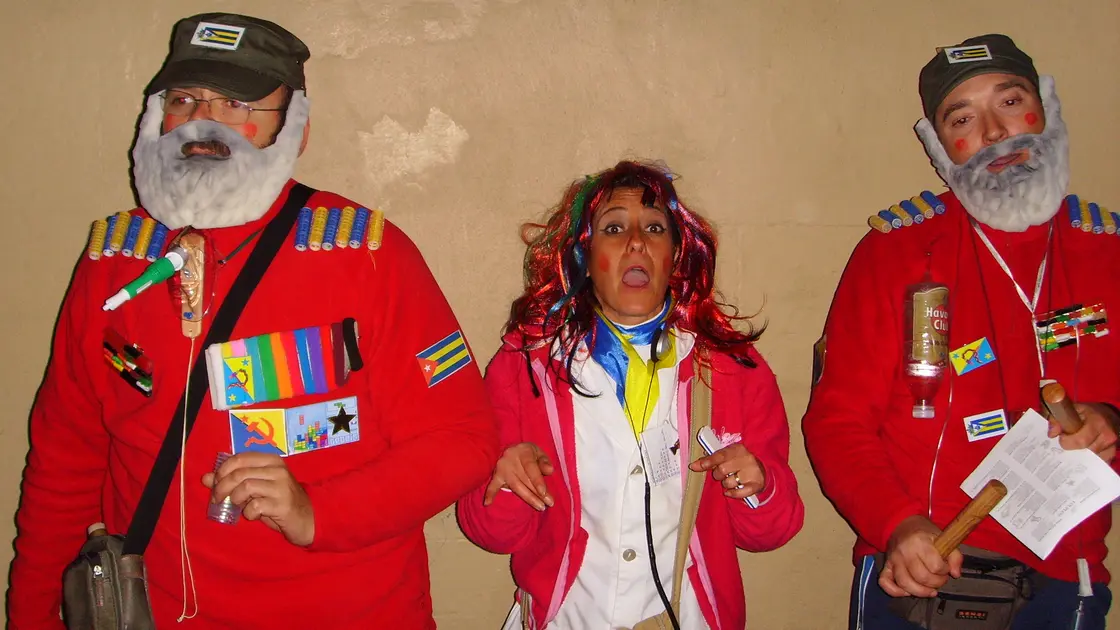
Cádiz Carnival Chirigota Experience
Experience Cádiz Carnival chirigotas in La Viña and at the Gran Teatro Falla: 7–12-member ensembles, free street callejeras, COAC sessions…
Phoenician Cádiz is more than a story. The chance find of a male Phoenician anthropoid sarcophagus on shipyard ground in 1887 started the archaeology collection of what is now the Museo de Cádiz[13]. Two sarcophagus finds, one in 1980 and an earlier one, lent credence to the city's Phoenician origins[14]. Treat the date of 1100 BCE as tradition, and the sarcophagi as the evidence in hand.
Gades and Qādis: how the name travelled into Spanish
Greek writers heard Gadir and said Gádeira[15]. The Carthaginians kept the old name when they occupied the city, and every later form derives from it[16]. In Latin the city became Gādēs, and its Roman colony carried the formal name Augusta Urbs Iulia Gaditana[17].
Recommended tours
Tours are selected for quality, not commission. We earn a small fee if you book, at no extra cost to you.
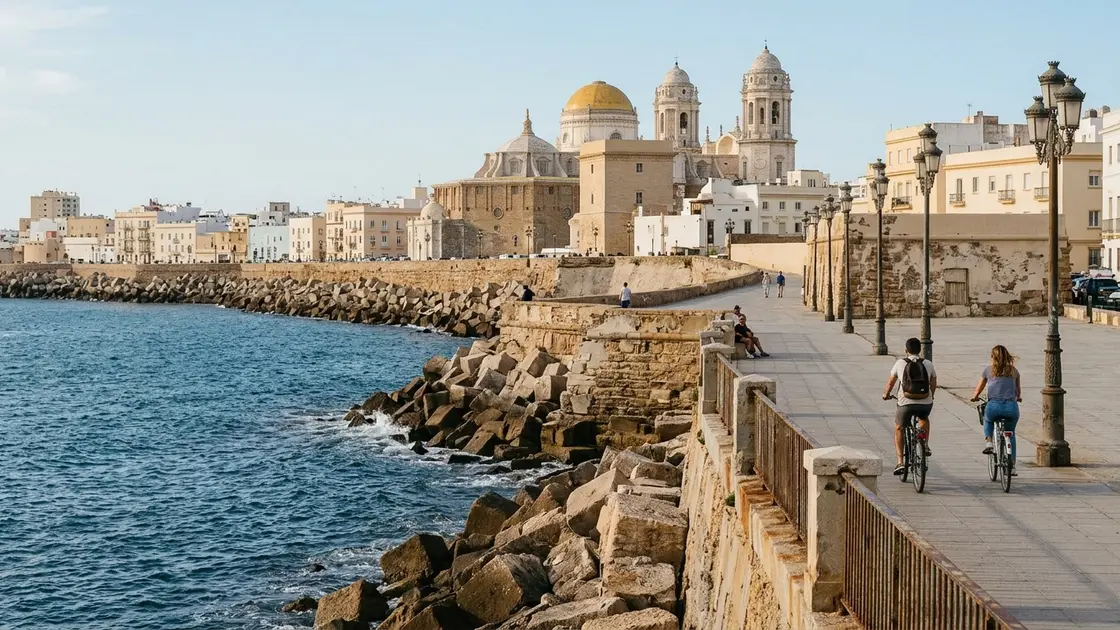
After it surrendered to Rome, Gades steadily grew more prosperous[18]. The stonework backs that up. A Roman theatre, one of the oldest and best preserved in Spain, was discovered in the El Pópulo district in 1980[19].
- c. 1100 BCE
Gadir
Traditional date for the Phoenician founding.
- c. 501 BCE
Carthaginian rule
The Carthaginians occupy the city and keep the name.
- 40 BCE
A Gaditano consul
Balbus becomes the first naturalised Roman consul.
- 711
Qādis
Moorish rule begins and the port is renamed Jazīrat Qādis.
- 1262
Castilian conquest
Alfonso X of Castile captures the city.
The Arabic form is the hinge. The Latin name became Qādis in Arabic, and the Spanish Cádiz derives from that Arabic word[20]. Moorish rule over the port, which was renamed Jazīrat Qādis, lasted from 711 until 1262, when Alfonso X of Castile took the city[21].
The adjective survived on a separate track. People and things from the city are gaditano, a word that still sits close to the colony's Latin Gaditana[22].
Two gaditanos who carried the name to Rome
Gades was a name known well beyond Spain. The poet Juvenal opens his tenth satire with the lands lying "from Gades as far as Dawn and the Ganges", using the city as one end of the known world[23].
Lucius Cornelius Balbus was born in Gades around 100 BCE and became a wealthy naturalised Roman, important in Roman politics in the last years of the Republic[24]. Julius Caesar took him on as chief of staff during his praetorship in 62 BCE[25], and in 40 BCE he became the first naturalised Roman to hold a consulship[26]. Julius Caesar had by then granted Roman citizenship to every inhabitant of the city[27]. His nephew and namesake[33], Balbus the Younger, ordered the building of the city's theatre in the 1st century BCE[28].
Deep dive · Article
12 Interesting Facts About Cádiz: History, Towers & Secrets
Discover 12 interesting facts about Cádiz, from Phoenician houses buried under a puppet theatre and two marble sarcophagi to 134 watchtower…
Columella took a quieter road. Born in Gades in the 1st century CE, he was a Roman soldier and farmer who wrote extensively on agriculture[29]. His De re rustica runs to twelve books[30], and in it he speaks of fish found "in nostro gadium municipio", in our Gaditan municipality[31]. A man who left Gades for farms in Italy still wrote "our".
Neither man left a building under his own name, but the city kept the theatre Balbus the Younger ordered. The Roman Theatre, known in Latin as the Theatrum Balbi, lies beneath the streets of El Pópulo, and its interpretation centre on Calle Mesón keeps its own hours, so check the Junta de Andalucía site, and the excavated area is temporarily restricted during expansion works[32].