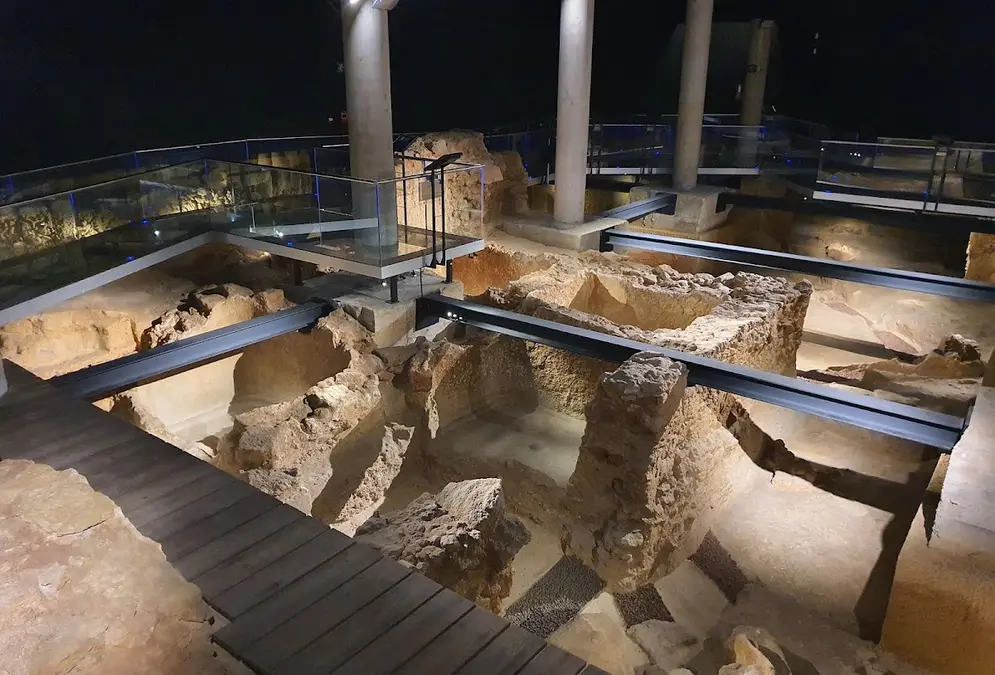
Directly beneath the Teatro del Títere La Tía Norica at Calle San Miguel 15, the Yacimiento Arqueológico Gadir opens onto the oldest urban layer in historic Cádiz. Admission is free (entrada libre), and the underground walkway crosses 9th-century BC Phoenician clay streets, mud-brick dwellings and later Roman fish-salting vats just steps from Torre Tavira and the Mercado Central de Abastos.
Because architectural remains of Phoenician settlements are scarce across the Mediterranean, the excavation has become a central point of reference for historians studying how the first settlers from Tyre actually built and lived.
Tyre, Erytheia and the founding of Gadir
Phoenician sailors from Tyre made their first reconnaissance landings in the first quarter of the first millennium BC, establishing a permanent colony whose exact dating remained hard to pin down until these layers came to light beneath the puppet theatre. The settlement stood on the highest point of the ancient island of Erytheia, the smaller island in the old Cádiz archipelago.
That elevated position explains why archaeologists treat Calle San Miguel as a primary marker for mapping the urban footprint of Phoenician Gadir across the historical archipelago.
Ninth-century BC streets, mud-brick houses and hoofprints
The site is organised across several stratigraphic levels corresponding to distinct periods of occupation, led by the street layout, domestic buildings and everyday tools of the 9th century BC. Excavations preserve eight dwellings arranged across two terraces and set around two paved streets.
All eight structures were built using earthen architecture (arquitectura de la tierra), shaped primarily from mud and clay rather than cut stone. From the earliest building phase, the thoroughfares were surfaced with packed clay as well, and their hardened surface still holds fossilised hoofprints of cattle (bóvidos) that walked between the houses nearly three millennia ago.
Mattan and the 6th-century BC fire
Visits follow a themed narrative centred on Mattan, a Phoenician resident who died during a major fire that swept the city in the 6th century BC. His skeletal remains form a central part of the underground route, anchoring the domestic utensils and house plans in a single recorded catastrophe.
Above the Phoenician terraces, a later occupation phase preserves the stone structures of a Roman fish-processing factory (factoría de salazón) from the era of the Roman Theatre, complete with the vats (piletas) used to cure salted fish. Across the main archaeological layers, the walkway passes:
- Eight 9th-century BC Phoenician dwellings built of mud and clay across two terraces
- Two clay-paved streets preserving fossilised bovid hoofprints from the earliest phase
- Everyday Phoenician domestic utensils recovered from the 9th-century BC occupation levels
- The remains of Mattan, a resident killed in the great 6th-century BC city fire
- Roman fish-salting vats (piletas) from a later factoría de salazón
The Teatro del Títere above and how to visit
The ruins lie under the municipal Teatro del Títere La Tía Norica, one of the theatres run by the Ayuntamiento de Cádiz Delegation of Culture. In 1984, Carlos Aladro and the Fundación Municipal de Cultura promoted a new company with veteran puppeteers that laid the foundations for the present puppet theatre, whose wider history is told at the Museo del Títere; for the marble anthropoid sarcophagi from Phoenician-Punic Gadir, follow the Cádiz old town walk toward the Barrio del Mentidero and the Museo de Cádiz on Plaza de Mina.
| Detail | Visitor information |
|---|---|
| Address | Calle San Miguel, 15, 11001 Cádiz |
| Building | Underground level beneath Teatro del Títere La Tía Norica |
| Admission | Free (Entrada libre) |
| Visit format | Timed route centred on the 6th-century BC figure of Mattan; check pass times at yacimientogadir.com or at the entrance desk |
Because entry takes place in timed sessions, confirm current pass schedules at the Calle San Miguel 15 desk or on the official website before setting out.