history-buffsart-loversbudget
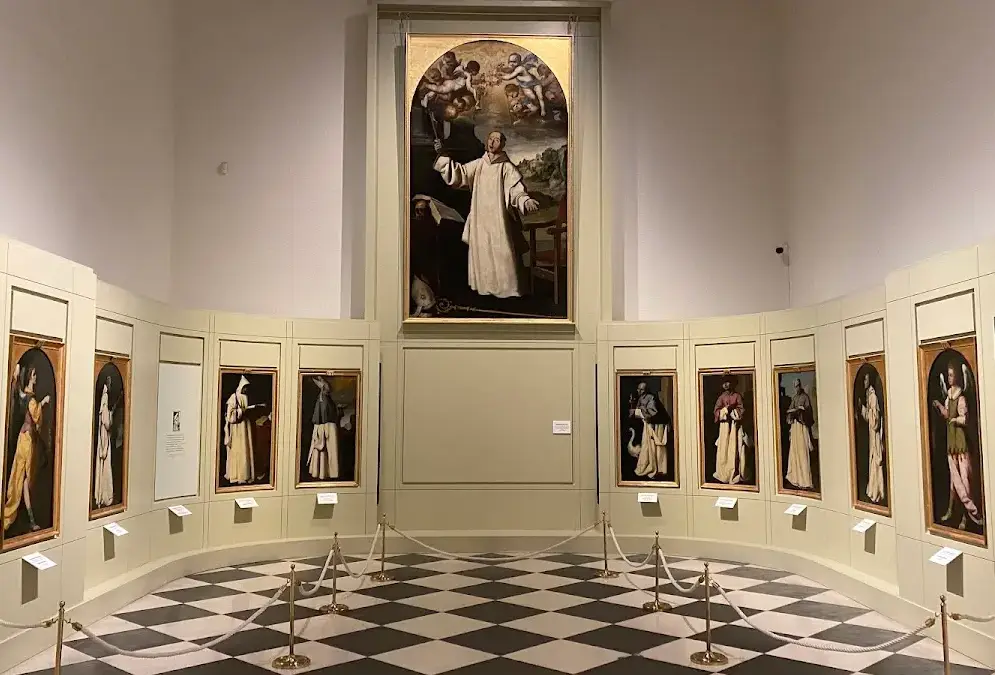
Zurbarán's Jerez Charterhouse paintings displayed in a curved gallery at the Museo de Cádiz, with a checkerboard floor
archaeology phoenician sarcophagi

Museo de Cádiz: Phoenician Sarcophagi and Fine Art

Cádiz's provincial museum on Plaza de Mina holds both Phoenician sarcophagi found in Spain and Zurbarán's Jerez paintings. Free for EU citizens; check rooms.

The Museo de Cádiz is the province's main museum, set in a late neoclassical building on Plaza de Mina. It holds the two Phoenician anthropoid sarcophagi found in Spain and a fine-arts collection that includes Zurbarán's paintings for the Jerez Charterhouse. Admission is free for EU citizens and €1.50 for everyone else, so the real cost of a visit is time, not the ticket.

The museum is three collections under one roof: archaeology, fine arts and a smaller ethnography section. Building works that began in 2023 closed some rooms for a long stretch, so confirm which are open before you plan around a particular object.

The Phoenician sarcophagi

Archaeology is the reason most visitors come. The rooms follow the province from prehistory through Phoenician-Punic Gadir to Roman Gades and Baelo Claudia, and the two Phoenician anthropoid sarcophagi are the centrepiece. The male one was found by chance in 1887 on ground belonging to the Cádiz shipyards, and that discovery started the archaeology collection.

The female sarcophagus, known as the Dama de Cádiz, came to light on 26 September 1980, when foundation works in calle Ruiz de Alda struck marble. It dates to about 480 BC.

Its discovery has a neat irony. Pelayo Quintero Atauri, director of the provincial museum, spent years convinced that a female sarcophagus must exist to match the male one and died without finding it. It turned up a century later under a palm tree at his old house. In 2020 a University of Cádiz team went further, reporting that the person buried inside was a robust man of about 45 to 50, so the nickname is now a museum habit rather than a description.

Zurbarán and the fine-arts rooms

The fine-arts collection started in 1835 with paintings from convents closed under the Mendizábal disentailment, and it became the Provincial Museum of Fine Arts of Cádiz. Its best-known group is the set Zurbarán painted for the Jerez Charterhouse between 1637 and 1639. All of them come from that monastery except Pentecost, which came from the Consulado de Cargadores a Indias, the Indies traders' body in the port.

The Baroque rooms also hold work by Alonso Cano, Rubens, Carreño de Miranda and Murillo, and the museum has a Joan Miró in its contemporary section. A temporary exhibition, Nexos. Del lienzo al objeto, sets paintings beside archaeological objects to show daily life and trade in early modern Cádiz. It runs on the first floor of the fine-arts building from 11 September 2026 to 10 January 2027.

The building on Plaza de Mina

The museum has stood on Plaza de Mina since 1935, in a building Juan Daura designed in 1838 and shared with the city's Academy of Fine Arts. Daura is the same architect who took over the works at Cádiz Cathedral in 1832. The archaeology and fine-arts museums were merged into the present institution only in 1970.

If you are choosing between the two sections, the answer depends on the traveller. Archaeology puts the Roman Theatre in the longer story of Gadir and Gades, while fine arts is the one to pick for Spanish Baroque painting.

Opening hours and visiting

The Junta de Andalucía publishes these hours:

Day Hours
Tuesday to Saturday 09:00 to 21:00
Sundays and public holidays 09:00 to 15:00
Monday Closed, except a Monday before a holiday, which opens on holiday hours

The museum is also closed on 1 and 6 January, 1 May, and 24, 25 and 31 December. It sits at the end of the old town walk, and the Oratorio de la Santa Cueva is about 250 m away, so the two combine easily in one morning.

Reporter notebook

Insider tips

Money tip

Carry ID if you claim the free entry

Admission is free for EU citizens and €1.50 for other visitors. Bring a passport or national ID in case the desk asks for proof of nationality.

Booking tip

Ask which rooms are open

Works have closed parts of the museum since 2023. If the Zurbarán paintings or the contemporary section are the reason you are going, check with the museum first.

Best time

Use the long weekday opening

From Tuesday to Saturday the doors stay open until 21:00, while Sunday closes at 15:00. A late weekday visit leaves room to see both sections without rushing.

Practical information

Opening hours
Tue-Sat 09:00-21:00; Sun and public holidays 09:00-15:00; Mon closed (a Monday before a holiday opens on holiday hours). Closed 1 and 6 Jan, 1 May, 24, 25 and 31 Dec. Check the official site for current room openings.
Admission
Free for EU citizens; general admission €1.50 (Cádiz city tourism office).
Address
Plaza de Mina s/n, 11004 Cádiz, Spain View on Google Maps

Frequently asked questions

Is the Cádiz museum free?

Admission is free for citizens of the European Union. Other visitors pay a general fee of €1.50, according to the Cádiz city tourism office.

What are the opening hours of the Museo de Cádiz?

Tuesday to Saturday from 09:00 to 21:00 and Sundays and public holidays from 09:00 to 15:00. It is closed on Mondays, except a Monday before a holiday, and on 1 and 6 January, 1 May, and 24, 25 and 31 December.

Where can I see the Phoenician sarcophagi in Cádiz?

Both Phoenician anthropoid sarcophagi found in Spain are displayed in the Museo de Cádiz on Plaza de Mina. The male one was found in 1887 and the female one in 1980.

Who is the Dama de Cádiz?

It is the museum's name for the female Phoenician sarcophagus found in calle Ruiz de Alda in 1980. Anthropological work reported in 2020 found that the person buried inside was a man of about 45 to 50.

What is in the Museo de Cádiz besides the sarcophagi?

Archaeology from prehistory to Roman Gades and Baelo Claudia, plus fine arts with Zurbarán's paintings for the Jerez Charterhouse, Murillo and Rubens. There is also a contemporary section and an ethnography section.

Are all the rooms of the Museo de Cádiz open?

Not necessarily. Building works that began in 2023 closed the fine-arts and contemporary rooms and part of archaeology for a long period. Check which rooms are open before you go.

Is the Museo de Cádiz worth visiting?

Yes, if you want the Phoenician origins of Gadir or Spanish Baroque painting. The ticket costs at most €1.50, so the only real cost is the time.

Further reading

Sources

17 references Show
  1. Junta de Andalucía — 2633 (opens in a new tab)

    “Martes a sábado de 09:00 a 21:00; domingos y festivos de 09:00 a 15:00. Lunes cerrado, excepto los lunes víspera de festivo, que abre con horario de festivo.”

  2. Junta de Andalucía — 2633 (opens in a new tab)

    “Cerrado 1 y 6 de enero, 1 de mayo y 24, 25 y 31 de diciembre.”

  3. Junta de Andalucía — 2633 (opens in a new tab)

    “El hallazgo casual en 1887 del sarcófago antropoide fenicio masculino en los terrenos de los Astilleros de Cádiz fue el punto de arranque de la colección arqueológica”

  4. Junta de Andalucía — 2633 (opens in a new tab)

    “No será hasta 1970 cuando se fusionen ambas instituciones en el actual Museo de Cádiz, incluyéndose también una Sección de Etnografía.”

  5. Junta de Andalucía — 2633 (opens in a new tab)

    “un edificio tardoneoclásico construido por el arquitecto Juan Daura en 1838”

  6. Turismo de Cádiz (opens in a new tab)

    “Gratuito para ciudadanos de la Unión Europea.”

  7. Turismo de Cádiz (opens in a new tab)

    “Entrada general 1,50€”

  8. Turismo de Cádiz (opens in a new tab)

    “desde la prehistoria, pasando por el Gadir fenicio-púnico, hasta las romanas de Gades y Baelo Claudia”

  9. Turismo de Cádiz (opens in a new tab)

    “las obras realizadas por Zurbarán para la cartuja de Jerez entre 1637 y 1639”

  10. Wikipedia — Museo de Cádiz (opens in a new tab)

    “Todas las obras de Zurbarán proceden de la Cartuja de Jerez de la Frontera, excepto Pentecostés, que procede del Consulado de Cargadores a Indias.”

  11. Wikipedia — Museo de Cádiz (opens in a new tab)

    “obras de Zurbarán, Alonso Cano, Rubens, Juan Carreño de Miranda y Murillo”

  12. Wikipedia — Dama de Cádiz (opens in a new tab)

    “Se trata de uno de los dos sarcófagos fenicios hallado en España, ambos se encuentran expuestos en el Museo de Cádiz.”

  13. Wikipedia — Dama de Cádiz (opens in a new tab)

    “El 26 de septiembre de 1980, en el curso de unas obras de excavación destinadas a la colocación de cimientos para una nueva construcción en la gaditana calle de Ruiz de Alda, fue hallado el más antiguo y valioso sarcófago fenicio”

  14. Wikipedia — Dama de Cádiz (opens in a new tab)

    “La sorpresa mayúscula llegó cuando, un siglo después, la Dama de Cádiz se encontró justo debajo de una palmera de la antigua casa de Quintero Atauri.”

  15. hum509.uca.es (opens in a new tab)

    “la persona inhumada es, sin ningún género de dudas, un varón robusto de unos 45-50 años”

  16. Junta de Andalucía — Programacion de actividades en el museo de cadiz (opens in a new tab)

    “Fecha y hora: Del 11 de septiembre de 2026 al 10 de enero de 2027”

  17. ondacadiz.es (opens in a new tab)

    “Pero la realidad es que esas obras se están demorando más de lo previsto, además de un problema de falta de personal.”