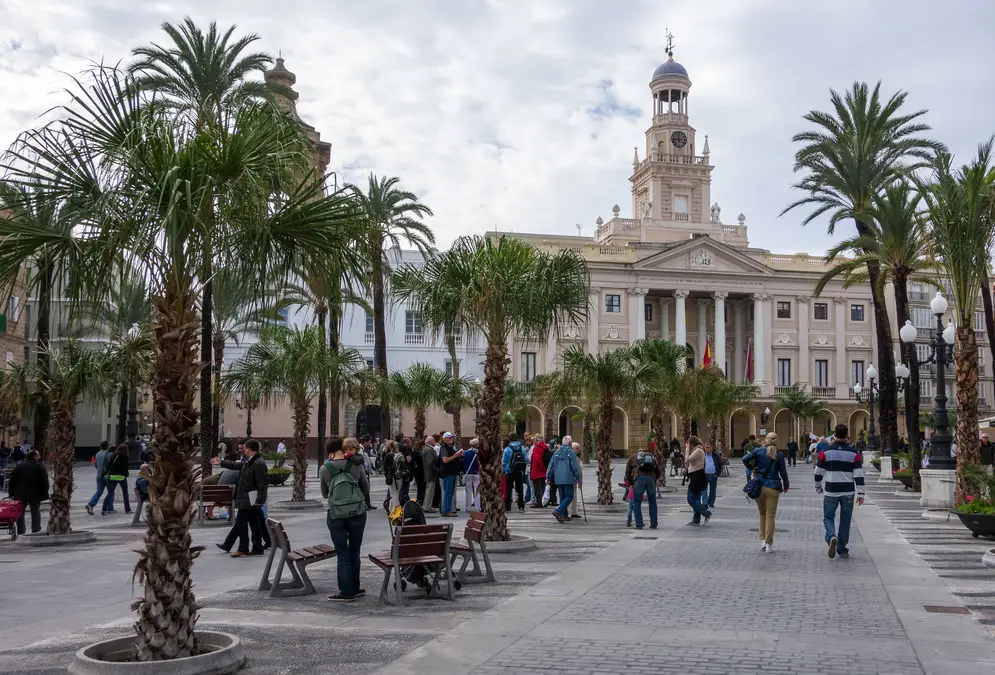
Plaza de San Juan de Dios is the first open space a visitor meets when stepping off the harbour front into the old town. Formerly the city's Plaza Mayor and known for centuries as La Corredera, the square grew outside the medieval walls beside the original Puerta del Mar, now the Arco del Pópulo at the entrance to El Pópulo. Its elongated, slightly uneven ground plan is not an accident of town planning; it follows the mouth of the ancient sea channel that once split the island of Cádiz in two.
When to Visit
Visit duration
20 to 40 minutes
From Indies market to civic square
By the 16th century the square was already working as a commercial hub open to the port and presided over by the Town Hall. As Cádiz's trade with the Americas expanded, the open ground filled with stalls selling exotic goods unloaded from the Indies fleets. In the late 18th century the council ordered permanent stalls built, turning the square into a public market next to merchant palaces such as the Casa del Almirante that lasted until the Mercado Central opened.
A 2012 remodelling completed the pedestrianisation of the square and returned the monument to Cádiz politician Segismundo Moret, which had first been unveiled here in 1909. Today the space is flat, smooth and free of severe wheelchair barriers, with street vendors selling local artisan crafts near the approaches and frying pans working in the surrounding bars.
Visit on a weekday morning to see inside the church
The square itself never closes, but the Iglesia de San Juan de Dios only opens its doors Monday to Friday between 10:00 and 13:30. Time your crossing for mid-morning if you want to see Torcuato Benjumeda's 1791 reform of the 1688 gilded Baroque altarpiece.
The Ayuntamiento de Cádiz
The Ayuntamiento de Cádiz has stood on this site since the 16th century, replacing the late 17th-century Casas Consistoriales. The building seen today went up in two distinct campaigns: a neoclassical phase begun in 1799 by Torcuato Benjumeda (incorporating designs by Pedro Ángel Albisu) and an Isabelline interior phase between 1861 and 1865 directed by Manuel García del Álamo. In 1936, the Andalusian flag was raised here for the first time.
The main facade rises over a semicircular-arched portico supporting a central balcony with giant-order Ionic columns and a triangular pediment carrying a relief of Hercules, mythical founder of the city. Above it stands a three-stage Mannerist clock tower modelled on the earlier building's tower: a square lower body flanked by statues of patron saints San Servando and San Germán, an octagonal middle stage, and a hemispherical dome housing the bell. Across the square, the Town Hall clock chimes a melody from El Amor Brujo by the Cádiz-born composer Manuel de Falla.
Inside, a square courtyard and late 17th-century monastic staircase hold a white marble statue of Hercules from the city's ancient single fountain, alongside two large paintings depicting the patron saints and the miracle of the Virgen del Rosario during the 1755 tsunami. The rectangular Council Chamber (Sala del Consejo), dated to 1870, is finished in Isabelline style with marble, stucco, ceiling frescoes, trompe-l'oeil reliefs imitating busts of prominent citizens, and two large Venetian glass chandeliers.
Three landmarks on the square
- Ayuntamiento de Cádiz: The 1799 neoclassical and 1861–1865 Isabelline Town Hall presiding over the southeastern end.
- Iglesia de San Juan de Dios: Attached to the hospital of the same name at the corner of El Pópulo, built on a Greek-cross plan inscribed in a square with a 1768 corner tower by Torcuato Cayón (who also worked on the Puerta de Tierra) and a 1688 gilded Baroque altarpiece reformed by Torcuato Benjumeda in 1791.
- Casa de los Pazos Miranda: One of the three principal historic buildings framing the square alongside the Town Hall and church.
Visiting and practicalities
The square itself is open day and night and free to cross, making it a natural starting point for the Cádiz old town walk, a short walk north of the Casa de Iberoamérica and south of the Barrio de San Carlos. The Iglesia de San Juan de Dios opens Monday to Friday from 10:00 to 13:30, with Mass Monday to Saturday at 10:30 and Sundays at 11:30. Inside the Ayuntamiento, admission is free of charge with step-free access from the square, though interior visits are arranged on request for groups rather than run on a drop-in turnstile.