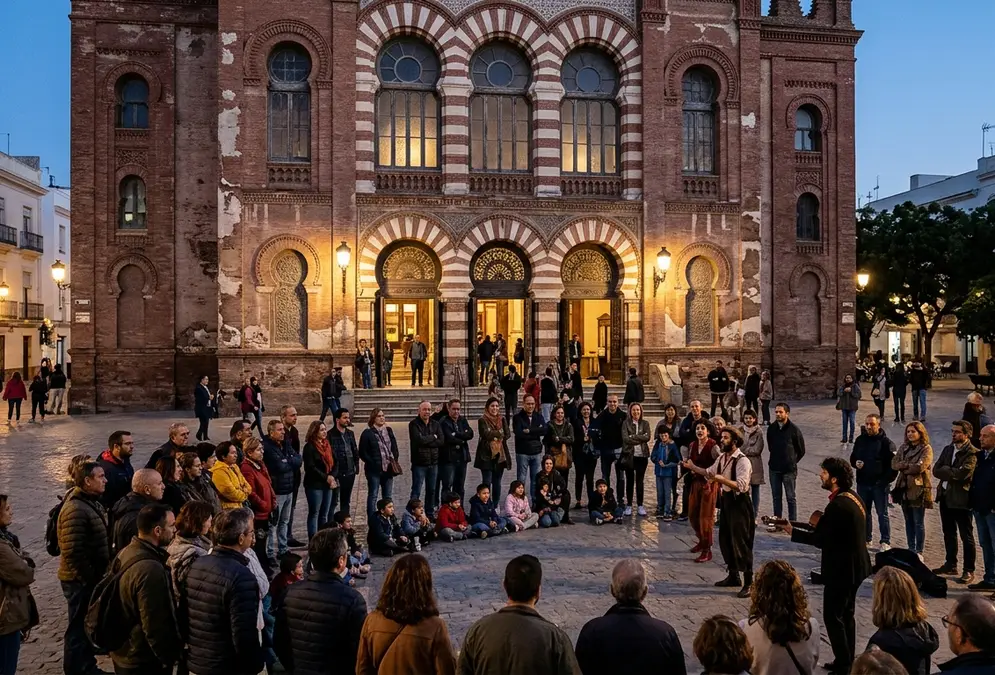

Coordinated through the municipal cultural directory of the Fundación Municipal de Cultura, the Festival Iberoamericano de Teatro de Cádiz (FIT) brings Latin American and Iberian performing arts to the city every October[1]. Productions divide between the Teatros de Cádiz indoor network, seventeenth- and eighteenth-century coastal fortifications, and open-air squares across the walled old town[1][2].
Municipal theatres and main stages
Three municipal stages form the indoor core of the Teatros de Cádiz network during the festival[2]. Flagship ensembles play the Gran Teatro Falla at Plaza Fragela, s/n, an independent Neo-Mudéjar building of exposed red brick and horseshoe arches begun in 1885 to designs by architect Adolfo Morales and completed in 1910[3][5]. Known simply as the Gran Teatro de Cádiz until 1926, the auditorium took its current name to honour Cádiz-born composer Manuel de Falla, Hijo Predilecto of the city[6].
| Venue | Location | Architectural Setting & Festival Role |
|---|---|---|
| Gran Teatro Falla | Plaza Fragela, s/n | 1885–1910 Neo-Mudéjar brick theatre with adapted access; main indoor stage for year-round performing arts[3][4][5] |
| Sala Central Lechera | Plaza de Argüelles | Municipal Teatros de Cádiz stage for smaller-scale and contemporary theatre[2] |
| Teatro del Títere La Tía Norica | Calle San Miguel | Municipal puppetry and visual stage alongside the Museo del Títere[1][2] |
| Baluarte de la Candelaria | Alameda Marqués de Comillas, s/n | 1672 harbour bastion with the Sala «Tía Norica» and a palm-lined courtyard for theatre and concerts[7][8] |
| Casa de Iberoamérica | Calle Concepción Arenal, s/n | 1794–1836 former Royal Prison hosting Latin American cultural events and exhibitions[9][10] |
| Castillo de Santa Catalina | La Caleta seafront | Fortification with free general admission (11:00–19:30 in October) outside specially announced events[11] |
Coastal bastions and the Casa de Iberoamérica
Beyond the proscenium theatres, the festival uses buildings shaped by Cádiz's Atlantic defences and American trade. On the northwest seafront at Alameda Marqués de Comillas, s/n, the Baluarte de la Candelaria was erected in 1672 under Governor Diego Caballero de Illescas to guard the harbour mouth; today its palm-shaded courtyard and Sala «Tía Norica» host theatre works, exhibitions, and concerts[7][8]. At the western end of La Caleta, the Castillo de Santa Catalina opens daily on its winter timetable (11:00 to 19:30 from October to March) with free entry except during previously announced performances[11].
At the southern edge of the old town on Calle Concepción Arenal, s/n, the Casa de Iberoamérica occupies the former Cárcel Real (Royal Prison), begun in 1794 after Neoclassical plans by Torcuato Benjumeda and completed in 1836[9][10]. As the city's permanent cultural centre for Latin American exhibitions and encounters, it anchors the festival's transatlantic programme[9].
October climate and visitor logistics
October sits comfortably between summer heat and winter rain, making evening walks between venues straightforward. State meteorological records for Cádiz show an October mean temperature of 20.3°C, with average daytime highs of 23.4°C, nighttime lows of 17.3°C, and 228 hours of monthly sunshine against 67 mm of rainfall spread over 5.6 rain days[12].
- Box office and accessibility: The Gran Teatro Falla at Plaza Fragela, s/n provides adapted access for visitors with reduced mobility and handles cultural inquiries via telephone (956 22 08 34) and email (
granteatrofalla.cultura@telefonica.es)[5]. - Free cultural spaces: Entry to the Casa de Iberoamérica exhibitions and standard daytime access to the Castillo de Santa Catalina (11:00–19:30) are free of charge unless a specific ticketed act is announced[9][11].
- Walking between venues: All municipal theatres and fortifications sit inside the historic peninsula, allowing visitors to move on foot between Barrio del Mentidero, La Caleta, and the southern seafront.