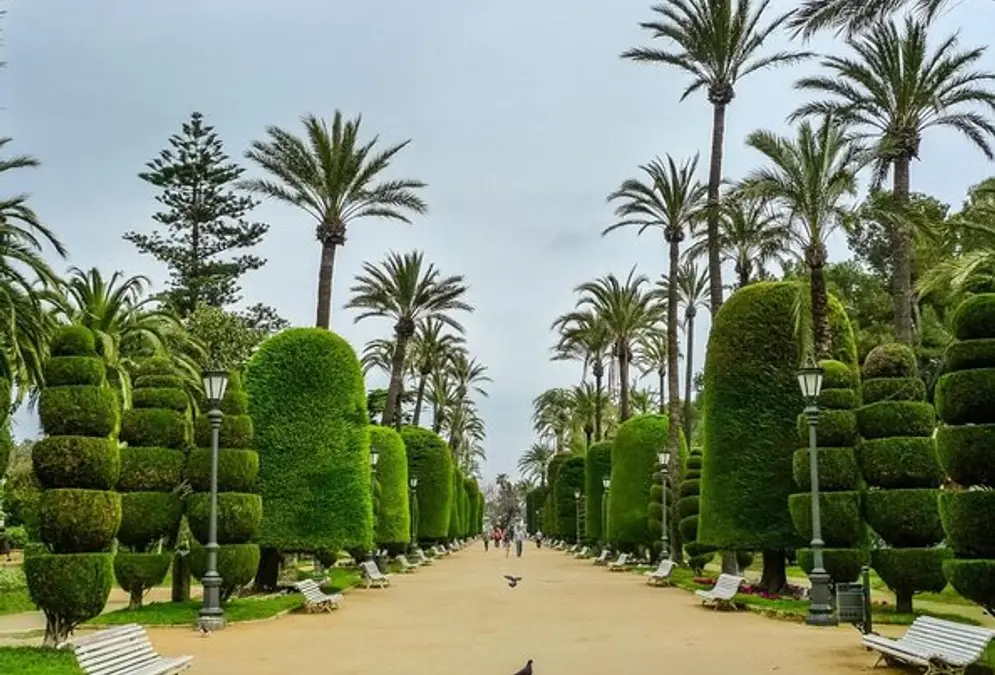
Parque Genovés occupies 30,000 square metres at the north-western edge of Cádiz's walled peninsula, making it the largest green space inside the historic old town. Declared a Bien de Interés Cultural on 19 March 2004 by the Junta de Andalucía, it retains the layout of a 19th-century Romantic botanical garden and remained the city's biggest park overall from its August 1892 inauguration until Parque Celestino Mutis opened in 2012. Its roughly trapezoidal footprint sits between the Parador Nacional Atlántico on Calle Jesús Caído, the Atlantic seafront along the Cádiz seafront walk at Paseo de Santa Bárbara, Avenida Duque de Nájera and its continuation Avenida Doctor Gómez Ulla, and Paseo de Carlos III at Plaza Rocío Jurado on the edge of the Barrio del Mentidero, just west of the Baluarte de la Candelaria, the Iglesia del Carmen and the Alameda promenade leading from Barrio de San Carlos.
When to Visit
Visit duration
30–60 minutes
From Paseo del Perejil to the 1892 Romantic garden
The garden began at the end of the 18th century as a bare strip of ground between the sea wall and the Camposanto and La Bomba barracks, left unbuilt because of military easement and nicknamed the Paseo del Perejil (Parsley Promenade) for its sparse vegetation. From 1854 onwards the council expanded the promenade and renamed it the Paseo de las Delicias, using the earthworks to give paid employment to needy residents during a cholera epidemic in Cádiz. In 1863 the neighbouring Cuartel de Columela was demolished and its plot planted with trees, chiefly American cypress, and by 1869 the park was spacious and well laid out enough to take over the annual August festival of the Velada de Nuestra Señora de los Ángeles (Velada del Corpus) from Plaza de Isabel II and Calle de la Aduana.
The park takes its present name and layout from Mayor Eduardo Genovés y Puig, who completed the reforms begun by Mayor Juan Valverde and reopened the grounds in August 1892. Genovés brought in the Catalan landscape gardener Ramón Oliva Bogunyá, Director of Public Gardens in Barcelona and later Director of Parque Genovés and of the Royal Household gardens, to fold the old promenade and the adjoining Bosque del Ejército into a larger asymmetrical garden.
Oliva's 1892 design introduced rare botanical species from across the world alongside fountains, a tea room, the waterfall and lake of La Gruta, and a summer theatre whose iron frame was designed by Gustave Eiffel. In the 1930s the council dismantled Eiffel's metallic frame and moved it to Plaza de la Merced to roof the Mercado de la Merced; recently restored, that ironwork still stands inside the Centro Municipal de Arte Flamenco. Back in the park, the municipal open-air music venue Cortijo Los Rosales opened beside the rose garden in 1942 on the plot where the Teatro de Verano José María Pemán was later built, staging summer concerts until it closed in 1970.
Use the canopy for midday Levante shade or summer evenings
When summer heat or a stiff wind makes the open seafront tiring, the dense 19th-century tree canopy filters both sun and breeze. In summer the gates stay open until 22:30, making it a cool evening stroll after dinner.
Paseo Central, La Gruta and over 150 botanical species
Through the main gates at Plaza Rocío Jurado runs the Paseo Central, a broad avenue split into three lanes by a double row of symmetrical parterres. Here fountains built of local porous piedra ostionera (oyster stone) are flanked by common cypresses (Cupressus sempervirens) at the corners and Monterey cypresses (Cupressus macrocarpa) in the centre, all clipped into rounded English-style topiary alongside date palms (Phoenix dactylifera).
Beyond that formal spine, Oliva laid out winding paths that shelter more than 150 species of trees, palms and shrubs, most of them exotic imports from other continents that have adapted to Cádiz's mild coastal microclimate. One flagship corner is La Gruta, an artificial pond with a waterfall whose rocky shell has a walkway running right through the interior behind the water, complemented by 19th-century wrought-iron railings, streetlamps and a kiosk.
| Botanical specimen | Scientific name | Origin & distinction in the park |
|---|---|---|
| Canary Islands dragon tree | Dracaena draco | Centenary specimen and one of the city's signature monumental trees |
| New Zealand pohutukawa (metrosidero) | Metrosideros tomentosa (excelsa) | Originating in New Zealand; considered one of the most significant specimens in Europe |
| Norfolk Island & Bunya pines | Araucaria excelsa & Araucaria bidwillii | Two Araucaria varieties whose oldest trees are among the park's longest-lived and reach up to 50 m |
| Silk floss tree (palo borracho) | Chorisia speciosa | Spiny, bottle-trunked South American tree planted along the asymmetrical garden walks |
Fountains and monuments along the paths
Several of the park's best-known sculptures have travelled before settling under its trees. The Fuente de los Niños del Paraguas (Fountain of the Children under the Umbrella) depicts Paul and Virginie, the young protagonists of Jacques-Henri Bernardin de Saint-Pierre's 1787 novel; the Aramburu family bought the piece in Paris and kept it in the courtyard of their Plaza de San Antonio palace until donating it to the city in 1907.
In a parterre on the central avenue stands the marble bust of the Cádiz-born botanist José Celestino Mutis, carved by the local sculptor José Gargallo and inaugurated on 6 April 1932 by the First City Council of the Second Republic for the bicentenary of Mutis's birth. At the end of the Paseo de las Palmeras near the Avenida Doctor Gómez Ulla entrance rises Julio González Pola's stone bas-relief to Carmen Angolotti Mesa, Duchess of la Victoria, unveiled on 24 November 1925 to honour the Cádiz noblewoman's Red Cross nursing work during the Rif War.
Other memorials scattered through the grounds and outer walls include:
- Columela (Lucius Junius Moderatus), the Gades-born Roman writer on agriculture.
- Tributes to the Cádiz composer Manuel de Falla and the writer José María Pemán.
- Statues dedicated to the Spanish naturalist Félix Rodríguez de la Fuente, the conquistador Rodrigo de Bastidas and St Rose of Lima, patron saint of gardeners.
- A Battle of Trafalgar memorial fitted with steel plaques listing every ship that fought in the engagement.
- A stone coat-of-arms plaque of Cádiz set into the outer wall on Paseo de Santa Bárbara beside the main gate, the sole surviving remnant of Mariano Benlliure's Los niños meones fountain, which vanished from the park in the mid-1970s.
Practical visit details
Parque Genovés is an open-air municipal park with free admission and flat, shaded gravel and paved walks. Gates open daily at 08:00 and close at sunset, with extended summer hours from 08:00 to 22:30, though the city council adjusts opening times or closes the gates during high winds and severe weather.