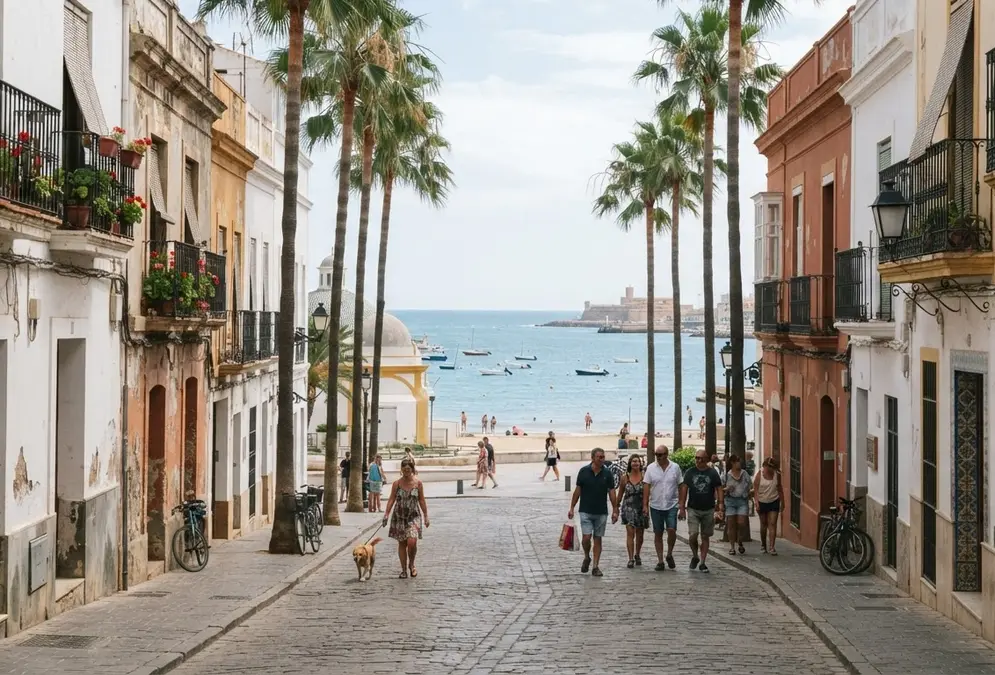
Palm-lined Calle Virgen de la Palma in the La Viña quarter of Cádiz leading toward the Atlantic at La Caleta
culture

La Viña & Carnival Walk

Walk 1.8 km from Gran Teatro Falla through El Mentidero and La Viña to La Caleta. Follow Cádiz's Carnival coplas, historic taverns and seafront bastions.

This 1.8 km linear route connects the two halves of Cádiz's musical and satirical life: the formal competition stage on Plaza Fragela and the salt-stained lanes where the repertoire is actually lived. Starting at the Gran Teatro Falla on the edge of El Mentidero, the walk threads south-west into La Viña, pauses at century-old and mid-century tavern counters, and finishes on the sand of La Caleta beside the bronze bust of Paco Alba (Francisco Alba Medina).

Even outside February, the route makes sense of why Cádiz sounds the way it does. The red-brick auditorium where Manuel de Falla is honoured by name sits fewer than ten minutes' walk from the whitewashed fishermen's blocks where chirigotas and comparsas sing without microphones on corner steps.

Gran Teatro Falla and the Plaza Fragela stage

Begin on Plaza Fragela in front of the Gran Teatro Falla, the city's main theatre and the indoor heart of the February contest. Architect Adolfo Morales de los Ríos drew up the project, building work began in 1884 over the burnt ruins of the wooden Gran Teatro de Cádiz, and the completed neo-Mudéjar brick playhouse opened on 12 January 1910 before taking the composer Manuel de Falla's name in 1926. Stand back across the square to read its red-brick façade and the three horseshoe-arched entrance doors lined with alternating red and white voussoirs.

Every winter, the Concurso Oficial de Agrupaciones Carnavalescas (COAC) fills this horseshoe auditorium for roughly a month before moving into the streets. The official competition divides entries into four distinct vocal and theatrical formats:

  • Coros: large ensembles that perform with plucked string instruments (bandurrias and lutes) and ride open carriages through town during the festival.
  • Comparsas: poetic, harmonically rich vocal groups accompanied by bass drum (bombo), snare drum (caja), guitars and pito de caña (reed kazoo), a modality created around Paco Alba's groups in 1960.
  • Chirigotas: sharp, fast-moving satirical groups driven by punchlines, topical parody and double meanings.
  • Cuartetos: small comic ensembles (despite the name, three to five performers) relying on rapid dialogue, rhyming parodies and claves.

If you want to step inside the theatre outside show nights, guided tours run on selected dates for €6 (45 minutes, maximum 30 people per group), booked ahead through the Cádiz Turismo office at Paseo de Canalejas.

From El Mentidero into the grid of La Viña

From the eastern side of Plaza Fragela, clip the edge of El Mentidero, an 18th-century residential quarter built over former market gardens (huertas) whose central square was completed around 1773. Its name recalls the old habit of trading rumours and tall tales around the square, a habit that fed naturally into Carnival verse.

Head south-west across Calle Sagasta and into La Viña, the north-western barrio bounded between Calles de la Rosa and Sagasta. Before the 18th-century building boom covered the land in tight blocks of whitewashed housing, vineyards grew here; once urbanised, the quarter was settled by working-class families who made their living fishing off La Caleta. That maritime and popular character has never left the street plan.

Drop into Plaza Pinto, universally known in Cádiz as Plaza del Tío de la Tiza in honour of the early Carnival composer Antonio Rodríguez Martínez. Along with neighbouring Plaza San Antonio (which hosts the Sunday Ostionada oyster feast), this square and the adjoining lanes lead the city's pre-Carnival gastronomic calendar during the last two weeks of January.

Taberna Las Banderas, Casa Manteca and Calle Virgen de la Palma

Two blocks south of the square, turn onto Calle Virgen de las Penas for Taberna Las Banderas at number 1. Originally opened in 1892 as a shop and bar, the premises stood shut for just over thirty years before reopening as a traditional taberna in 2022–2023 with its historic woodwork intact. It is a prime stop for cold tapas (especially ensaladilla and dobladillo gaditano of mackerel, tomato and mayonnaise), Iberian cured meats, tinned seafood, and wines from the Marco de Jerez, and it hosts live Ciclo Coplas performances.

Walk west to the corner of Calle Corralón de los Carros 66, where Lorenzo Ruiz Manteca founded Casa Manteca in 1953 before passing it to his son Pepe Manteca. The walls are papered with bullfighting memorabilia, old photographs and Carnival press clippings. No reservations are taken: you lean at the counter for a cold beer and chicharrones (spiced sliced pork belly) or chacinas served straight onto brown butcher's paper (papel de estraza), while fried fish comes across the lane from the family's freiduría opposite.

That corner drops straight onto Calle Virgen de la Palma, the palm-lined pedestrian spine of La Viña. On a late Sunday in January, the street packs wall-to-wall for the Erizada Popular, the oldest of the Carnival food festivals, when kilos of freshly cracked sea urchins are handed out to the crowd. Midway along the street stands the 18th-century Baroque Church of Nuestra Señora de la Palma, whose devotion is tied to the legend of the 1755 Lisbon earthquake and tsunami, when residents credit the Virgin's standard with halting the advancing sea at the doors of the church. A block south at Calle San Félix 15, El Faro de Cádiz has anchored the dining end of the barrio since 1964, when Gonzalo Córdoba opened it in the fishermen's quarter and put tortillitas de camarones at the centre of its menu.

Finishing at La Caleta and the bust of Paco Alba

Follow Calle Virgen de la Palma to its western end, where the houses part and the Atlantic opens across La Caleta. Flanked by the Castles of San Sebastián and Santa Catalina, and curving around the white timber arcades of the 1926 Balneario de Nuestra Señora de la Palma y del Real, this is the cove that every La Viña copla returns to sooner or later.

On the seafront promenade above the beach stands the monument and bust of Paco Alba (1918–1976). Born in Conil de la Frontera and trained as a shipyard worker in Cádiz after moving to the city, Alba entered the contest in 1953 with Los vendedores de marisco and wrote groups of such lyrical and musical ambition that organisers created the comparsa category in 1960 to judge his entry Los pajeros. Over his career he won 13 First Prizes and 3 Special First Prizes at the Falla. Finishing the walk here, with the 1926 bathhouse below and the sunset dropping between the two sea forts, completes the thread that started on Plaza Fragela.

Stop-by-Stop Route

  1. 1

    Gran Teatro Falla

    Monument 20 mins

    Designed by Adolfo Morales de los Ríos and built between 1884 and 1910 over the ashes of an earlier wooden playhouse, this red-brick neo-Mudéjar theatre on Plaza Fragela hosts the February Concurso Oficial de Agrupaciones Carnavalescas (COAC).

    Tip: Walk the perimeter on Plaza Fragela to see the three horseshoe-arched doors with red-and-white voussoirs; 45-minute interior tours cost €6 and require advance booking via Cádiz Turismo.

  2. 2

    Barrio del Mentidero

    Neighborhood 10 mins

    An 18th-century residential quarter laid out over former market gardens, with its central square finished around 1773. Its name comes from the gossip and tall tales once traded on the square, a tradition closely linked to Carnival satire.

  3. 3

    Urbanised in the 18th century over former vineyards and settled by La Caleta fishing families, La Viña is the popular heart of the Cádiz Carnival. Its central square, Plaza Pinto, is named Plaza del Tío de la Tiza after Carnival pioneer Antonio Rodríguez Martínez.

    Tip: Notice how the tight whitewashed grid funnels the sea breeze inland from La Caleta toward Plaza Pinto.

  4. 4

    Taberna Las Banderas

    Bar 20 mins

    A historic 1892 corner premises at Calle Virgen de las Penas 1 that reopened in 2022–2023 after three decades shut. It serves cold tapas such as ensaladilla, Iberian cured meats, tinned seafood and Marco de Jerez wines alongside Ciclo Coplas events.

    Tip: Pair a glass of fino or manzanilla with the house ensaladilla or a dobladillo gaditano.

  5. 5

    Casa Manteca

    Bar 25 mins

    Founded in 1953 by Lorenzo Ruiz Manteca at Calle Corralón de los Carros 66, this bullfighting- and Carnival-lined tavern serves chicharrones, cured meats and cheese on brown wax paper right on the main route of the street Carnival groups.

    Tip: No bookings are accepted; arrive close to the 12:30 or 20:30 opening time to claim a spot at the counter.

  6. 6

    Calle Virgen de la Palma & Iglesia de la Palma

    Landmark 15 mins

    La Viña's palm-shaded pedestrian artery, home to the 18th-century Baroque Church of Nuestra Señora de la Palma and the late-January Erizada Popular sea-urchin feast.

    Tip: Step inside the 18th-century church to see the shrine credited in local tradition with stopping the 1755 tsunami waters in the street outside.

  7. 7

    La Caleta & Bust of Paco Alba

    Neighborhood 20 mins

    Cádiz's historic western cove, framed by two sea castles and the 1926 Balneario de Nuestra Señora de la Palma y del Real, where the bronze bust of comparsa creator Paco Alba (1918–1976) overlooks the Atlantic.

    Tip: Time the final stretch for late afternoon so you reach the promenade above the 1926 bathhouse as the sun drops toward Castillo de San Sebastián.

Reporter notebook

Insider tips

Best time

Start at 11:30 to hit the taverns as the shutters rise

Leaving Plaza Fragela around 11:30 gives you unhurried morning light on the Gran Teatro Falla brickwork and brings you to Calle Corralón de los Carros right as Casa Manteca opens at 12:30, before the counter queues build.

What to order

Keep the tavern stops short and specific

Treat La Viña as a grazing route rather than a single sit-down lunch: order chicharrones on brown wax paper with a cold caña at Casa Manteca, then step over to Taberna Las Banderas for ensaladilla and a glass of manzanilla or fino.

Local custom

Listen for illegal street groups on February steps

During Carnival, besides the official Falla finalists, unamplified callejera (street) groups gather on the steps and corners between Plaza del Tío de la Tiza and Calle Virgen de la Palma. Stand back in a tight semicircle and stay quiet while they sing.

Practical information

Distance
1.8 km
Duration
1.5–2 hours
Difficulty
easy
Start
Gran Teatro Falla (Plaza Fragela)
End
Playa de La Caleta (Paseo Fernando Quiñones)

Frequently asked questions

How long does the La Viña and Carnival walk take?

The 1.8 km walk takes 30 to 40 minutes of pure walking on flat ground, or 1.5 to 2 hours if you pause at Plaza Fragela, stop for a round of chicharrones and sherry at Casa Manteca or Taberna Las Banderas, and watch the light at La Caleta.

Can you do the La Viña Carnival walk outside February?

Yes. While the COAC contest at Gran Teatro Falla takes place in February and the Erizada Popular runs in the last two weeks of January, the neo-Mudéjar theatre exterior, the 18th-century streets of La Viña, the historic taverns and the La Caleta promenade are open year-round.

What is the difference between a chirigota and a comparsa in Cádiz?

Both are official Carnival group categories that compete at the Gran Teatro Falla and sing in the streets of La Viña. A chirigota focuses on fast, witty satire and comic punchlines, while a comparsa—the modality created around Paco Alba in 1960—uses more poetic lyrics and richer multi-part vocal harmonies.

Where is the Erizada Popular held along this route?

The Erizada Popular, the oldest of Cádiz's pre-Carnival gastronomic festivals, takes place on Calle Virgen de la Palma and around Plaza del Tío de la Tiza in central La Viña during the last two weeks of January.

Do I need reservations for the taverns in La Viña?

Casa Manteca does not accept reservations at all, so you simply turn up when it opens at 12:30 or 20:30. Taberna Las Banderas and El Faro de Cádiz do take bookings, which are strongly recommended on weekends and throughout January and February.

Further reading

Sources

29 references Show
  1. Wikipedia — Gran Teatro Falla (opens in a new tab)

    “a wooden building designed by García del Álamo and built in 1871, but which had burned in 1881.”

  2. Wikipedia — Gran Teatro Falla (opens in a new tab)

    “Comenzó a construirse en 1884, siguiendo el proyecto de Adolfo Morales de los Ríos”

  3. Wikipedia — Gran Teatro Falla (opens in a new tab)

    “El teatro se inauguró el 12 de enero de 1910 con la interpretación de una sinfonía de Barbieri”

  4. Wikipedia — Gran Teatro Falla (opens in a new tab)

    “De estilo neomudéjar, está construido en ladrillo rojo, y presenta tres grandes puertas de arco de herradura en su fachada principal, con dovelas alternas en rojo y blanco.”

  5. Wikipedia — Gran Teatro Falla (opens in a new tab)

    “Todos los años y durante el mes de febrero se celebra en el Gran Teatro Falla el Concurso de Agrupaciones del Carnaval de Cádiz”

  6. Turismo de Cádiz — Visitas guiadas al gran teatro falla (opens in a new tab)

    “Las entradas tienen un precio de 6 euros para la entrada general, 4 euros para personas mayores de 65 años y desempleados, 3 euros para poseedores del carné joven y entrada gratuita para menores de hasta 12 años.”

  7. Wikipedia — El Mentidero (Cádiz) (opens in a new tab)

    “Antigua zona de huertas, su urbanización se proyectó a mediados del siglo XVIII, quedando la plaza homónima terminada hacia 1773, que se constituyó en el eje del nuevo barrio.”

  8. Wikipedia — Plaza del Mentidero (opens in a new tab)

    “La plaza del Mentidero es una pequeña plaza de Cádiz, destacada actualmente como espacio estrechamente ligado al carnaval.”

  9. hoteles.net

    “fueron las clases más humildes, dedicadas a la pesca, las que los habitaron. Se dedicaban a faenar en la Playa de La Caleta.”

  10. hoteles.net

    “Se halla en la parte noroccidental de la villa, entre las calles de la Rosa y Sagasta”

  11. hoteles.net

    “nos encontraremos con la iglesia barroca de la Virgen de La Palma, del siglo XVIII.”

  12. hoteles.net

    “la Plaza del Tío de la Tiza, en honor a Antonio Rodríguez Martínez, un importante personaje del carnaval gaditano”

  13. hoteles.net

    “la famosa Taberna Casa del Manteca. Se trata de un local del año 1953”

  14. hoteles.net

    “es el centro neurálgico de los carnavales gaditanos”

  15. andaluciadestinodecine.com (opens in a new tab)

    “La Viña owes its name to the vineyards that once existed in the area before its urbanization in the 18th century.”

  16. andaluciadestinodecine.com (opens in a new tab)

    “The central hub of this neighborhood includes Virgen de la Palma Street and the popular Tío de la Tiza Square, where you can visit the Church of La Palma.”

  17. festivalesdeespana.com (opens in a new tab)

    “La Erizada Popular es la decana de las fiestas gastronómicas del Carnaval de Cádiz.”

  18. festivalesdeespana.com (opens in a new tab)

    “La Calle Virgen de la Palma es su arteria principal y se llena para la erizada.”

  19. andalucia.org (opens in a new tab)

    “Durante las dos últimas semanas del mes de enero, la ciudad empieza a prepararse para su fiesta más representativa”

  20. eldiario.es (opens in a new tab)

    “Fue fundada en 1953 por el santanderino Lorenzo Ruiz Manteca, que posteriormente lo cedió a su hijo Pepe Manteca.”

  21. eldiario.es (opens in a new tab)

    “Su especialidad son las tapas frías, con los chicharrones de Cádiz como plato estrella.”

  22. codigocarnaval.com (opens in a new tab)

    “Locales como Casa Manteca, Bar Casa Pepe o Antonio del Palillo están en pleno itinerario de las agrupaciones.”

  23. codigocarnaval.com (opens in a new tab)

    “Taberna centenaria (desde 1892) reabierta en 2023 tras tres décadas de cierre, recuperando sus elementos emblemáticos.”

  24. elfarodecadiz.com (opens in a new tab)

    “Cuando Gonzalo Córdoba abrió El Faro en 1964, en el barrio marinero de La Viña, puso a la tortillita de camarones en el centro de su carta y en el corazón de su cocina.”

  25. Wikipedia — Playa de La Caleta (Cádiz) (opens in a new tab)

    “Es un tema recurrente en las coplas de Carnaval.”

  26. Turismo de Cádiz — La caleta (opens in a new tab)

    “en su arena se levanta el Balneario de Nuestra Señora de la Palma y del Real, edificio construido en 1926 que modela la fisonomía de esta singular playa urbana.”

  27. Turismo de Cádiz — Carnaval (opens in a new tab)

    “Coros, comparsas, chirigotas y cuartetos cantan sus coplas de un modo gratuito ante un público completamente entregado al espectáculo en el que se convierte la calle en general, y cada plaza y rincón en particular.”

  28. carnavaldecadiz.com (opens in a new tab)

    “Como era imposible comparar sus agrupaciones con las de otros autores, se decidió crear la modalidad de la comparsa en 1960 para encasillar al estilo de las agrupaciones de Paco Alba, considerado como el creador de esta modalidad.”

  29. carnavaldecadiz.com (opens in a new tab)

    “En total obtuvo: 13 primeros premios, 3 primeros premios especiales, 5 segundos premios y 2 terceros premios.”