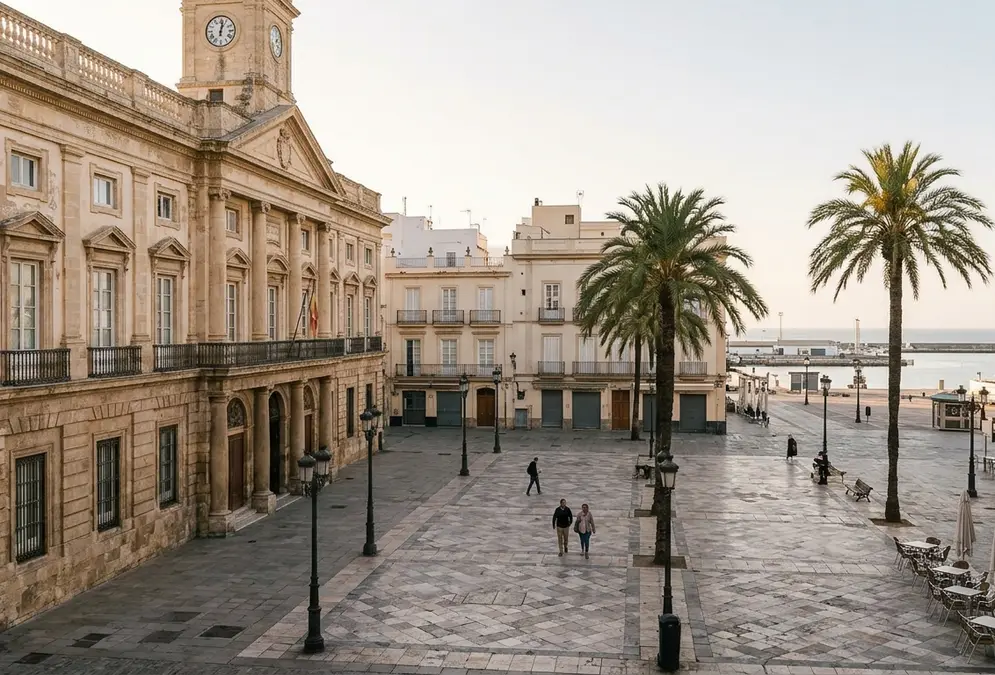

Four plazas, one route, about 1.5 km. This walk joins Plaza de San Juan de Dios, Plaza de las Flores, Plaza de San Antonio and Plaza de Mina in an order that keeps you off the cathedral crowds, with a market, a watchtower and the oratory where the Cortes sat along the way. Plan on about 2 h 45 min, plus whatever time you give the Museo de Cádiz at the end.
Plaza de San Juan de Dios to the market
Start on Plaza de San Juan de Dios, the city's old main square, also called La Corredera. It lay outside the medieval walls beside the sea gate, today's Arco del Pópulo, and by the sixteenth century it was the centre of urban life, with goods from the Indies fleets sold on it. The town hall and the church of San Juan de Dios face the port. The remodelling finished in 2012 made the square fully pedestrian, and the monument to Sigismundo Moret, which first stood here in 1909, was returned to it. El Pópulo starts behind the town hall, but this route turns inland.
About 450 m on, Plaza de las Flores (listed on some addresses as Plaza de Topete) fills with flower stalls. Bar La Marina sits on the square beside the Mercado Central. The market opened in 1838 on Plaza de la Libertad and is listed by the city tourism office as open Monday to Saturday from 09:00 to 15:00. The market's own site lists different winter hours, but the council's hours make it safest to do this walk in the morning. Go in even if you buy nothing; the fish hall is the best free look at what ends up in pescaíto frito later.
A watchtower and the Cortes
Two short blocks north, Torre Tavira stands 45 m above sea level in the highest part of the old town. Merchants used the city's watchtowers to follow ships and cargo, and this one now holds a camera obscura. The visit takes 45 minutes and goes by prior appointment, so book on the tower's own site. General admission is 8 EUR on the tower's own listing. Opening hours follow the season, so check the current ones and the last-entry time on the tower's site before you plan around it.
A 160 m detour brings you to the Oratorio de San Felipe Neri. The Cortes met here from 1811 to 1813, and a Murillo Immaculate Conception hangs inside. The city council lists it open Monday to Friday from 10:30 to 16:00 and Saturday from 10:00 to 14:00, with a general ticket of €5; Sunday is Mass only. Outside those hours the exterior and the street are enough for a pause.
Plaza de San Antonio and Plaza de Mina
Plaza de San Antonio began as the Campo de Jara, named for the nearby Jara well that long supplied the city with drinking water. A hermitage to Saint Anthony gave it its present name in the mid seventeenth century. The 1812 Constitution was proclaimed here, and the same square saw the bloody repression of the liberal movement in 1820. Look at the facades: the Casino Gaditano, built in the eighteenth century by the Marqués del Pedroso, and the former Banca Aramburu, whose front was renewed in Modernista style in 1910. A few streets south-east in the surrounding district, Plaza de Candelaria holds the Monumento a Emilio Castelar, commemorating the Cádiz-born orator and historian Emilio Castelar (1832–1899), who served as President of the Executive Power of the First Spanish Republic between 1873 and 1874. Listán Wine Tasca is on the square and keeps lunch and evening hours from Tuesday to Saturday; it is closed on Sunday and Monday.
The walk ends at Plaza de Mina, 175 m east. It occupies the former orchard of the Franciscan convent and was laid out as public space in the mid nineteenth century. A plaque on no. 3 marks the birthplace of the composer Manuel de Falla. The Museo de Cádiz, in the same square, has been here since 1935. Its archaeology collection began with a Phoenician anthropoid sarcophagus found in 1887, and it opens Tuesday to Saturday from 09:00 to 21:00, Sunday and holidays from 09:00 to 15:00, closed Monday. About 250 m away, the Oratorio de la Santa Cueva is the natural next stop if you have energy left.
Distance and timing
The stops are 1.28 km apart in a straight line, and street detours bring the route to about 1.5 km. The figure comes from the stop coordinates, not from a measured route. At an easy 4.5 km/h that is about 20 minutes of walking; the rest of the 2 h 45 min is the visit time listed at each stop.