history-buffsarchitecturefamilies
The Puerta de Tierra, Cádiz
city-walls land-gate baroque

The Puerta de Tierra, Cádiz

Cádiz's surviving 18th-century land gate, with Cayón's 1756 marble portal, a walkable upper level and the Puppet and Lithography museums. Check times first.

Gate and walls viewable from outside at any time. Upper walkway and museum hours are not published in our sources; check with Cádiz City Council
Viewing the gate from outside is free. Entry prices for the upper walkway and museums are not confirmed; check with Cádiz City Council.
Directions

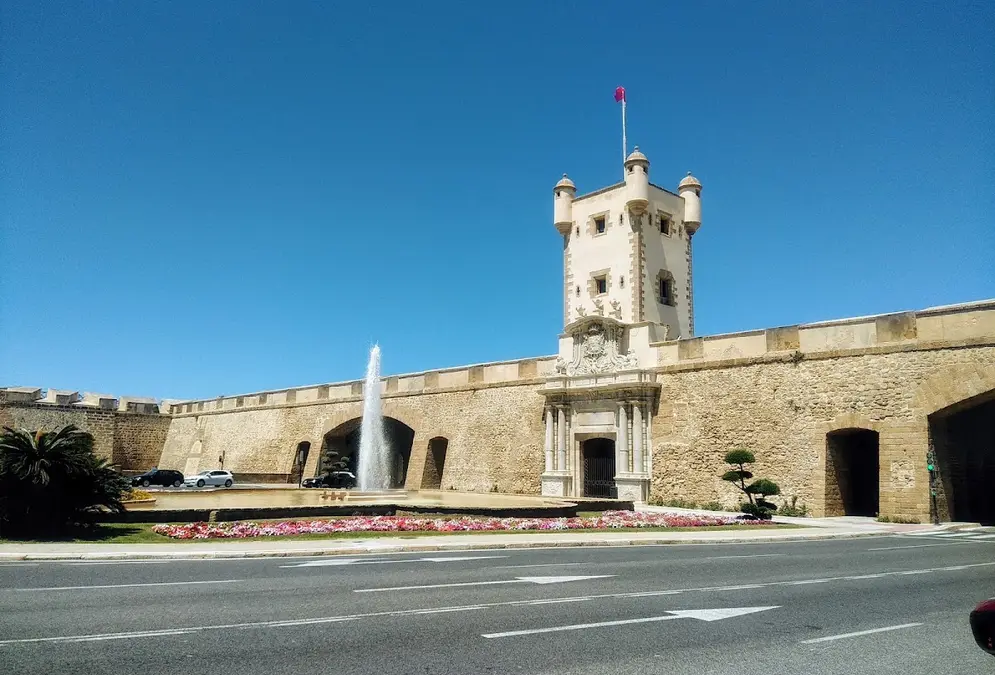
The Puerta de Tierra is the one gate of Cádiz's old land wall that still reads as a gate: a heavy rampart pierced by a marble portal, standing where the Casco Antiguo ends and the modern city begins. It is the answer to a question every visitor asks sooner or later, which is how anyone got into this island-like city on foot. The defences here guarded the city's only land connection, since Cádiz is surrounded for the most part by sea.

It is also a better stop than it looks from the road. Behind the walls sit two small municipal museums, and the upper level has been open to the public again since 2013.

A wall that grew in stages

The first wall on this site went up in the 16th century, and in 1574 it was extended with two bastions. The 18th-century gate you see now is the work of the architect Torcuato Cayón. Its marble portal, designed by José Barnola, is dated 1756. Cayón conceived it less as a fortification than as a religious altarpiece in stone, and it shows: the portico is built as a triumphal arch facing the old quarter, with the Baroque confidence of a city then at the height of its Atlantic trade.

The two flanking bastions carry the names of San Roque and Santa Elena, after chapels demolished in 1737 to make way for barracks.

The wall did not survive the 20th century untouched. A plan to demolish it was dropped in favour of partly filling the moats and opening two new arches for traffic, which is why cars now pass through the rampart on either side of the old portal. The gate holds Bien de Interés Cultural status, declared on 22 June 1993. On the coat of arms the lion's sword has been missing since 2007, and the city council has begun a restoration.

Confirm hours before you plan around the walkway or museums

Opening times and prices for the upper level and the two museums are not published in the sources checked here. Check with Cádiz City Council before building the stop into a fixed itinerary.

What to see

  • The marble portal on the old-town side, the best-looking piece of the whole structure.
  • The central esplanade, where two marble triumphal arches dedicated to San Servando and San Germán, the patron saints of Cádiz, stand.
  • The central vault, turret and upper walkway, which give a view back over the roofs of the old town and out to the modern district.
  • The optical telegraph tower, the Torreón de Puerta de Tierra, built as tower no. 57 of José María Mathé's Andalusian line.

The gate marks the boundary between the walled Casco Antiguo and the modern Extramuros district, so it works well as the start or end of a walk toward Plaza de San Juan de Dios and the Casa de Iberoamérica.

The museums inside

The vaulted rooms house two collections. The Puppet Museum covers 1,500 m² across 18 restored barrel vaults, split between the ground and first floors. Its core is a collection bought by Cádiz City Council from Ismael Peña in 2008, with over 500 items, including around 350 international puppets.

The Lithography Workshop Museum descends from the Litografía Alemana de Cádiz, set up in 1861, and holds more than a thousand lithographic stones. Both are small enough to see in an hour or so.

Visiting

Opening hours for the walkway and the museums, and any ticket prices, are not confirmed in the sources used here and change by season, so check with Cádiz City Council before you plan around them. The gate itself, and the walls around it, can be seen from outside at any time. It sits on the edge of the old town, a natural pairing with the Cádiz Cathedral and the sea-facing Castillo de San Sebastián, and a short way from the quarter of El Populo.

Reporter notebook

Insider tips

Photo spot

Frame the marble portal from the old-town side

The triumphal-arch portal of 1756 faces the old quarter, and that is the side that shows it at its best. The two marble arches on the central esplanade make a good second shot.

Local custom

Use the gate as the line between two Cádiz

Locals treat the Casco Antiguo as Cádiz proper and the area beyond the wall as the modern city. Walk through the portal rather than past it to feel the change.

Practical information

Opening hours
Gate and walls viewable from outside at any time. Upper walkway and museum hours are not published in our sources; check with Cádiz City Council, as times change seasonally.
Admission
Viewing the gate from outside is free. Entry prices for the upper walkway and museums are not confirmed; check with Cádiz City Council.
Address
Puertas de Tierra, Cádiz, Spain View on Google Maps

Tags

city walls land gate baroque bic museums puppets lithography

Frequently asked questions

What is the Puerta de Tierra in Cádiz?

It is the surviving land gate of Cádiz's old city wall, built in the 18th century under the architect Torcuato Cayón. It stands between the Casco Antiguo and the modern Extramuros district.

Can you walk on top of the Puerta de Tierra?

Yes. The central vault, turret and upper walkway have been open to the public since 2013. Opening times are not confirmed, so check with Cádiz City Council before you go.

Is the Puerta de Tierra free to visit?

The gate and walls can be seen from outside at no cost. Entry prices for the upper walkway and the museums are not confirmed, so check with Cádiz City Council.

When was the Puerta de Tierra built?

A first wall went up in the 16th century and was extended with two bastions in 1574. The marble portal of the current gate is dated 1756, designed by José Barnola under Torcuato Cayón.

What is inside the Puerta de Tierra?

The Puppet Museum, with over 500 items including around 350 international puppets, and the Lithography Workshop Museum, which holds more than a thousand lithographic stones.

Is the Puerta de Tierra a protected monument?

Yes. It is a Bien de Interés Cultural, declared on 22 June 1993.

Further reading

Sources

16 references Show
  1. eldiario.es (opens in a new tab)

    “formaba parte del sistema defensivo que protegía la única conexión por tierra de la ciudad, rodeada en gran parte por el mar.”

  2. beticaromana.org (opens in a new tab)

    “The central vault, turret and upper walkway of Puerta Tierra, the inland gateway, which has been reopened to the public since 2013”

  3. Wikipedia (opens in a new tab)

    “En el siglo XVI se construyó la primera muralla en esta zona y en 1574 se realizó una ampliación para protegerla con dos baluartes.”

  4. Wikipedia (opens in a new tab)

    “En el centro de la construcción se abre una portada de mármol diseñada por José Barnola, en 1756.”

  5. beticaromana.org (opens in a new tab)

    “An elegant marble portico, designed by Torcuato Cayón, was built as a triumphal arch for the facade leading into the city’s old quarter.”

  6. Wikipedia (opens in a new tab)

    “Levantada en el siglo XVIII por Torcuato Cayón, la portada está labrada en mármol y está concebida más como retablo religioso que como fortificación militar.”

  7. Wikipedia (opens in a new tab)

    “Finalmente se decidió el relleno parcial de los fosos y la apertura de dos nuevos arcos en el lienzo de la muralla.”

  8. Wikipedia (opens in a new tab)

    “| Declaración | 22 de junio de 1993 |”

  9. diariobahiadecadiz.com (opens in a new tab)

    “desde el año 2007 “falta la espada del león de este escudo, lo que afectaba a la imagen de la Puerta de Tierra”.”

  10. beticaromana.org (opens in a new tab)

    “The central esplanade has two marble triumphal arches dedicated to San Servando and San Germán, the patron saints of Cadiz.”

  11. Wikipedia (opens in a new tab)

    “El Torreón de Puerta de Tierra fue erigido a finales de 1850 para que sirviera como la torre n.º 57 de la línea de telegrafía óptica de Andalucía de José María Mathé”

  12. Wikipedia (opens in a new tab)

    “separa en la actualidad, el Casco Antiguo (conocido popularmente como "Cádiz" o "Cádiz Cádiz") y la zona moderna”

  13. beticaromana.org (opens in a new tab)

    “Puerta de Tierra is also home to the Lithography Workshop Museum and the Puppet Museum.”

  14. beticaromana.org (opens in a new tab)

    “The Puppet Museum is 1,500 m2 and has 18 restored barrel vaults, that are divided between the first and the ground floors of this attractive architectural enclave.”

  15. beticaromana.org (opens in a new tab)

    “This collection boasts over 500 items, including some 350 international puppets.”

  16. beticaromana.org (opens in a new tab)

    “The museum has a highly important collection of over a thousand lithographic stones, from the quarries of Bavara and noted for their high quality.”