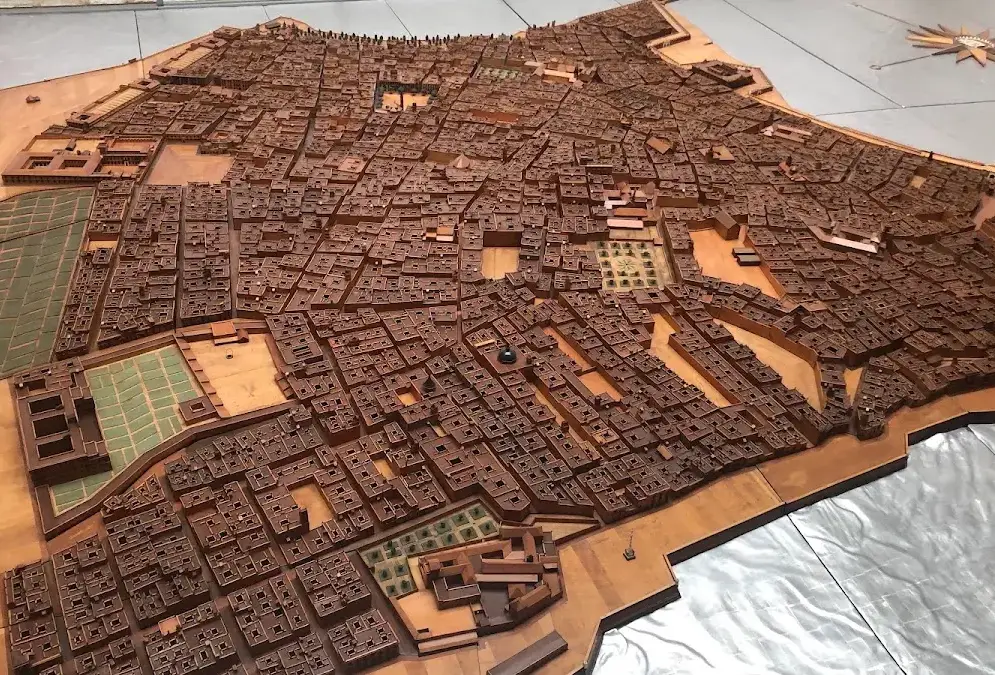
The Museo de las Cortes de Cádiz is a free municipal museum on Calle Santa Inés, and its main exhibit is a wood, ivory and silver model of the whole walled city, built between 1777 and 1779. It stands right beside the Oratorio de San Felipe Neri, so the church where the Cortes met gives you the debate and this building gives you the city that hosted it.
The museum reopened on 1 July 2026 after maintenance work, and entry costs nothing. If you have one indoor hour in the old town, this is the best use of it.
The Maqueta de Cádiz
The model is the reason to come. At roughly 1/250 scale, it shows intramuros Cádiz as it stood in the late 1770s: every block of houses, the squares, the churches and the shore defences. Charles III ordered it, and a team of craftsmen under the military engineer Alfonso Ximénez built it between July 1777 and March 1779.
The materials are part of the story. Mahogany, cedar, ebony, beech and pine make up the houses and streets, with ivory, bone and a few silver details. The sea is carved cedar boards imitating waves, covered in a thin sheet of silver. The model covers 10.8 by 6.45 metres and comes apart into 350 removable pieces grouped in 305 blocks, which is how restorers clean it.
Cádiz's 18th-century street plan has stayed practically unchanged, according to the city's tourism office, so the model works as a map of the old town you are about to walk. Find the narrow neck of land where the Puerta de Tierra now stands, trace the line from the cathedral quarter to the shore, then compare the miniature rooftops with the real ones from Torre Tavira, the 1778 watchtower a few streets away.
Viniegra's painting and the 1812 rooms
The model shares its room with a very large canvas by Salvador Viniegra, painted between 1910 and 1912. It shows the proclamation of the Constitution on 19 March 1812, after the constituent deputies had voted, sworn and signed it. A painting made a century after the event is not a record of it, but it shows how the city chose to remember the day.
From there the route turns to the Cortes themselves. One room is given over to the Cortes and the 1812 Constitution, with oil views of the city and portraits of deputies, among them the most prestigious Spanish American representatives. A small room beyond covers the Trienio Liberal, the years from 1820 to 1823 when the Constitution was briefly in force again. That liberal tradition shaped a later generation of Cádiz figures, including Emilio Castelar, born in Cádiz on 7 September 1832 to liberal parents and later President of the Executive Power of the First Spanish Republic between 1873 and 1874.
Look at the main staircase on the way up. Its stained glass, by Mauméjean Hermanos in 1912, recreates the oath to the Constitution in allegory. For the sessions in the church itself, go next door to the Oratorio de San Felipe Neri.
The siege room and the building
The second floor holds the Sala del Asedio, centred on the defence of Cádiz and the Isla de León, today San Fernando, against Napoleon's troops. Scale models show the uniforms of the Voluntarios Distinguidos, portraits show members of the Junta Superior de Defensa y Gobierno, and a collection of weapons rounds out the room. The same floor lets you look down on the model from above, which is the clearest view of the city's tight grid and the way the peninsula sticks out into the Atlantic.
The building is as much a monument to the 1812 centenary as the collection inside it. Mayor Cayetano del Toro y Quartiellers pushed through its creation for the centenary, and it was inaugurated on 5 October 1912. The municipal architect Juan Cabrera Latorre gave it a neoclassical facade with a central balcony between giant Ionic columns. An explosion at a Navy arsenal in 1947 damaged it badly and it stayed shut until 1964. From 1964 to 1997 it was the Museo Histórico Municipal, and it took back its full name, Museo Iconográfico e Histórico de las Cortes y Sitio de Cádiz, in 1997.
What is on each floor
- Ground floor: a large panoramic view of 17th-century Cádiz, a donation from the Aramburu family, shows the city before the one in the model.
- First floor: the model, Viniegra's canvas, the Cortes and Constitution room and the Trienio Liberal room.
- Second floor: the overhead view of the model and the Sala del Asedio.
Opening hours and admission
Admission is free. The city council publishes these hours, with last entry 15 minutes before closing:
| Day | Hours |
|---|---|
| Monday | 9:00 to 14:30 |
| Tuesday to Friday | 9:00 to 18:00 |
| Saturday and listed holidays | 9:30 to 14:00 |
The listed holidays that count as Saturday hours are 28 February, 15 August, 12 October, 6 December and 8 December. The Ayuntamiento also opens on 18 May, International Museum Day, when it falls on a Sunday. No other Sunday hours are published, so treat Sunday as closed unless the city's museum page says otherwise.
The museum closes for short periods, most recently from 7 to 11 September 2026 to set up a temporary exhibition, so check the Ayuntamiento's page before you cross town for it.