Why Christopher Columbus Sailed From Cádiz in 1493 and 1502
Christopher Columbus sailed from Cádiz on his 17-ship Second Voyage in 1493 and his Fourth Voyage in 1502. Trace his fleets and medieval El Pópulo today.
Historian specialising in Cádiz's ancient, colonial and constitutional heritage.
Published
Christopher Columbus launched two of his four transatlantic crossings from the Bay of Cádiz: the 17-ship Second Voyage on 25 September 1493 and the four-caravel Fourth Voyage in May 1502.[1][2] Where the first crossing from Palos had required crews to row out in small boats to ships anchored off the Saltés sandbar, the Crown needed a deep-water port once exploration turned into full-scale settlement.[3] Between those two departures, Columbus also landed back at Cádiz in June 1496 aboard La India, the first European vessel built in the Americas.[4]
Second voyage leaves Cádiz
25 Sep 1493
Columbus sailed from Cádiz with 17 ships and 1,200 to 1,500 men[1][5]
Return to Cádiz harbour
11 Jun 1496
Ended the second voyage at Cádiz with the Americas-built ship La India[4][6]
Fourth voyage sets sail
9–11 May 1502
Departed Cádiz with 4 caravels and 144 men to seek a western strait[2][7][8]
In this article
Jump to a section
⌄
Why the 1493 second voyage moved from Palos to Cádiz
The Catholic Monarchs shifted Columbus's second expedition from the Tinto-Odiel estuary at Palos to the Bay of Cádiz because a 17-ship colonisation armada could not be assembled and loaded in shallow river channels.[1][3] After Alfonso X reconquered Cádiz in 1262, revived urban life and maritime trade had already turned the city into one of the principal ports of the Iberian Peninsula by the time the Americas were reached.[9]
To organise the fleet, the Crown appointed Juan Rodríguez de Fonseca, Archdeacon of Seville and a firm defender of royal authority who went on to direct New World affairs until the early reign of Charles I.[10] Working across Andalusia's two main Atlantic ports, Seville and Cádiz, Fonseca assembled and equipped the entire armada in four months.[1][11]
The Royal Treasury also used the Cádiz departure to tighten fiscal oversight. Organisers placed a lieutenant of the Contadores Mayores aboard the fleet and drew up plans to establish royal customs houses (aduanas) strictly in Cádiz and in the newly discovered territories.[12] Even after Seville gained the Casa de la Contratación in 1503, the draught (calado) of larger vessels often kept them from ascending the Guadalquivir fully laden, forcing the Crown to authorise cargo operations in Cádiz and set up a Juzgado de Indias there in 1535, an early step toward the later monopoly told in Cádiz and the Atlantic trade.[13]
What sailed out of Cádiz on 25 September 1493
When Columbus weighed anchor at Cádiz on 25 September 1493, he commanded 17 vessels (14 caravels and 3 naos) carrying between 1,200 and 1,500 men, with Pero Alonso Niño serving as chief pilot (piloto mayor).[1][5][14] Royal organisers had initially capped the muster at 1,000 men, including 800 soldiers, but applications overflowed the quota before the ships cleared the bay.[14] For the first leg into the Atlantic, Spanish naval warships escorted the convoy to deter a Portuguese attack.[11]
Unlike the three exploratory vessels of 1492, the 1493 Cádiz fleet carried the materials to transplant Castilian agriculture and town life across the ocean:
Timeline
25 Sep 1493
Second voyage leaves Cádiz
Columbus sails from Cádiz with 14 caravels, 3 naos and over 1,200 men.[14]
6 Jan 1494
Foundation of La Isabela
The Cádiz expedition establishes the first Spanish settlement in the Americas.[17]
11 Jun 1496
Return to Cádiz on La India
Columbus lands back at Cádiz after clashes with royal investigator Juan de Aguado.[4][6][18]
30 May 1498
Third voyage from Sanlúcar
Six ships sail from neighbouring Sanlúcar de Barrameda after two supply vessels leave in February.[19]
9–11 May 1502
Fourth voyage leaves Cádiz
Four caravels and 144 men depart Cádiz to seek a strait around the world.[2][7][8]
Livestock unknown in the Americas: cattle, horses and pigs loaded onto the ships at Cádiz.[5]
Crops and orchard stock: wheat and barley seeds alongside fruit trees and farming tools.[5][15]
Settlers and clerics: fortune-seeking hidalgos, farmers, artisans with their trade instruments and a group of religious friars led by a Benedictine from Montserrat.[15]
Early sugar production: among those who sailed on the second voyage was the Catalan Miguel Ballester, later alcaide of Concepción de la Vega, whom the chronicler Gonzalo Fernández de Oviedo recorded as the first person to make sugar in the Americas.[16]
Steering a more southerly course than on his first crossing, Columbus coasted the Windward Islands, the Virgin Islands, Puerto Rico, southern Cuba and Jamaica.[6] On 6 January 1494, the expedition founded La Isabela in the north of the present-day Dominican Republic, the first permanent Spanish settlement in the New World.[17]
The 1496 return to Cádiz aboard La India and in Franciscan cloth
Columbus returned to the port of Cádiz on 11 June 1496 at the end of a troubled three-year expedition.[6][18] Inevitable clashes in Hispaniola with the royal investigator Juan de Aguado had forced the Admiral to leave the island for Castile on 10 March 1496 to defend his administration before the court.[18]
That June 1496 arrival in Cádiz brought an American maritime first into the bay. Sailing in Columbus's returning squadron was La India, the first European vessel ever constructed in the new Castilian territories across the Atlantic.[4] While his third expedition two years later departed from neighbouring Sanlúcar de Barrameda on 30 May 1498 after two supply ships sailed in February, the anchorage off El Pópulo remained the port where his second crossing both began and ended.[6][19][20]
To counter complaints reaching the court from returning colonists, the Admiral turned his journey from Cádiz to meet the Catholic Monarchs in Burgos into a carefully staged spectacle.[21] He appeared dressed in the habit of a Franciscan friar, surrounded by Antillean Indigenous captives and bright tropical birds.[21]
May 1502: the fourth and final voyage from the Bay of Cádiz
Columbus's last departure from Cádiz took place between 9 and 11 May 1502, when he was in failing health, nearly blind, stripped of the governorship of the Indies and forbidden by the Crown to set foot on Hispaniola.[2][7] Even so, he received royal permission for a fourth crossing aimed at finding a western maritime strait that would allow ships to sail around the world.[7]
Recommended tours
Tours are selected for quality, not commission. We earn a small fee if you book, at no extra cost to you.
The flotilla was modest compared with the 1493 armada. Four caravels (La Capitana, Santiago de Palos, Gallego and Vizcaíno) left the port of Seville on 3 April 1502 and descended the Guadalquivir to Puebla Vieja.[2][22] From there, the Admiral's brother Bartolomé Colón (the Adelantado, who had also been removed from office in Hispaniola) brought the hulls into the Bay of Cádiz to finish preparing them, while Columbus stayed briefly in Seville to handle crew recruitment and munitions before joining the ships in Cádiz to complete their armament.[8][22]
In total, 144 people embarked on the four caravels at Cádiz.[8] Alongside Bartolomé Colón and the official scribe Diego Méndez de Segura sailed Columbus's 13-year-old son Hernando (Fernando), who took charge of writing down his father's notes as the Admiral's eyesight gave out.[2][8] State archival summaries record the departure from Cádiz on 9 May 1502 and other accounts place the final sailing on 11 May; the ships sighted the Central American mainland on 27 July 1502, ended up stranded on Jamaica, and finally returned to Spain at Sanlúcar de Barrameda on 7 November 1504.[2][7][22]
Where to walk the medieval Cádiz that Columbus knew
Visitors looking for the late-15th-century town that watched the 1493 and 1502 fleets load should head straight into the medieval walled core of El Pópulo.[20][23] Although the 1596 sack later burned much of the city's housing and forced 17th-century rebuilds, the medieval street plan, two of the original gates and the foundational parish church of the walled villa still frame the quarter:
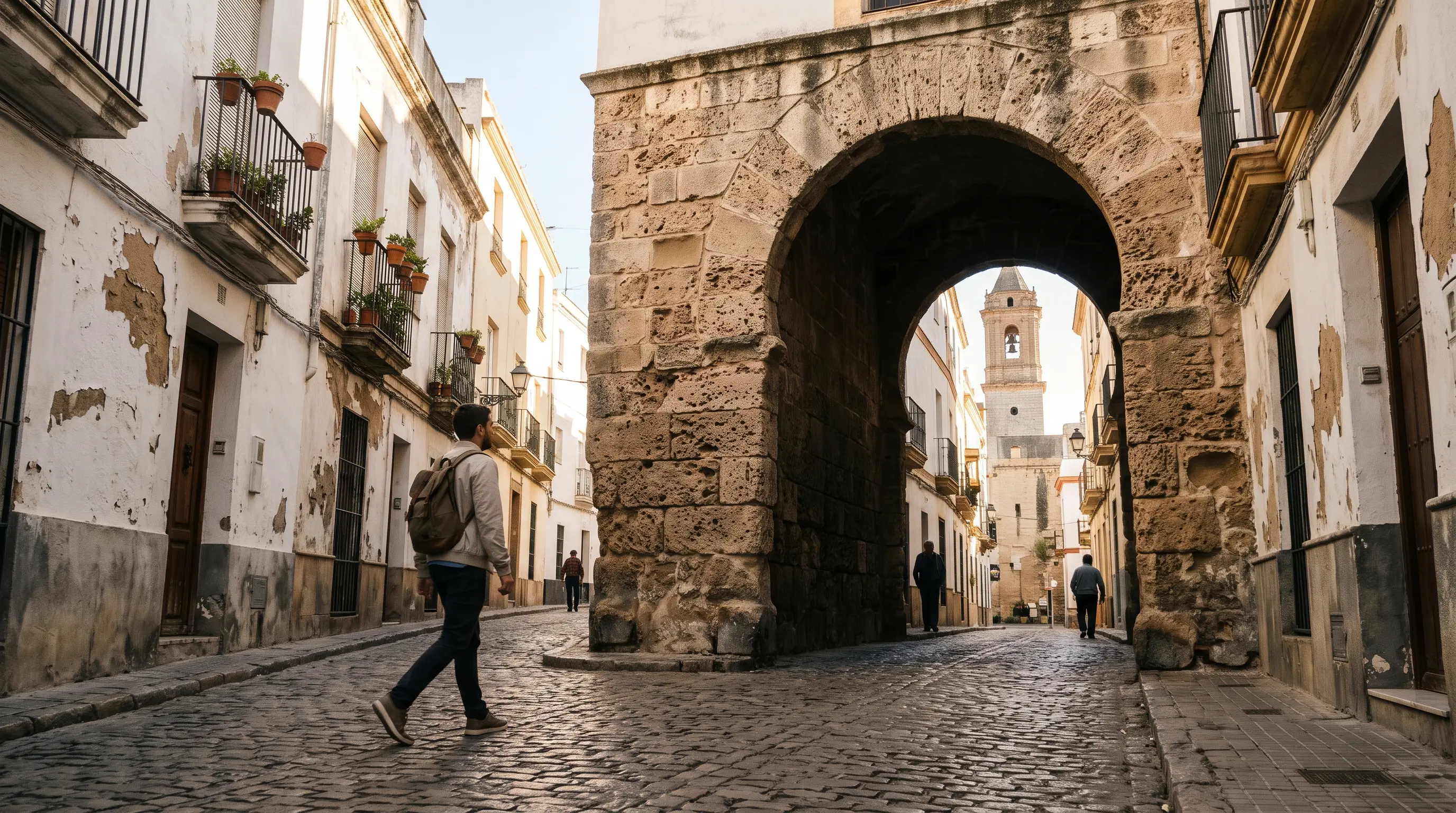
Puerta del Mar / Arco del Pópulo (Calle Pelota side): With foundations dating back to the 12th century, this archway was the main sea gate leading directly out to the old port of Cádiz where fleets embarked; a 17th-century chapel to Nuestra Señora del Pópulo built above the arch gave it its present covered-passageway form.[20]
Puerta de Poniente / Arco de la Rosa (beside Cádiz Cathedral): Built in the 15th century with a brick entrance arch and a surviving upper machicolation (matacán), this western gate opened toward the fishermen's quarter of Santiago and was restored in 1973.[23]
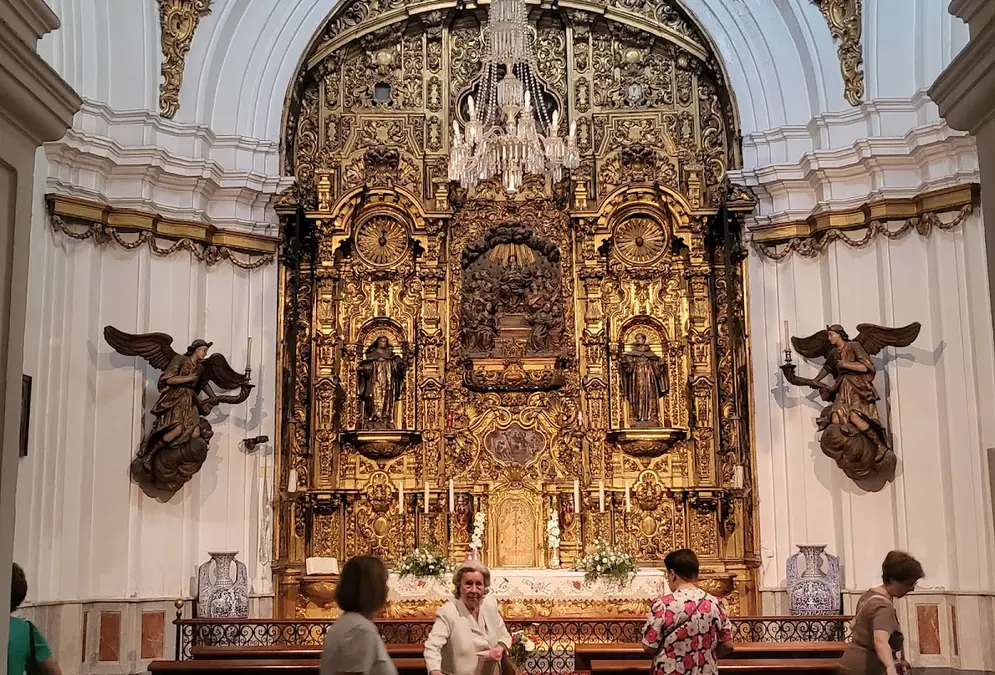
Iglesia de Santa Cruz / Catedral Vieja (Plaza de Fray Félix): Standing on the medieval cathedral site originally founded under Alfonso X that anchored the walled town in Columbus's day, the church was rebuilt after the 1596 fire; above its reconstructed portal, the architrave carries three carved stone shields bearing the emblems of the cathedral, Bishop García de Haro and the Catholic Monarchs who commissioned Columbus's Cádiz voyages.[24]
Frequently asked questions
Which of the christopher columbus cadiz voyages sailed from the city?
Christopher Columbus sailed from Cádiz on two of his four transatlantic expeditions: his Second Voyage on 25 September 1493 (returning to Cádiz on 11 June 1496) and his Fourth Voyage between 9 and 11 May 1502.[1][2][6][7]
Why did Columbus sail from Cádiz instead of Palos in 1493?
His 1492 first voyage from Palos used just three ships anchored off the Saltés sandbar, to which crews rowed in small boats; the 1493 second voyage was a 17-ship colonization armada organized in Seville and Cádiz that needed Cádiz's deep-water port and royal customs oversight.[1][3][11][12]
How many ships and men sailed with Columbus from Cádiz in 1493?
Organized in four months by Archdeacon Juan Rodríguez de Fonseca, the 1493 fleet comprised 17 vessels (14 caravels and 3 naos) with Pero Alonso Niño as chief pilot and between 1,200 and 1,500 men, exceeding the original 1,000-man limit.[1][5][10][14]
What animals and crops did Columbus take from Cádiz on the second voyage?
The 25 September 1493 fleet carried cattle, horses and pigs (animals previously unknown in the Americas) along with wheat and barley seeds, fruit trees and building tools, while passenger Miguel Ballester later produced the first sugar in the Americas.[5][15][16]
What was special about the ship La India that arrived in Cádiz in 1496?
When Columbus returned to Cádiz on 11 June 1496 at the end of his second voyage, he brought back La India, the first European ship ever built in the New World territories.[4][6]
Who accompanied Columbus on his 1502 fourth voyage from Cádiz?
Sailing in May 1502 with 144 men across four caravels (La Capitana, Santiago de Palos, Gallego and Vizcaíno), the nearly blind Admiral was accompanied by his brother Bartolomé Colón, official scribe Diego Méndez de Segura and his 13-year-old son Hernando Colón, who wrote his notes.[2][8]
What survives in Cádiz from the time of Columbus?
In the medieval El Pópulo quarter you can still walk through the 12th-century Puerta del Mar (Arco del Pópulo), which opened onto the old port, and the 15th-century brick Arco de la Rosa, as well as visit the Church of Santa Cruz on the medieval cathedral site, whose post-1596 portal architrave carries the coat of arms of the Catholic Monarchs alongside the shields of the cathedral and Bishop García de Haro.[20][23][24]
“Primero fue encargado de la preparación del segundo viaje de Cristóbal Colón, lo preparó en cuatro meses, el 25 de septiembre de 1493, la expedición zarpaba de Cádiz al frente de una armada de 17 navíos y unos 1.200 tripulantes.”
“Privado de la gobernación del Nuevo Mundo y sujeto a la prohibición de desembarcar en La Española, el 11 de mayo de 1502 parte al frente de cuatro carabelas: "La Capitana", "Santiago de Palos", "Gallego" y "Vizcaíno". Le acompañan su hermano Bartolomé y su hijo Fernando, quien se encargará de escribir sus notas, pues Colón ya apenas puede ver y su salud se halla francamente deteriorada.”
“La expedición partió de Palos el 3 de agosto de 1492. Tras oír misa, los tripulantes se trasladaron en botes a las naves, que estaban ancladas en la barra de Saltés, frente a la Punta del Sebo.”
“El segundo viaje se produjo en septiembre de 1493 y el almirante genovés partió esta vez de Cádiz con el objetivo de explorar y colonizar, por lo que la expedición fue mayor. Del Nuevo Mundo regresó con la India, primer buque fabricado en los nuevos territorios castellanos.”
“El 25 de setiembre de 1493, Colón salió de Cádiz al mando de una gran flota de 17 barcos y unos 1500 hombres. Llevaba vacas, caballos, cerdos, animales hasta entonces desconocidos en el Nuevo Mundo; herramientas para la construcción de poblados, semillas de trigo y cebada, además de árboles frutales.”
“El segundo viaje se inicia en Cádiz el 25 de septiembre de 1493, con un rumbo más al sur y finaliza en el mismo puerto el 11 de junio de 1496. Los territorios costeados son las Islas de Barlovento, las Once Mil Vírgenes, Puerto Rico, la costa sur de Cuba y Jamaica.”
“El cuarto viaje de Cólón tiene por objeto dar la vuelta al mundo. Zarpa el 9 de mayo de 1502 de Cádiz, avistando tierra firme el 27 de julio. Atraviesa el Atlántico sin hallar lo que buscaba. Cuando se dirigía a la isla de La Española, llega a la de Jamaica . Regresa a España dos años después, desembarcando en Sanlúcar de Barrameda el 7 de noviembre de 1504.”
“La tripulación fue de 144 personas. Colón seleccionó a algunos miembros de su tripulación; su hermano Bartolomé Colón (que también había sido apartado del gobierno de La Española), su hijo Hernando Colón (de 13 años) y Diego Méndez de Segura como escribano oficial.”
“La conquista cristiana de la ciudad en el año 1262 por Alfonso X el Sabio supone la revitalización de la economía y de la vida urbana. Esta recuperación facilitó que Cádiz fuera uno de los principales puertos de la península en el momento en que se produce el descubrimiento de América.”
“El organizador de este segundo viaje fue Juan Rodríguez de Fonseca, arcediano de Sevilla. Un acérrimo partidario del autoritarismo regio que acabó enfrentándose con Colón y que, para desgracia de éste, se encargó de dirigir todas las cuestiones relativas al Nuevo Mundo hasta los primeros tiempos del reinado de Carlos I.”
“La Armada acabó organizándose, con algunas dificultadas dada su magnitud, en los puertos más importantes del Atlántico andaluz: Sevilla y Cádiz. Finalmente, la expedición partió de esta última ciudad el 25 de septiembre de 1493, y durante un tiempo fue escoltada por la flota de guerra hispánica, a fin de evitar la posibilidad de un ataque portugués.”
“Y para velar por los intereses de la Real Hacienda incluyeron en la expedición a un teniente de los Contadores Mayores y planearon la creación de aduanas en las tierras recién descubiertas y en Cádiz.”
“El calado no siempre permitía a los buques navegar con toda su carga por el Guadalquivir hasta Sevilla, por lo que fue preciso autorizar que, eventualmente, pudiesen efectuar en Cádiz las operaciones de carga y descarga. Al amparo de esta licencia se desarrolló un activo contrabando, por lo que se estableció en Cádiz un Juzgado de Indias (1535), cuya finalidad era lograr un mejor control de este tráfico.”
“La organización decidió limitar el número de expedicionarios a 1.000 hombres, de los cuales 800 habían de ser soldados. No obstante, estas previsiones quedaron finalmente cortas, pues, al parecer, acabaron embarcando más de 1.200 hombres en un total de 17 buques, de los cuales 14 eran carabelas y 3 naos. La flota quedó bajo el mando de Colón y Pero Alonso Niño fue nombrado piloto mayor.”
“Junto a los soldados, también formaron parte de la expedición hidalgos en busca de fortuna, labradores con animales, aperos agrícolas y semillas, artesanos con sus instrumentos, y un grupo de religiosos bajo la dirección de un benedictino de Montserrat.”
“Poco más podemos decir de este respetado catalán, salvo que durante la rebelión de Roldán seguía siendo alcaide de la Concepción y que, según Oviedo, “... en la ciudad de la Concepción de la Vega...fue el primero que hizo azúcar ”.”
“El 6 de enero de 1494, Colón fundó el primer asentamiento hispánico en el Nuevo Mundo, que fue bautizado como La Isabela, al norte de la actual República Dominicana.”
“Los roces de Colón con Aguado fueron inevitables y llevaron al Almirante a emprender la ruta de retorno a Castilla el 10 de marzo de 1496, llegando a Cádiz el 11 de junio siguiente.”
“Dos de las ocho naves que componían la flota partieron para el Nuevo Mundo en febrero de 1498, llevando diferentes pertrechos. Y el resto inició la singladura el 30 de mayo de 1498 desde Sanlúcar de Barrameda.”
“Puerta del Mar o Arco del Pópulo: los fundamentos de esta puerta se remontan al siglo XII. Durante el siglo XVII se construyó sobre ella la capilla de Nuestra Señora del Pópulo, construcción que modificó las proporciones arquitectónicas de la puerta y le dio su actual aspecto de pasadizo. A través de esta puerta se accedía al antiguo puerto de Cádiz.”
“Colón se entrevistó con los Reyes Católicos en Burgos, organizando una exótica puesta en escena. Apareció rodeado de indígenas antillanos, con vistosas aves tropicales y vestido como un fraile franciscano.”
“Partieron el 3 de abril de 1502 del puerto de Sevilla con dirección a la Puebla Vieja,[16] descendiendo el Guadalquivir con los barcos. Una vez allí, el Adelantado decidió llevar las naves a Cádiz para terminar de prepararlas y Colón se trasladó a Sevilla para ocuparse de la tripulación y las municiones. Colón partió posteriormente a Cádiz para completar el armamento de la flotilla. Zarparon de Cádiz el 11 de mayo.[5][3]”
“Puerta de Poniente o Arco de la Rosa: construido en el siglo XV. En su parte superior se conserva un matacán mientras que el arco de entrada está realizado en ladrillo. Restaurado en 1973. A través de esta puerta se accedía al barrio de los pescadores, bajo la advocación de Santiago.”
“Los únicos elementos decorativos son los tres escudos ubicados en el arquitrabe con los emblemas de los Reyes Católicos, la catedral y el obispo García de Haro.”