How Phoenician Gadir Built Tyre's Atlantic Port in Cádiz
Phoenician Gadir turned the Cádiz archipelago into Tyre's Atlantic port. Explore the Temple of Melqart, the 9th-century BC streets and the Dama de Cádiz.
Historian specialising in Cádiz's ancient, colonial and constitutional heritage.
Published
Sailors from Tyre founded Phoenician Gadir on the islands of today's Cádiz, building the Sanctuary of Melqart in the east and their port city in the west.[1] Classical tradition dated that landing to 1100 BC, while excavations beneath modern Cádiz have uncovered 9th-century BC houses now open at the Yacimiento Arqueológico Gadir.[2][3] Nearby at the Museo de Cádiz, a 2020 osteological study proved that the city's famous female Phoenician sarcophagus actually holds a robust middle-aged man.[4]
Classical foundation date
1100 BC
Dated by Livy and Velleius Paterculus to eighty years after the Trojan War[2]
Depth of Yacimiento Gadir
9 m
Excavated beneath the La Tía Norica theatre between 2002 and 2010[5]
Male in female sarcophagus
45–50 yrs
A 2020 study showed the Dama de Cádiz skeleton belongs to a robust male[4]
In this article
Jump to a section
⌄
Why Tyre founded Gadir on a three-island archipelago
Classical writers dated the Tyrian foundation of Cádiz to eighty years after the Trojan War, which Livy and Velleius Paterculus calculated at around 1100 BC.[2] Strabo records that an oracle ordered the Tyrians to establish a colony by the Pillars of Hercules, and that only on their third voyage did they settle Gades, placing their sanctuary in the east and the town in the west.[1] The spades of modern archaeologists tell a slightly later story. Beneath the streets of Cádiz, the earliest excavated Phoenician occupation strata begin in the 9th and 8th centuries BC.[3]
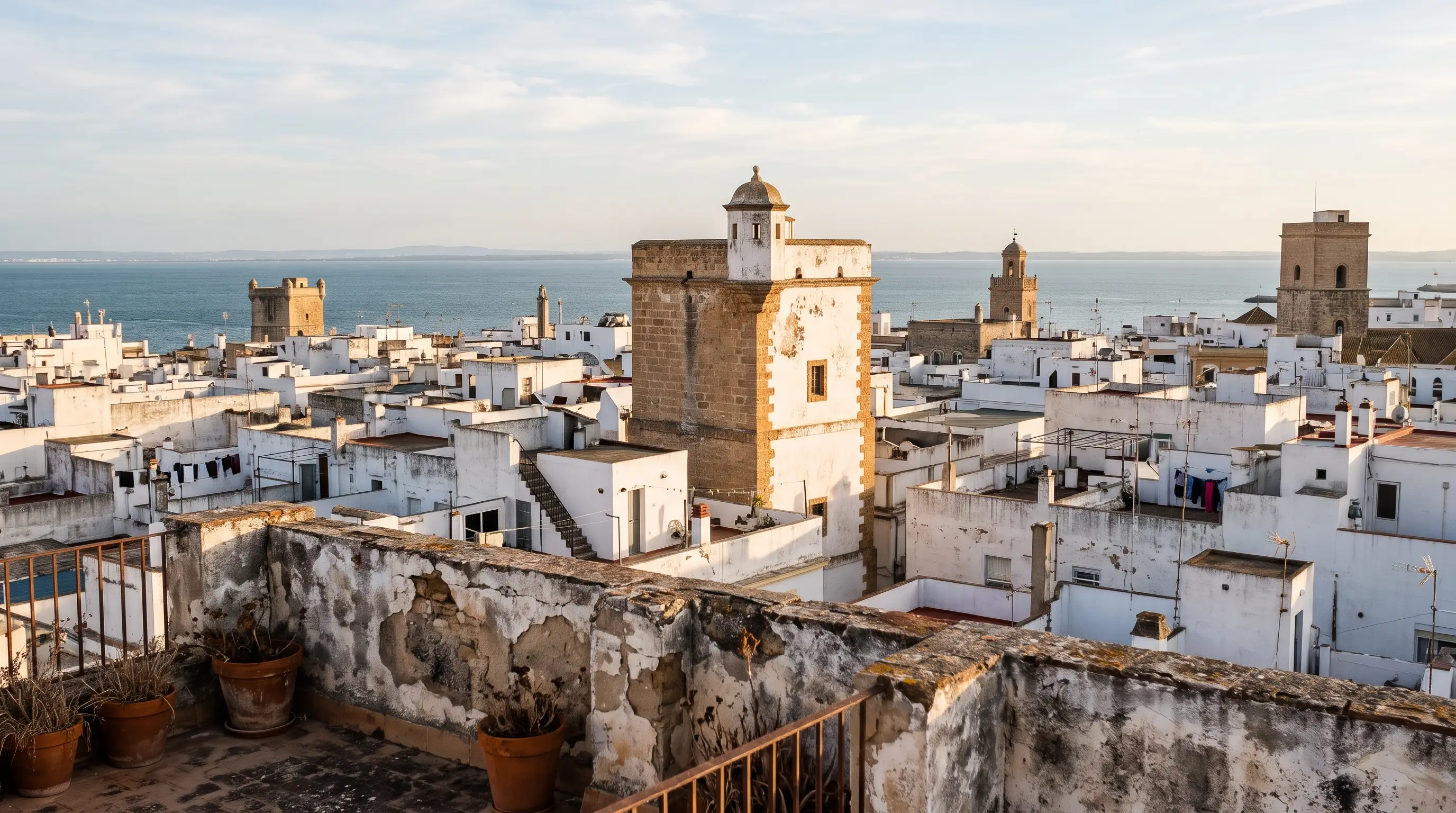
The settlers did not land on the single peninsula visitors walk today. Phoenician Gadir sat across a three-island archipelago formed by Erytheia, Cotinusa (Kotinoussa) and Antipolis, now corresponding to Cádiz and San Fernando.[6] From those islands, Tyrian merchants controlled the Atlantic tin and copper routes and traded directly with the Tartessian-Turdetanian market on the mainland.[6]
Timeline
c. 1100 BC
Classical foundation date
Livy and Velleius Paterculus place the Tyrian landing eighty years after the fall of Troy.[2]
9th century BC
Earliest excavated houses
Eight rammed-earth dwellings are built on terraces at the top of Erytheia.[3]
237 BC
Barcid landing at Gadir
Hamilcar Barca and his young son Hannibal arrive as Carthage takes control of the city.[8]
1887 & 1980
Anthropoid sarcophagi found
Workers unearth the male Phoenician sarcophagus at the shipyard and the female sarcophagus on Calle Ruiz de Alda.[9][10]
2020
Osteological surprise
University of Cádiz researchers determine that the skeleton inside the female sarcophagus is a robust man.[4]
Gadir guarded those sea lanes fiercely. For generations the Phoenicians of the port kept the Atlantic passage to the tin islands a commercial secret from outsiders.[7] When Roman vessels finally shadowed a Gaditane shipmaster to learn where the market lay, the captain deliberately ran his ship onto a shoal and wrecked his pursuers with him.[7] He chose shipwreck over sharing the map.
The Heracleion at Sancti Petri and the western sanctuaries
The Heracleion, the sanctuary of Melqart and later Hercules Gaditanus, stood at the eastern tip of Cotinusa on today's islet of Sancti Petri.[11] Founded in the Phoenician period, it became the leading oracular temple of the Strait of Gibraltar and kept its rituals going until the 4th century AD.[11] Ancient accounts claimed the temple lay twelve miles from the western town so that the walk matched the twelve labours of Hercules, though Strabo dryly noted that twelve miles was nearly the entire length of the island.[12]
Inside the precinct, rules were strict. Priests alone could enter the sanctuary, and they barred both women and pigs from the grounds.[13] Sailors who survived long ocean passages came here to sacrifice at the end of a voyage, standing before two brass pillars eight cubits high inscribed with the cost of building the temple.[14] Polybius also described a freshwater spring inside the sanctuary reached by a few steps, whose water subsided when the Atlantic tide rose and refilled at the ebb.[15]
Two other sanctuaries balanced the sacred map at the western end of the islands, around La Caleta. Strabo and Avienus place the Temple of Saturn where the Castillo de San Sebastián stands today, with the sanctuary of Venus Marina facing it across the water on Erytheia.[16] Off the opposite shore at Sancti Petri, divers have recovered archaic pre-Roman bronze statuettes in the threatening Smiting God posture alongside a Hadrianic statue of Hercules Gaditanus.[17]
From Hamilcar and Hannibal to Neo-Punic Gades
After a period of decline between the 6th and 3rd centuries BC, Gadir passed under Carthaginian rule in 237 BC.[8] That year the general Hamilcar Barca landed in the city with his young son Hannibal, who swore eternal hatred toward Rome inside the Temple of Hercules before marching on Italy.[8]
When the Barcid war collapsed, the city switched sides and went on to prosper as Roman Gades. Yet Latin did not wipe out the older tongue overnight. Throughout the Roman Republican period the port stayed bilingual, and its local Neo-Punic language and script survived on coin legends and amphora stamps right down to the start of the Imperial age.[18]
You can trace how the Punic settlement evolved into the Roman municipality by following the Cádiz old town walk through the historic centre. Beneath those streets, modern archaeologists finally caught up with the 9th-century BC town that classical authors had described.
The two Phoenician sarcophagi and the 2020 osteological twist
Two marble coffins found nearly a century apart anchor the Phoenician rooms of the provincial museum: in 1887, workers on the grounds of the Cádiz shipyard at Punta de la Vaca accidentally struck a bearded male Phoenician anthropoid sarcophagus, and in 1980, a construction operator on Calle Ruiz de Alda unearthed a second, female-carved lid and pulled the marble head out by hand before archaeologists arrived.[9][10]
For forty years visitors knew that second monument as the Dama de Cádiz, assuming the skeleton inside matched the female face carved on the lid. In 2020, University of Cádiz researchers reopened the case and proved that the person buried inside the female sarcophagus was unambiguously a robust man aged 45 to 50.[4] The lady was a man.
Paleopathologist Mª Milagros Macías López and archaeologist Ana Mª Niveau de Villedary found that he stood between 1.68 and 1.72 metres tall, noticeably above the 1.60-metre average later recorded for Roman citizens.[4][19] Either the sarcophagus was commissioned beforehand and reused, or it arrived from the Eastern Mediterranean workshops ready-made when the man died.
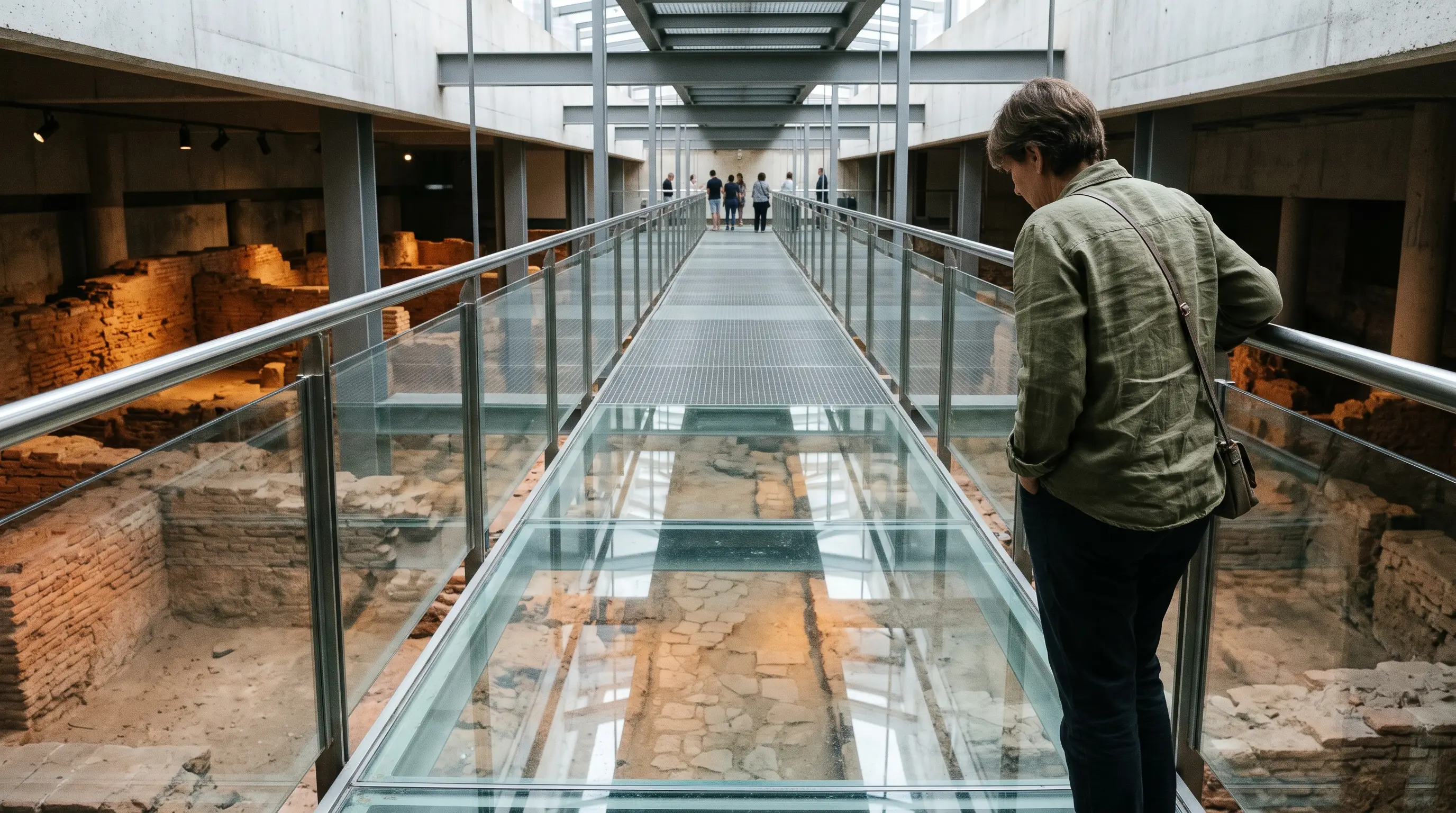
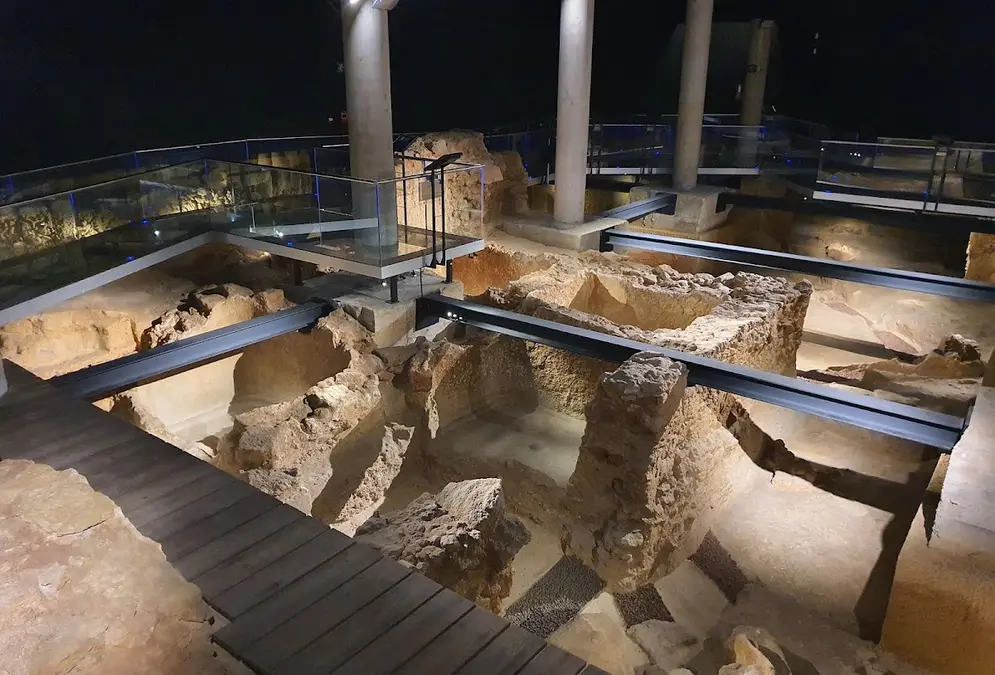
Two indoor sites in the historic centre preserve the physical remains of Phoenician Gadir, and both sit within a ten-minute walk of each other. Start underground at the Yacimiento Arqueológico Gadir, discovered nine metres below street level during excavations under the La Tía Norica puppet theatre between 2002 and 2010.[5]
The site occupies what was once Erytheia and preserves eight Phoenician dwellings arranged across two terraces along two streets of rammed clay.[3] Look closely at the clay floor. The fossilised hoofprints of several cattle (bóvidos) that walked those lanes in antiquity are still visible in the surface, and the route centres on the skeleton of Mattan, a Phoenician resident killed in a great 6th-century BC city fire.[20]
Recommended tours
Tours are selected for quality, not commission. We earn a small fee if you book, at no extra cost to you.
From there, walk north to the Museo de Cádiz to see the portable finds recovered around the bay.[21] Four stops and details worth planning around:
Yacimiento Arqueológico Gadir: free admission, with guided tours lasting 30 to 45 minutes through the excavated structure and exhibitions.[22]
Underground architecture: rammed-earth (tapial) walls built with local clays and lime over foundations of porous local piedra ostionera shellstone.[3]
Museo de Cádiz (Phoenician rooms): the male and female anthropoid sarcophagi displayed beside Phoenician and Punic grave goods from Cádiz, the Villa de Doña Blanca and the Sanctuary of Melqart at Sancti Petri.[21]
La Caleta headland: walk out toward the Castillo de San Sebastián at the western edge of the old town, where ancient writers placed the Phoenician-era sanctuary of Saturn.[16]
Frequently asked questions
What was Phoenician Gadir in Cádiz and when was it founded?
Phoenician Gadir in Cádiz was the western trading colony founded by sailors from Tyre on an archipelago of three islands (Erytheia, Cotinusa and Antipolis). Classical authors such as Livy and Velleius Paterculus dated its foundation to around 1100 BC, eighty years after the Trojan War, while excavated houses in the city date from the 9th century BC.[2][3][6]
Where did the Temple of Melqart (Hercules Gaditanus) stand?
The Heracleion stood at the eastern end of the ancient island of Cotinusa, on what is today the islet of Sancti Petri south of Cádiz. Founded in Phoenician times, the oracular sanctuary remained active until the 4th century AD, and underwater finds from the waters around Sancti Petri include archaic bronze statuettes in the Smiting God posture.[11][17]
What were the bronze pillars inside the Temple of Hercules at Gades?
Strabo describes two brass pillars eight cubits high inside the sanctuary, inscribed with the cost of erecting the building. Sailors who completed long voyages came to those pillars to offer sacrifices to Hercules, making the spot famous across the ancient Mediterranean.[14]
Why is there a man buried inside the female Phoenician sarcophagus in Cádiz?
For forty years after its 1980 discovery on Calle Ruiz de Alda, the carved marble lid led scholars to assume the skeleton inside was a woman, nicknamed the Dama de Cádiz. In 2020, an anthropological study by University of Cádiz researchers proved that the bones belong to a robust man aged 45 to 50 who stood between 1.68 and 1.72 metres tall.[4][10][19]
What can you see at the Yacimiento Arqueológico Gadir?
Located nine metres beneath the La Tía Norica theatre, the excavation preserves eight 9th-century BC Phoenician houses arranged on two terraces along two rammed-clay streets. Visitors can see walls built of tapial earth and ostionera stone, fossilised cattle hoofprints in the clay floor, and the remains of Mattan, who died in a 6th-century BC fire.[3][5][20]
Is entry to the Yacimiento Arqueológico Gadir free?
Yes, admission to the Yacimiento Arqueológico Gadir is free and includes a guided visit of 30 to 45 minutes through the archaeological structure and its exhibitions.[22]
“La tradición clásica sitúa la fundación de Cádiz ochenta años después de la guerra de Troya. Ello sitúa la fundación entre los siglos XIII a. C. y XI a. C. (y según los cálculos de Tito Livio y Veleyo Patérculo en los años 1100 a. C.)”
“Se localizan los restos arquitectónicos de un total de ocho viviendas distribuidas en dos terrazas y organizadas en torno a dos calles de arcilla apisonada. Todas estas construcciones han sido realizadas siguiendo lo que se denomina arquitectura de la tierra, es decir, realizadas principalmente con arcillas autóctonas y cal, mediante la técnica del tapial (estructura encofrada, rellena y apisonada) y utilizando la piedra local, denominada “piedra ostionera”, como base o cimentación”
“Tras el estudio antropológico, los investigadores han revelado que, pese a la creencia generalizada, la persona inhumada es, sin ningún género de dudas, un varón robusto de unos 45-50 años.”
“La primera fase de intervención comenzó en el año 2002, con la ejecución de dos sondeos estratigráficos manuales, que permitieron documentar y realizar una secuencia estratigráfica completa en este punto de la ciudad y localizar los primeros indicios de hábitat de época fenicia, a nueve metros de profundidad. La excavación en extensión del resto del solar, comenzó en 2006 y finalizó en 2010, llegando de nuevo, a la profundidad alcanzada en los dos sondeos previos.”
“sobre lo que antaño era un pequeño archipiélago (formado por las islas: Eritea, Antípolis y Cotinusa) y en la actualidad el conjunto de Cádiz y San Fernando, para explotar las ricas rutas atlánticas del estaño, del cobre y el mercado tartésico-turdetano.”
“Formerly the Phœnicians alone carried on this traffic from Gades, concealing the passage from every one; and when the Romans followed a certain ship-master, that they also might find the market, the shipmaster of jealousy purposely ran his vessel upon a shoal, leading on those who followed him into the same destructive disaster”
“Entre los siglos VI y III a. C. la ciudad entra en una etapa de decadencia que terminará a partir del año 237 a. C., momento en que Cádiz pasa a estar bajo el dominio de la ciudad norteafricana de Cartago. En este tiempo, arriba a la ciudad el general cartaginés Amilcar Barca y su hijo Anibal, que jurará en el templo de Hércules odio eterno a Roma.”
“El hallazgo accidental, en 1887, del sarcófago antropoide fenicio masculino en los terrenos del actual astillero gaditano, marcó el punto de partida de la colección arqueológica.”
“Antonio Álvarez, presente entre el público, recuerda cómo el operario que se topó con el sarcófago en el solar de la calle Ruiz de Alda “extrajo con su mano la cabeza antes de llegar nosotros””
“The most important oracular temple of the Strait of Gibraltar was the long-lived Heracleion, located at the eastern end of the island of Cotinusa (today’s islet of Sancti Petri), founded in Phoenician times and clearly maintained until the 4th century AD, since rituals were still carried out then.”
“They say that this temple is twelve miles from the city, thus making the number of miles and the number of [Hercules'] labours equal: but this is too great, being almost equal to the length of the island.”
“Los sacerdotes, que son los únicos que tienen el honor de penetrar en el santuario, han cerrado su entrada a las mujeres y cuidan de alejar de él a los puercos.”
“Others pretend that they are the pillars of brass eight cubits high in the temple of Hercules at Gades, on which is inscribed the cost of erecting that edifice; and that the sailors coming there on the completion of their voyage and sacrificing to Hercules, rendered the place so famous that it came to be regarded as the termination of the land and sea.”
“Polybius relates that there is a spring within the temple of Hercules at Gades, having a descent of a few steps to fresh water, which is affected in a manner the reverse of the sea- tides, subsiding at the flow of the tide, and springing at the ebb.”
“The temple of Saturn (around today’s Castillo de San Sebastián) and that of Venus Marina (opposite, in Erytheia), according to the sources (Strabo and Avienus).”
“It illustrates the recovery of a statue of Hercules, possibly very ancient, given his threatening posture ( Smiting God type ), similar to the pre-Roman bronzes from Sancti Petri or the Hadrianic statue of Hercules Gaditanus , all of them underwater finds.”
“Gades was bilingual during the Roman Republican period: the local language and script, known as Neo-Punic, survived practically until the beginning of the Imperial era, as we can see in coin inscriptions or amphora stamps—an example of the cosmopolitanism of the time.”
“Que determinarían, al fin, que la Dama de Cádiz era un caballero robusto, fuerte, que podría medir entre 1,68 y 1,72 centímetros –una estatura considerable teniendo en cuenta que “la media de un ciudadano romano era de 1,60”, ejemplifica Niveau– y que en el momento de su muerte podría tener entre unos 45-50 años de edad.”
“Es muy interesante como todavía se puede ver muchas huellas fosilizadas de varios bóvidos, que recorrieron estas calles. El eje central de la visita gira en torno a la figura de Mattan, un fenicio fallecido en un gran incendio que tuvo lugar en la ciudad en el siglo VI a.C. y cuyos restos forman parte importante de la temática del recorrido.”
“En este tramo, además de los sugestivos sarcófagos antropoides fenicios, destacan por su uso los objetos funerarios y ajuares púnicos y fenicios recuperados en Cádiz y en el santuario de Melkart - Ercole en Sancti Petri y en la Villa de Doña Blanca”
“La entrada al Yacimiento Arqueológico Gadir es gratuita e incluye la visita a su estructura y a las exposiciones culturales o museísticas que se encuentren en su interior. Cada visita tiene una duración estimada de 30 a 45 minutos.”