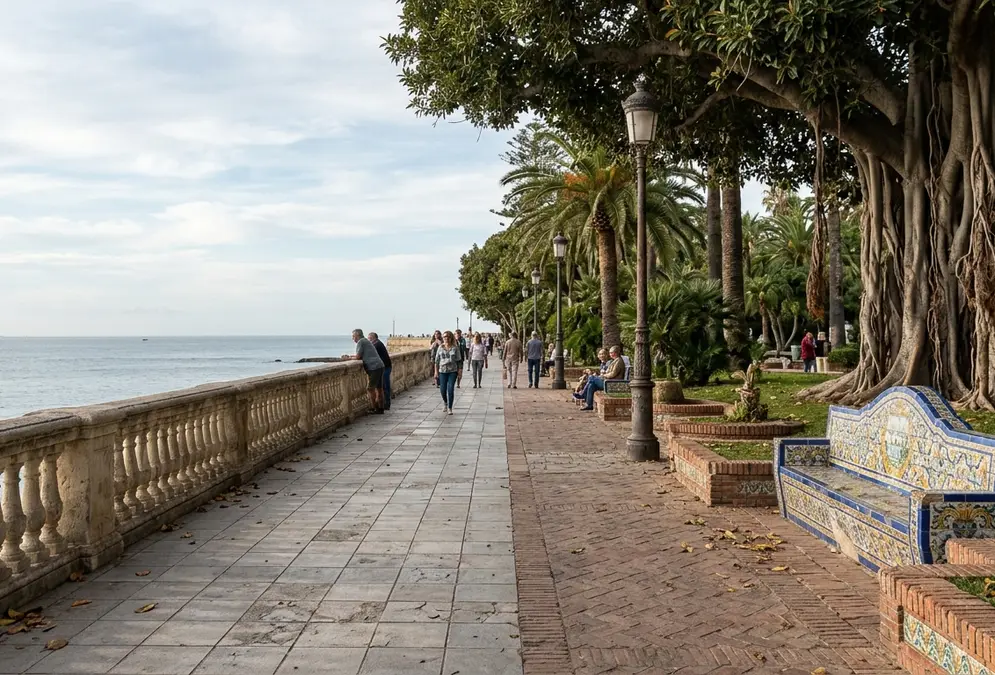

This 1.6 km linear walk follows the northern ramparts of Cádiz from west to east, where a 19th-century botanical garden, a 17th-century sea bastion and a 1920s regionalist promenade sit directly atop the defensive wall facing the Bay of Cádiz. Beginning under the exotic canopy of Parque Genovés, the route passes the Baluarte de la Candelaria and the Baroque Iglesia del Carmen, runs the length of the Alameda gardens, and finishes among the 18th-century merchant watchtowers and constitutional monuments of San Carlos and Plaza de España.
Along the way, Cádiz-born figures and Roman heritage anchor the city's scientific and liberal past: the physician and botanist José Celestino Mutis (1732–1808), honoured with a 1932 marble bust among the plants of Parque Genovés, the Gades-born Roman agronomist Columela (commemorated in the former Cuartel de Columela grounds inside the park), and the republican orator Emilio Castelar (1832–1899), remembered in the square behind the Candelaria bastion.
Parque Genovés: from Paseo del Perejil to Romantic botanical garden
Enter Parque Genovés through its main gate on Plaza Rocío Jurado. At the end of the 18th century, this strip between the Camposanto and La Bomba barracks and the sea wall was so sparsely planted that locals nicknamed it the Paseo del Perejil (Parsley Promenade). Expanded from 1854 as the Paseo de las Delicias to provide public-works employment during a cholera epidemic, and enlarged again in 1863 when the Cuartel de Columela was demolished and planted with American cypresses, it received its definitive 30,000 m² Romantic garden layout in August 1892 under Mayor Eduardo Genovés y Puig and Catalan landscape director Ramón Oliva Bogunyá.
Declared a Bien de Interés Cultural in 2004, the park shelters more than 150 species of mostly exotic trees, palms and shrubs adapted to the Cádiz microclimate:
- Paseo Central (Santa Bárbara avenue): a three-lane central promenade divided by symmetrical parterres, oyster-stone (piedra ostionera) fountains, and common and Monterey cypresses (Cupressus sempervirens and Cupressus macrocarpa) clipped into rounded English-style topiary.
- Monumental specimen trees: a centenary Canary Islands dragon tree (Dracaena draco), a New Zealand metrosidero (Metrosideros tomentosa) ranked among the most important in Europe, and two varieties of Araucaria (A. excelsa and A. bidwillii) reaching 50 metres in height.
- La Gruta: an artificial lake and waterfall with a walk-through grotto passage built inside the cascade.
- Statues and memorials: the 1907 Fuente de los Niños del Paraguas (depicting Paul and Virginie from Jacques-Henri Bernardin de Saint-Pierre's 1787 novel), José Gargallo's 1932 marble bust of botanist José Celestino Mutis on the central avenue, the 1925 monument to Carmen Angolotti Mesa (Duchess of la Victoria), and outside the main wall on Paseo de Santa Bárbara, the stone coat of arms that is the sole surviving piece of Mariano Benlliure's lost Los niños meones fountain.
Baluarte de la Candelaria and the Iglesia del Carmen
Leave the north-eastern gate of the park and cross toward the Baluarte de la Candelaria, erected in 1672 by Royal Engineer Cristóbal de Rojas under Governor Diego Caballero de Illescas. Built on a projecting angle of the rocky shore to cover the harbour entrance and the western sea wall between San Felipe and La Caleta, its irregular pentagonal recinto encloses roughly 6,000 m² behind battered walls of local oyster stone and white mortar. Inside the courtyard, the 19th-century Engineers' Barracks (a former maestranza, pigeon post and military clinic) and seven radiating casemates have been restored as municipal cultural and exhibition spaces; entry is free when shows are running (inland, Plaza de Candelaria holds the monument to Emilio Castelar).
Immediately facing the bastion at Alameda Marqués de Comillas 3 stands the Iglesia del Carmen (Iglesia de Nuestra Señora del Carmen y Santa Teresa). Begun in 1737 and completed in 1762 under the direction of master builder José Bolaños, this three-nave Baroque church is crowned by twin bell towers with ceramic-tiled bulbous cupolas and an exterior patio framed by mixtilinear cornices. Inside, the crypt holds the tomb of Admiral Federico Gravina (commander of the Spanish fleet at Trafalgar, who died in Cádiz on 9 March 1806), and on 19 March 1812 the deputies of the Cortes walked here in the pouring rain for the solemn Te Deum of thanksgiving just before proclaiming Spain's first constitution.
The Alameda seafront gardens: Talavera y Heredia's regionalist promenade
From the doors of El Carmen, step onto the landscaped seafront walk formed by the Alameda Hermanas Carvia Bernal (historically Alameda Marqués de Comillas) and the Alameda Clara Campoamor (historically Alameda Apodaca). Running east to west parallel to the bay and the northern city wall, this ground was known before the fortifications were built as the Caletilla de Rota, and its first wide promenade was laid out in 1617.
The current Sevillian Regionalist design was executed between 1926 and 1927 by architect Juan Talavera y Heredia. Divided into intimate garden salons (glorietas) with glazed ceramic tilework, wrought-iron lamps, pergolas and planted parterres, the walk centres on the monument to the second Marquess of Comillas and is shaded by two giant Moreton Bay figs (Ficus macrophylla) planted in the early 20th century. Keep to the seaward balustrade for open views across the shipping channel toward Rota and El Puerto de Santa María.
Barrio de San Carlos, the Four and Five Towers, and Plaza de España
At its eastern end, the Alameda meets the San Carlos quarter and the Murallas de San Carlos, a monumental semi-bastion and arcaded rampart built at the end of the 18th century under Cádiz governor Count O'Reilly (Conde O'Reilly) as part of an ambitious urban expansion plan across ground gained from the sea.
Turn inland onto the triangular Plaza de Argüelles, the axis of a quarter begun in 1755, to view the Casa de las Cuatro Torres, built between 1736 and 1745 by the Syrian merchant Juan de Fragela. Conceived as four independent rental properties wrapped into a single block with four corner watchtowers (torres-miradores, including the Torre del Sol), its towers retain original 18th-century red-ochre geometric tempera paintings and flagpole pulleys used to signal arriving Indies fleets; it was declared a National Historic-Artistic Monument in 1976.
A few steps south, the walk finishes on Plaza de España, opened up at the start of the 20th century when the port-side walls in the Diputación zone were demolished. On the western edge of the square, buildings 5-D, 6, 7, 8 and 9 form the Casa de las Cinco Torres, a continuous Baroque row built around 1771. In the centre of the gardens rises the Monumento a las Cortes de 1812, giving the walk a fitting civic finale a short stroll from the Museo de las Cortes de Cádiz and the Casa de Iberoamérica.