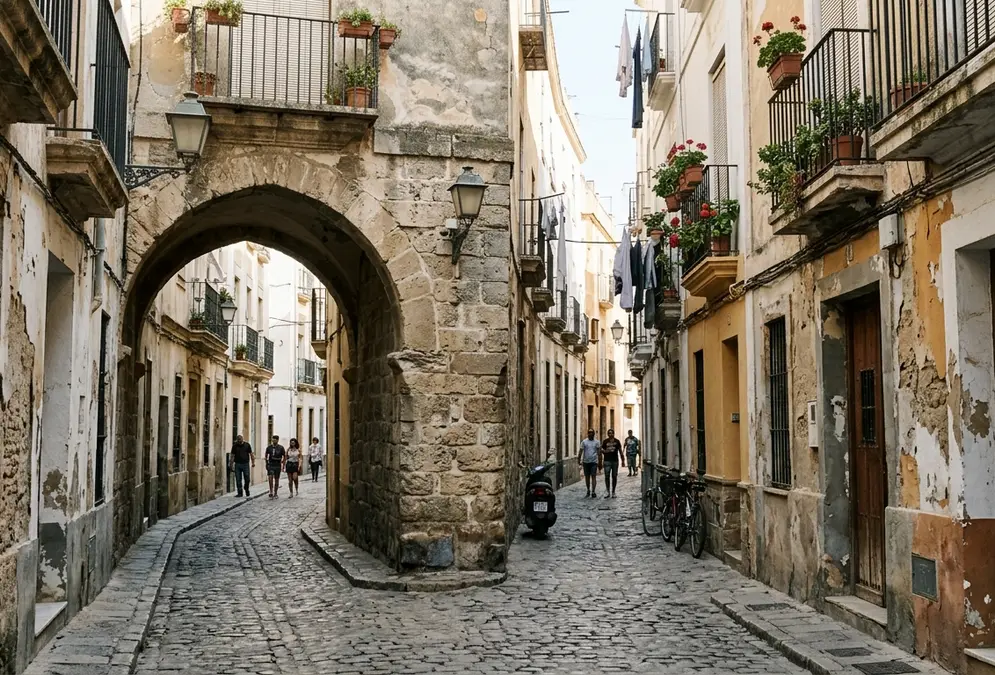

This 1.7 km linear walk traces the oldest inhabited ground in intramuros Cádiz, moving east from the walled medieval nucleus of El Pópulo into the 15th-century flamenco lanes of Santa María. Within twenty minutes on foot, the street plan shifts from a 1st-century BCE Roman cavea and Alfonso X el Sabio's 13th-century fortress gates to the buried curve of a Roman amphitheatre and the 18th-century landward ramparts at Puerta de Tierra.
Two historical figures anchor the route across two millennia: the Roman patron Lucio Cornelio Balbo (whose nephew Balbus the Younger built the theatre beneath El Pópulo) and the Cádiz cantaor Enrique el Mellizo (1848–1906), baptised at Santa Cruz and commemorated by a bust in central Santa María.
Plaza de San Juan de Dios and the Arco del Pópulo
Start on Plaza de San Juan de Dios, the wedge-shaped harbour square formerly called the Corredera that served from the 16th century as the commercial hub linking the port with the interior of the city. Its layout was regularized only after the 1596 Anglo-Dutch sack destroyed earlier irregular buildings, and the Neoclassical and Elizabethan Town Hall (Ayuntamiento) on its western side was built in two phases (begun in 1799 by Torcuato Benjumeda and finished in 1861 by García del Álamo).
Right beside the Town Hall opens the Arco del Pópulo, the original medieval Puerta del Mar that gave access to the harbour and was flanked by two defensive towers. The arrangement of its stone voussoirs dates the arch to the 12th-century Almohad period, part of the perimeter wall later reinforced when Castilian king Alfonso X conquered and repopulated Cádiz in 1262 (the town received the title of city in 1265). From 1587, an image of the Virgin bearing the Latin invocation "Ave María, ora por Pópulo" hung between the towers, giving both the gate and the quarter their popular name.
Inside the medieval walls: Santa Cruz, the Roman Theatre and Casa del Almirante
Follow the covered passageway of Calle Pópulo south toward the sea wall and the Iglesia de Santa Cruz, popularly called the Catedral Vieja (Old Cathedral). After the 1262 conquest, Alfonso X turned the site of the former Arab mosque into the city's first cathedral church so it could eventually hold his tomb, though he was ultimately buried in Murcia. After the Earl of Essex's Anglo-Dutch forces burned the church in 1596, it was rebuilt in the 17th century in a Mannerist and Baroque idiom.
Step around the apse onto Calle Mesón 11–13, the entrance to the Roman Theatre of Cádiz (Theatrum Balbi). Commissioned in the 1st century BCE by Lucius Cornelius Balbus the Younger, nephew of Lucio Cornelio Balbo, its roughly 120-metre diameter and estimated capacity of over 10,000 spectators make it the oldest known Roman theatre in the Iberian Peninsula and the second largest. Discovered beneath medieval cellars in 1980 after Alfonso X had ordered a 13th-century fortress built over its ruins, the site is free to enter (note that ongoing expansion works temporarily restrict direct access to parts of the open excavation; check the Junta de Andalucía schedule before setting out).
Climb onto Plaza de San Martín to see the façade of the Casa del Almirante, completed in 1685 for Diego de Barrios, fleet admiral of the Carrera de Indias. Its Baroque doorway of Genoese red marble, whose upper stage frames the Barrios coat of arms between Solomonic columns, announced the wealth of the Indies trade inside the medieval walls. Exiting the quarter via the Arco de la Rosa (the old western gate facing Cádiz Cathedral, where construction ran from 1722 to 1838) or the Arco de los Blancos (the 13th-century Puerta de Tierra embedded in a 17th-century structure by the Mier family), you cross the exact line of the medieval curtain wall.
Crossing into Santa María: amphitheatre curves and flamenco cantes
East of Calle San Juan de Dios, the lanes open into Santa María, one of the oldest barrios outside the medieval enclosure, which took shape in the 15th century as the Alfonsine villa overflowed its walls. Beneath these blocks and the edge of Plaza de San Juan de Dios lay the Roman Amphitheatre of Gades: nothing of the arena survives above ground, but the circular curve of the street layout preserves its ancient perimeter.
Where La Viña is tied to Carnival verse, Santa María is the historic cradle of Cádiz flamenco, especially the alegrías, soleares and malagueñas. A bust in the quarter honours Enrique el Mellizo (1848–1906), the slaughterhouse worker and cantaor regarded as the single most influential figure in shaping the Cádiz flamenco styles, while street plaques mark other performers born in these houses. Two blocks south stands Plaza de la Merced, known locally as Plaza del Piojito after its old street market. Here the Centro Municipal de Arte Flamenco La Merced occupies the restored 19th-century iron pavilion forged by Eiffel et Cie (originally erected as a summer theatre in Parque Genovés and moved here in the 1930s as a food market), now fitted with four soundproof rehearsal rooms and a stage.
Calle Sopranis, the Nazareno Chapel and Puerta de Tierra
Follow the neighbourhood lanes to the Convento de Santa María and its adjoining Capilla de Nuestro Padre Jesús Nazareno. Founded around 1527 as the first convent in the city, the Conceptionist house can be visited through guided tours by prior reservation, which fund its ongoing roof restoration. Inside the Nazareno chapel, whose titular image holds the title of Regidor Perpetuo (Perpetual Councillor) of Cádiz and processes every Maundy Thursday and Friday, look at the dado of 17th-century Dutch delftware tiles (azulejos holandeses) donated by two Armenian brothers living in the port.
A short walk north-east brings you to Calle Sopranis, lined with 17th- and 18th-century merchant Baroque houses such as Casa Lasquetty, and to the Convento de Santo Domingo, the sanctuary of Nuestra Señora del Rosario, patroness of Cádiz. From there the lane rises to the Puerta de Tierra, the monumental landward wall whose 18th-century marble tower and portico were designed by Torcuato Cayón. Inside its vaulted casemates sits the free Museo del Títere (open Tuesday to Sunday), bringing the walk to a close at the threshold between intramuros and extramuros Cádiz.
Key stops and opening hours along the route
| Stop | Admission | Typical Hours |
|---|---|---|
| Roman Theatre Interpretation Centre (Calle Mesón 11–13) | Free | 1 Oct–31 Mar: Mon–Sat 10:00–16:30, Sun 10:00–14:00 (closed 1st Mon of month) |
| Iglesia de Santa Cruz (Catedral Vieja) | Check parish | Morning and evening worship hours; confirm locally |
| Convento de Santa María | Paid guided visit | By prior reservation with the Conceptionist sisters |
| Museo del Títere (Puerta de Tierra, Bóvedas de Santa Elena) | Free | Tue–Fri 10:00–16:00; Sat–Sun 11:00–14:00 (closed Mon & holidays) |