history-buffsarchitectureart-lovers
Iglesia del Carmen, Cádiz
baroque church constitution-1812

Iglesia del Carmen, Cádiz

Facing the bay on Alameda Marqués de Comillas, Cádiz's 1762 Baroque Iglesia del Carmen hosted the 1812 Constitution Te Deum. Free entry; weekend hours inside.

Visits (Turismo Cádiz): Apr-Sep Sat 18:00-21:30; Oct-Mar Sat 17:30-20:30; Sun year-round 11:00-13:30. Masses (Diocese): Mon-Fri 09:00 & 19:30 (winter) / 20:00 (summer); Sat vigil 20:00; Sun & holidays 12:30 (winter) / 12:00 (summer).
Free admission during opening and worship hours (confirm locally before visiting)
Directions

The Iglesia del Carmen — formally dedicated to Nuestra Señora del Carmen y Santa Teresa — is an 18th-century Baroque Catholic church at Alameda Marqués de Comillas, 3, on the northern seafront of Cádiz. Set right where the landscaped promenade looks across the bay, its twin colonial-style bell gables (espadañas) give the waterfront one of its most Americanist silhouettes. On 19 March 1812, the church hosted the solemn Te Deum of thanksgiving for the completion of the Spanish Constitution, proclaimed that same afternoon.

When to Visit

Quietest hours

Sunday 11:00 to 12:00 before midday Mass, or Saturday early evening

Visit duration

About 20 to 30 minutes

From Carmelite arrival to the 1812 Te Deum

Construction began in 1737, six years after the Carmelite Order settled in Cádiz, under the direction of the master builder (alarife) José Bolaños. The building went up during the decades when the port held the monopoly on trade with the Americas, and the Baroque church was completed in 1762. It lies at the western end of the seafront promenade that runs from the Barrio de San Carlos along the edge of the Barrio del Mentidero, right between the Baluarte de la Candelaria and Parque Genovés, and was declared a Bien de Interés Cultural (BIC) on 27 April 2009.

Half a century after its completion, the church stepped into national politics. After the Cortes finished drafting Spain's first constitution at the nearby Oratorio de San Felipe Neri, a solemn Te Deum of thanksgiving was celebrated inside the Iglesia del Carmen on 19 March 1812, before La Pepa was proclaimed that afternoon and the city entered the turbulent decades of liberal Cádiz from 1812 to 1873.

Aim for Saturday evening or Sunday late morning

Outside weekday Mass slots (09:00 and 19:30 or 20:00), the most reliable visiting windows are Saturday evenings (from 17:30 in winter, 18:00 in summer) and Sunday mornings between 11:00 and 13:30, bearing in mind Sunday Mass starts at 12:00 or 12:30.

Twin espadañas and Cádiz Baroque architecture

The main façade is organised in three sections with a two-tier marble frontispiece carried on Ionic columns and presiding over an image of Our Lady of Mount Carmel. Superimposed Tuscan pilasters link the lateral bays to the central wall, and the composition is crowned by two richly decorated bell gables (espadañas) of unmistakably Americanist design.

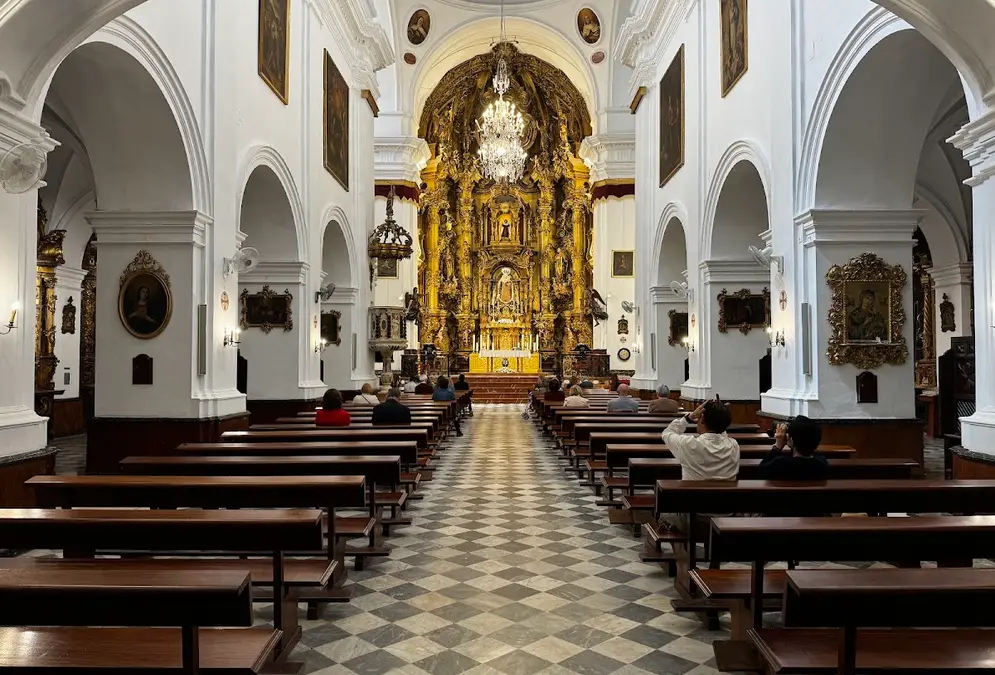
Inside, the church follows a Latin-cross floor plan with three naves, with the central nave divided into five bays by Tuscan pillars. Eighteenth-century wall paintings run along the walls and the arches opening into the side aisles.

Altarpieces, Genoese marble and the sacramental chapel

The interior holds a compact group of 17th- and 18th-century works from across the trade routes that fed Cádiz:

  • Built between 1766 and 1785, the main altarpiece (retablo mayor) is divided into three vertical bays by Corinthian columns carved with rocalla (rocaille), and its two-tier central canopy houses a 1638 statue of the Virgen del Carmen by Jacinto Pimentel below and a Child Jesus in the tradition of Juan Martínez Montañés above.
  • Carved toward the end of the 17th century, the Genoese marble pulpit pairs marble reliefs framed by twisted Solomonic columns with a gilded wood Rococo sounding board (tornavoz).
  • In the sacramental chapel, a silver tabernacle from 1732 stands beneath the image of Nuestra Señora de la Bendición de Dios, titular of an extinct public rosary archconfraternity, flanked by smaller Carmelite sculptures of Saint Teresa of Ávila and Saint John of the Cross.

Opening hours, Mass times and planning your visit

Admission is free during visiting and worship hours, and the church sits right on the route of the Cádiz seafront walk. Both the municipal tourism board and the Diocese of Cádiz and Ceuta publish schedules for visitors and worshippers:

  • Weekend cultural visits run from 18:00 to 21:30 on Saturdays from April to September, 17:30 to 20:30 on Saturdays from October to March, and 11:00 to 13:30 on Sundays all year.
  • Weekday Masses take place Monday to Friday at 09:00 and 19:30 in winter, or 09:00 and 20:00 in summer.
  • Weekend Masses are celebrated at 20:00 on Saturday evenings year-round, and at 12:30 in winter or 12:00 in summer on Sundays and holy days.

Because parish hours can shift for feast days, especially around 16 July, the feast of Our Lady of Mount Carmel, call +34 956 22 28 33 or check the noticeboard at Alameda Marqués de Comillas, 3 if you are making a special trip.

Reporter notebook

Insider tips

Photo spot

Step back onto the Alameda promenade for the twin belfries

The façade faces north-east toward the bay across the tree-lined Alameda. Late morning and late afternoon give the cleanest light on the marble portal and the two Americanist espadañas without harsh midday shadows.

Local custom

Look for the Genoese marble pulpit and sacramental chapel

Do not stop at the high altar: check the late 17th-century Genoese marble pulpit with its twisted Solomonic columns on the nave side, and step into the sacramental chapel to see the 1732 silver tabernacle.

Practical information

Opening hours
Visits (Turismo Cádiz): Apr-Sep Sat 18:00-21:30; Oct-Mar Sat 17:30-20:30; Sun year-round 11:00-13:30. Masses (Diocese): Mon-Fri 09:00 & 19:30 (winter) / 20:00 (summer); Sat vigil 20:00; Sun & holidays 12:30 (winter) / 12:00 (summer).
Admission
Free admission during opening and worship hours (confirm locally before visiting)
Address
Alameda Marqués de Comillas, 3, 11003 Cádiz, Spain View on Google Maps

Tags

baroque church constitution 1812 bic 18th century free entry alameda

Frequently asked questions

When was the Iglesia del Carmen in Cádiz built and who designed it?

Work began in 1737, six years after the Carmelite Order arrived in Cádiz, under the direction of the master builder (alarife) José Bolaños. The Baroque church was completed in 1762, and its main rocaille altarpiece followed between 1766 and 1785.

What is the connection between the Iglesia del Carmen and the 1812 Spanish Constitution?

On 19 March 1812, the solemn Te Deum of thanksgiving for the completion of the Constitution of Cádiz (La Pepa) was celebrated inside the Iglesia del Carmen. The Constitution was formally proclaimed that same afternoon.

What are the opening hours and Mass times of the Iglesia del Carmen in Cádiz?

Turismo Cádiz lists weekend visiting hours on Saturdays (18:00 to 21:30 from April to September; 17:30 to 20:30 from October to March) and Sundays (11:00 to 13:30 all year). The Diocese of Cádiz and Ceuta lists weekday Masses Monday to Friday at 09:00 and 19:30 in winter (20:00 in summer), Saturday vigil Mass at 20:00, and Sunday Mass at 12:30 in winter (12:00 in summer).

Why does the Iglesia del Carmen in Cádiz look like a Latin American colonial church?

Its main façade is crowned by two richly decorated bell gables (espadañas) built in an Americanist style during the height of Cádiz's 18th-century Indies trade, paired with a two-tier marble frontispiece on Ionic columns.

Who sculpted the Virgen del Carmen inside the Iglesia del Carmen in Cádiz?

The statue of the Virgen del Carmen in the central niche of the main altarpiece was carved in 1638 by Jacinto Pimentel, more than a century before the present church was finished. Above it sits a Child Jesus in the tradition of Montañés.

Where is the Iglesia del Carmen located in Cádiz and is entry free?

It stands at Alameda Marqués de Comillas, 3, facing the bay next to the Baluarte de la Candelaria in the Barrio del Mentidero. Admission is free during opening and Mass hours, with quiet respectful dress expected during services.

Further reading

Sources

14 references Show
  1. Wikipedia (opens in a new tab)

    “La Iglesia del Carmen que se encuentra en la Alameda Marqués de Comillas, en la ciudad de Cádiz (Andalucía, España) es un templo católico de estilo barroco. Su advocación completa es Nuestra Señora del Carmen y Santa Teresa.”

  2. Wikipedia (opens in a new tab)

    “Seis años después de la llegada a la ciudad de la Orden Carmelita, 1737, se inician las obras del templo dirigidas por el alarife José Bolaños.”

  3. Wikipedia (opens in a new tab)

    “Se construyó en estilo barroco y se culminaron las obras en 1762.”

  4. Wikipedia (opens in a new tab)

    “arquitectura barrocaDeclaración 27 de abril de 2009[editar datos en Wikidata]”

  5. Wikipedia (opens in a new tab)

    “Destaca en su exterior la fachada, con dos espadañas de aires americanistas, y la imagen de Nuestra Señora del Carmen.”

  6. Wikipedia (opens in a new tab)

    “El sagrario de plata es de 1732, y preside dicha capilla la imagen de Nuestra Señora de la Bendición De Dios, Titular Del Rosario Público y Archicofradía De Nuestra Señora De La Bendición De Dios, hoy extinta, y dos imágenes que son obras menores que representan a Santos Carmelitas: Santa Teresa de Jesús a un lado y San Juan De La Cruz a otro lado”

  7. Turismo de Cádiz (opens in a new tab)

    “Las obras de esta iglesia se terminaron durante 1762. Además de la importancia artística que disfruta el templo, el histórico nos remite a la celebración del solemne Te Deum el 19 de marzo de 1812 , en acción de gracias por la culminación de la Constitución de Cádiz, que se proclamó esa misma tarde.”

  8. Turismo de Cádiz (opens in a new tab)

    “La iglesia tiene planta de cruz latina con tres naves. La nave principal se divide en cinco tramos, a través de pilares toscanos, con gradas en cruz.”

  9. Turismo de Cádiz (opens in a new tab)

    “está dividida en tres cuerpos, el principal ocupando el frontispicio, en mármol y compuesto por dos cuerpos sostenidos por columnas jónicas. Los tramos laterales están conectados por una superposición de pilastras toscanas colocadas contra el muro y coronadas por campanarios con profusa decoración.”

  10. Turismo de Cádiz (opens in a new tab)

    “La construcción del retablo principal se inició en 1766 y se terminó en 1785. Está dividido en tres bandas por columnas corintias decoradas con rocalla. La banda central alberga una marquesina formada por dos cuerpos: el principal tiene la imagen de la Virgen del Carmen, obra de Jacinto Pimentel de 1638, mientras que el segundo tiene un Niño Jesús de tradición montanesa.”

  11. Turismo de Cádiz (opens in a new tab)

    “En el interior de la iglesia destaca también el púlpito, una pieza de mármol de origen genovés realizada hacia finales del siglo XVII, decorada con relieves enmarcados por columnas retorcidas y cielo rococó en madera dorada, además de las pinturas del siglo XVIII que decoran los muros y los arcos de acceso a las naves laterales.”

  12. Turismo de Cádiz (opens in a new tab)

    “Horario: Abril a septiembre: Sábado: de 18 a 21.30h Octubre a marzo: Sábado: de 17.30 a 20.30h Todo el año: Domingo: de 11 a 13.30h”

  13. Turismo de Cádiz (opens in a new tab)

    “Dirección: Alameda Marqués de Comillas, 3Teléfono: +34 956 222 833”

  14. obispadocadizyceuta.es (opens in a new tab)

    “Horarios de misa Invierno Laborables 09:00 L, M, X, J, V 19:30 L, M, X, J, V Visperas 20:00 Festivos 12:30 Verano Laborables 09:00 20:00 Visperas 20:00 Festivos 12:00”